Kelly Howsley Glover, Wasco County community development director, presented changes to the Land Use and Development Ordinance addressing rural housing insecurity at the May 7 Wasco County Board of Commissioners meeting.
Kelly Howsley Glover, Wasco County community development director, presented changes to the Land Use and Development Ordinance addressing rural housing insecurity at the May 7 Wasco County Board of Commissioners meeting.
WASCO CO. — With low housing inventories across the country driving up home prices and keeping many potential homebuyers out of the market, state lawmakers and local governments have spent the last several years pushing for changes aimed at adding more homes.
A state figure backed up by Community Development Director Kelly Howsley Glover says Wasco County needs close to 660 new homes by 2040 to catch up with demand.
But adding new housing is not a straightforward task given a unique set of city and county Land Use and Development Ordinances created in 1973 to keep farms and forests out of developers’ hands. Officials in the Wasco County planning division want to make sure rural areas can properly house their growing populations, some of whom experience houselessness in a very different way than in the city.
“We’re not seeing people sleeping rough in the wild,” said Howsley Glover at a May 7 meeting of the Wasco County Board of Commissioners. “What we’re really seeing is people doubl[ing or] tripling up in homes, or living in unpermitted RVs.”
According to Howsley Glover, Wasco County is one of the regions difficult to measure in a census, due to lower access to computers and increased levels of mistrust toward delivering census data to the government. This dynamic can muddy officials’ interpretation of housing needs.
Howsley Glover and her team at the county planning department presented several changes to the Land Use and Development Ordinance directly targeted at addressing the rural experience of housing insecurity.
“Some of these efforts today are, in essence, new tools in the toolbox to help increase housing opportunities for folks,” she said. The board anticipates voting on these changes at their next May 21 meeting.
Making standards clearer
Previously, many of the county’s rural zoning decisions relied on language like “as much as possible” or “shall be retained,” terms that left staff and applicants guessing how much compliance was “enough.” By contrast, the new standards rely on measurable thresholds — for example, limiting the number of oak trees that can be removed to no more than five, or requiring a structure to remain within a set percentage of lot coverage.
“Having clear, objective criteria removes much of the discretionary decision-making that can often lead to confusion or inconsistent outcomes,” Howsley-Glover told commissioners.
She said the goal is to simplify the permitting process for residents while ensuring fair and transparent implementation of land use policy.
The shift toward objective rules is also a state requirement. Following recent legislative changes and legal rulings, counties are now mandated to implement clear and objective standards for residential development in rural zones. Wasco County is one of only four counties in Oregon proactively updating its code to comply.
“This is about predictability,” she said. “It’s about making the system work better for the public.”
Commission Chair Scott Hege asked Howsley Glover about the five oak rule, wondering if specificity can sometimes create more problems.
“What does oaks mean, for example,” Hege asked. “Is it like a little, tiny oak thing that’s maybe as big as a pencil, or does it have a certain diameter?”
Howsley Glover replied that the rule defines a specific diameter-breast-height of oak tree, noting that each rule takes particulars like this into account. She added that discretionary pathways will still be available for complex or unusual cases.
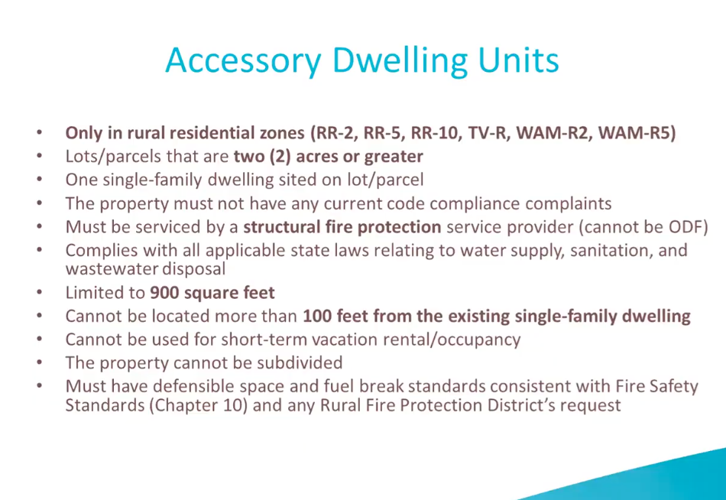
A screenshot from Kelly Howsley Glover presentation on Accessory Dwelling Units.
Adjustments to accessory structure rules
One of the most notable changes addressed the guidelines for accessory structures. Currently, accessory buildings cannot exceed 75% of the primary dwelling’s footprint.
Senior Planner Sean Bailey pointed out that this regulation “really does hurt small houses” by limiting the ability to build adequately sized storage or vehicle protection structures.
The new regulations propose that accessory structures on properties larger than two acres cannot exceed 20% of the total land area. For properties smaller than two acres, property owners have the option of limiting structures to 20% of the lot coverage or constructing buildings that do not exceed 150% of the primary dwelling’s footprint.
Bailey emphasized the need for flexibility, explaining, “We wanted to move towards general lot coverage as our requirement.”
Allowing accessory dwelling units (ADUs) on rural properties will also offer much-needed added housing.
“The public was, by and large, in support of adding accessory dwelling units to rural residential zone lands as a permitted use,” Howsley Glover said.
These units must adhere to a maximum size of 900 square feet, located within 100 feet of the primary dwelling, and cannot be used as a short-term vacation rental. Only rural residential properties exceeding two acres will be eligible.
A new outlook on mobile homes
Addressing concerns from community feedback gathered during comprehensive plan roadshows, the county is also modifying restrictions on single-wide mobile homes. Previously prohibited in several zones due to concerns about aesthetics and potential blight, the new standards will permit single-wide homes with conditions around roof pitch and age of manufacture.
“Citizens asked, ‘Please proceed with removing the prohibition against single-wide mobile homes, but consider manufactured date and roof pitch’,” Howsley-Glover summarized.
The planning commission recommended homes be no older than 15 years, with a discretionary review process for older homes demonstrating equivalent asset value.
Additionally, childcare facilities will now be explicitly allowed in all non-resource zones. Howsley-Glover explained that childcare is in a critical state, emphasizing the intention to address a community need.
To assist residents facing medical hardships, clearer language has been added to permit temporary dwellings for live-in caregivers. The provision has been explicitly included in all non-resource zones (outside the city limits and urban growth boundary), offering relief for families needing immediate support.
In response to destructive wildfires, the rules offer a more lenient approach to mobile home use post-wildfire, allowing displaced residents extended periods to rebuild their permanent homes without restrictive short-term deadlines.
Lastly, tiny homes received attention during discussions, but challenges persist due to state building codes, particularly fire safety regulations and sanitation requirements. Howsley-Glover noted these limitations, clarifying that while interest in tiny homes is high, state regulations significantly restrict their viability as permanent dwellings.
The final hearing for the proposed changes to the Land Use and Development Ordinance is scheduled for 9 a.m. on May 21 at the regular meeting of the Wasco County Board of Commissioners held at the county office: 401 E Third St., The Dalles.





Commented