
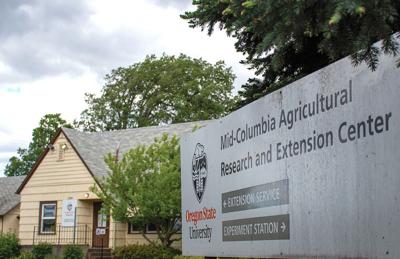

Research slows at Hood River experiment station
HOOD RIVER — “I was on this really great path, and I was contributing to society,” said a scientist formerly with the United States Department of Agriculture (USDA). “Then that was all just taken away from me, and now I’m starting to spiral downhill.”
Through USDA’s Agricultural Research Service, the scientist, who requested to remain anonymous for fear of retribution, used to work at the Mid-Columbia Agricultural Research and Extension Center in Hood River (MCAREC), which abruptly lost three probationary employees in February. So far, USDA has fired around 5,700 people nationwide, according to the New York Times.
“I feel betrayed by my country, by Republicans and the Democrats too,” he said under the pseudonym Huey.
At 19, Huey joined the Army infantry as a foot soldier and served two tours, one being in Afghanistan, where he saw friends killed and gunfire almost every day. Upon return, he was diagnosed with post-traumatic stress disorder (PTSD) and chronic depression, but gardening brought relief — it felt “therapeutic” — so he got a master’s degree in botany and plant pathology.
When Huey started at MCAREC in February 2023, he and others brought expertise in diseases that afflict fruit after picking, specialized knowledge the experiment station didn’t have for a decade, and which, according to MCAREC Director Brian Pearson, the local industry heavily desired. He played a critical role in analyzing mucor rot, a soil fungus that often latches onto fruit bins, survives cold storage temperatures and routinely infects at least 20 different fruits worldwide, including apples, cherries and pears.
Studies show that mucor rot can damage 5%-25% of apples during postharvest storage and transportation to the consumer.
“It really is a loss for the station,” said Pearson. “[Huey] was well-liked, he was really hard working and he was a strong asset to what we do here. The loss of talent and the loss of [Huey] as an individual is sad for all of us.”
Up until recently, no fungicides had proved effective in mitigating mucor rot until one called natamycin came along. While natamycin works well in experimental settings, among other projects, Huey was exploring how to successfully apply the fungicide along packing lines, something that hasn’t yet been done.
MCAREC’s research on mucor rot will continue, albeit at a slower pace. Of the three fired probationary employees, people typically in their first year or two of a federal job, USDA reinstated one who will essentially have to carry all of Huey’s workload, Huey said.
As a result of a judicial order, Huey was also reinstated, but only temporarily for 45 days. Knowing further reductions in force were coming, massive agency reorganization plans mandated by President Donald Trump, Huey opted for deferred resignation and guaranteed pay through September. How USDA originally fired him, though, and the agency’s overall lack of transparency cut deep.
“This whole thing triggered my PTSD and really caused a lot of chaos ... It affects my relationships and my overall mental and physical health,” the scientist said. “I’m never going to trust another employer again. Period.”
Like many other probationary employees, he was fired because of “poor performance.” Motivated to do the research, Huey recalled putting in 10-hour shifts and sleeping in his car to avoid a long commute. He wrote two peer-reviewed papers up for publication, was nominated for four awards in half as many years and recently got a promotion, which inadvertently reset his probationary period.
“That’s how I was an easy target when they started firing everyone, which just added more anger to my situation because I essentially got fired for being promoted,” Huey said.
Now, Huey might go back to school because he’s struggled to find other opportunities related to natural resources amidst firings at the United States Forest Service, Department of Interior, National Park Service and other agencies, regretting his pursuit of botany in the first place. Terrified of learning about additional terminations, Huey is also frustrated with Oregon’s Democrats in Congress, who he sees as complacent.
“They’re not doing anything,” said Huey. “We need younger people in there, or else we don’t have a shot.”
According to Pearson, there’s still a hiring freeze across the Agricultural Research Service, but MCAREC’s funding for its mucor rot studies is secure through a grant from the Washington Tree Fruit Research Commission, available in July. Pearson emphasized, however, that other sources of MCAREC’s funding aren’t necessarily safe.
When receiving grants from federal entities, MCAREC usually gets money to cover indirect costs alongside expenses directly related to the research, like equipment and chemicals. Indirect cost rates provided by The National Science Foundation (NSF) typically ranged from an additional 50% to 65% of the total grant amount, but the agency recently capped the rate at 15%. Oregon State University (OSU), which runs a network of experiment stations like MCAREC across the state, has more NSF-funded research than all other Oregon universities combined.
“That’s how we can operate and pay for things like buildings and lights and doors, because grants don’t cover that,” Pearson said. “It could be very hard to offer the services that we do.”
Two weeks ago, OSU joined a lawsuit filed by a coalition of universities and higher education organizations in an attempt to halt NSF’s new indirect cost policy. Under the Trump administration’s current budget plan, NSF would lose almost half of its funding, according to Forbes. Federal judges have already issued pauses on similar indirect cost caps implemented by the National Institutes of Health and the Department of Energy.
•••
If you’re a federal worker who recently lost your job, or would like to share what these past few months have been like, please email Nathan Wilson at natew@gorgenews.com.


Commented
Sorry, there are no recent results for popular commented articles.