
Hooved intruders are posing a challenge for Hood River Valley farmers.
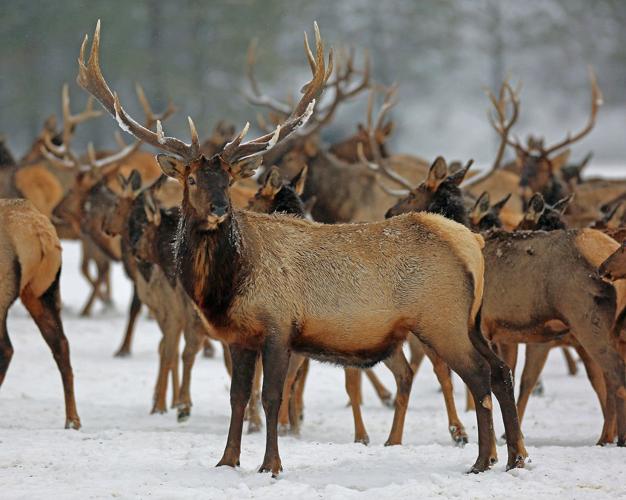
The elk population has increased over the last few years, causing a spate of property damage— from eaten fruit trees to destroyed fences — according to valley orchardists.
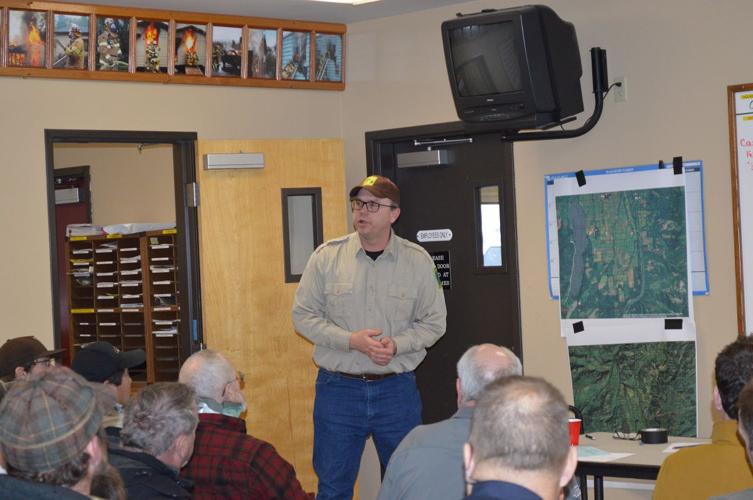
About 60 people gathered at Parkdale Fire Station Wednesday afternoon for a planning session to discuss the topic, hear a report by Oregon Department of Fish and Wildlife, and consider responses land owners can pursue.
Jeremy Thompson, ODFW wildlife biologist for Hood River, Wasco, and Sherman counties, delved into just how prominent the elk herds have become.
ODFW typically manages, and currently recognizes, a population of 120 elk in the Hood unit, Thompson said. But this year, based on conversations with land owners, he estimates the number to be in the hundreds, as high as 400.
Thompson asked the room of gathered valley residents how many had witnessed a group of a hundred or so elk — at once — this winter. A half dozen people raised their hands.
The well-attended event, “Hood River Valley Deer and Elk: A Comprehensive Planning Session” was organized by the Hood River County Farm Bureau, ODFW, and partner groups. Guests included Oregon State Police game wardens, Rocky Mountain Elk Foundation, and fence suppliers from the Parkdale area. In addition to farmers, several hunters attended the session.
Randy Kiyokawa, Farm Bureau representative and Parkdale orchardist, kicked off the session. He explained that a similar planning session had been convened about three years ago. This year’s gathering was a return to that issue, but with a more organized effort.
“The migration of the elk has definitely gone through the upper valley more. (That has) sparked a lot of the interest in being here,” Kiyokawa said.
He noted that the elk seem to have a particular taste for apples, which Kiyokawa Family Orchards grows, along with pears.
Whereas deer were the dominant ungulate nuisance about five years ago, the issue has shifted in some cases to their larger cousins, elk, according to speakers at the event.
Thompson, who led the main presentation, said there are essentially three elk herds in the Hood River area: a major group in the upper valley that’s “growing fastest,” an assortment near the Indian Creek Golf Course, and a small amount hunters have noticed near Cascade Locks.
“We have some real challenges here in the upper Hood River Valley,” Thompson explained. “You want to see elk here, but you don’t want elk eating your apple trees. There needs to be alternate areas (for elk) to go.”
Much of the surrounding federal and county forest land isn’t suitable for elk populations, Thompson said. Often, that land is specially managed timber or has a closed forest canopy that’s not conducive to the animals.
Recreation in the valley, “another leg of the stool,” like ATV and motorcycle riding, also pushes elk to move away from forest areas.
Land owners have methods of discouraging elk, such a fencing and hazing (chemicals and other tools), but Thompson maintained that without adequate alternative land, the elk will still push their way into orchards.
Thompson broke down his “next steps” into four points: habitat manipulation, possibly re-assessing the area’s current hunting strategy in attempt to curb population growth, coordinating agricultural fencing around the region, and identifying the key corridors where elk are moving.
Grant funding, he said, may be available from partner agencies to assist in a region-wide response.
Kiyokawa invited people to form a committee that will pool ideas to mitigate property damage while still protecting a manageable elk population.
For more information, visit the Hood River Farm Bureau website: www.oregonfb.org/about/county-farm-bureaus/hood-river-county-farm-bureau/.


Commented