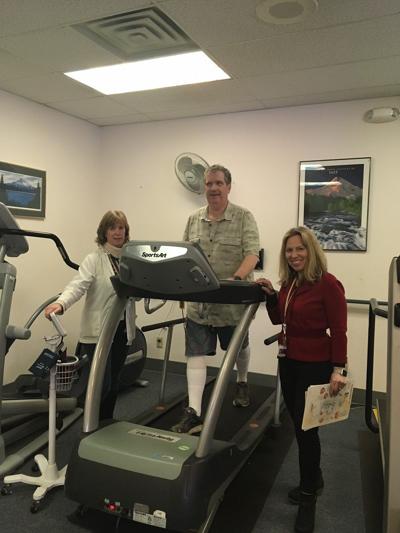
EXERCISE Physiologists Laney Gale, left, and, Kris Wilhelm, work with patient John Campbell at Providence Cardiac Rehab. Providence also provides financial assistance for those who qualify. Medicare and many commercial and government insurance programs cover Cardiac Rehab Cardiac Rehab is located at 1151 May St., Suite 102, in the building diagonal across from the main hospital. For more information, contact the clinic at 541-387-6326.
EXERCISE Physiologists Laney Gale, left, and, Kris Wilhelm, work with patient John Campbell at Providence Cardiac Rehab. Providence also provides financial assistance for those who qualify. Medicare and many commercial and government insurance programs cover Cardiac Rehab Cardiac Rehab is located at 1151 May St., Suite 102, in the building diagonal across from the main hospital. For more information, contact the clinic at 541-387-6326.
Heart Disease remains the number one killer of both men and women in the United States. The American Heart Association reports that on average per year, nearly 750,000 people, both men and women, suffer a heart attack or cardiovascular event.
According to the Center for Disease Control, nearly half of Americans have at least one risk factor for heart disease, such as high cholesterol, high blood pressure, obesity, physical inactivity or an unhealthy diet. Fortunately, almost all of these risk factors are controllable through diet, exercise and healthy lifestyle.
Most patients are aware of what they need to do to reduce their risks through diet and exercise. We all know it’s not easy to change habits, so we’re here to provide support. Our program typically provides patients with three sessions per week for three months. Studies have shown that it takes 30-90 days to develop a new habit, and we are here to provide accountability. We are the cheerleader, trainer, coach and medical monitor for each patient we care for.
During a cardiac rehab session, nurses monitor heart rhythms while exercising, providing immediate feedback to the patient. Cardio training equipment and weight training are used towards the goal to return the patient back to their activities prior to illness, such as going back to work, golfing, fishing, gardening, playing with grandkids and more.
Opening in 1996, the Providence Cardiac Rehab Center has helped hundreds of cardiac patients in the Gorge strengthen their hearts and learn ways to reduce their risks of heart disease in the future. Currently, up to 50 patients per day are seen at the Providence Cardiac Rehab Center in Hood River from all over the Gorge.
Providence Hood River Cardiac Rehab is proud to be supported by Providence Heart & Vascular Institute in Portland, offering the latest advances in diagnosis, treatment, and cardiac surgery. Local cardiac rehab staff members Laney Gale, RN and exercise physiologists, Kris Wilhelm and Lavita Davies, work in conjunction with the team featuring cardiologists, nurse practitioners, dieticians and stress management specialists to provide a comprehensive plan for each patient. Most patients are referred by their primary care physician to a cardiologist for tests if preventative care is the goal, or the cardiologist may become involved if there is a sudden cardiac event.
A doctor’s referral is required for the Cardiac Rehab program. Patients may contact the center or your physician’s office to see if they qualify. It’s important to know that patients don’t need to leave the Gorge to see a cardiologist to be treated for heart disease. The Providence Hood River Cardiology Clinic works closely with Cardiac Rehab and features providers Alicia Ross, M.D., and Laura Whiting, PA-C.
Cardiac Rehab is more than an exercise program, it is now a medical “Standard of Care,” meaning that it has been medically proven and is usually prescribed for most patients following heart surgery.



Commented