The Missing Corner is located in the quiet town of BZ Corner, Wash., near the White Salmon River. Now in its second year of operation, the center aims to bring community members together for small-business markets, create connections and host classes.
From March 19-26, The Missing Corner held its first Broken Kayak Drive. During this campaign, minor boat damage was repaired and plastic from extremely damaged boats was processed. While whitewater kayaks are made from thick high density polyethylene plastic, they eventually crack and become unusable after prolonged use.
The idea for the drive came from Natalie Kramer Anderson, owner and founder of The Missing Corner. The mom of two is a professional whitewater kayaker with a Ph.D. in fluvial geomorphology.
“I had seven broken kayaks in my backyard that were creating a lot of clutter,” she said, noting that it was time to find them a better use. “This event is a good reason for the community to come together, since having a place to recycle them is a need everyone has … It’s just a start at getting better with our resources.”
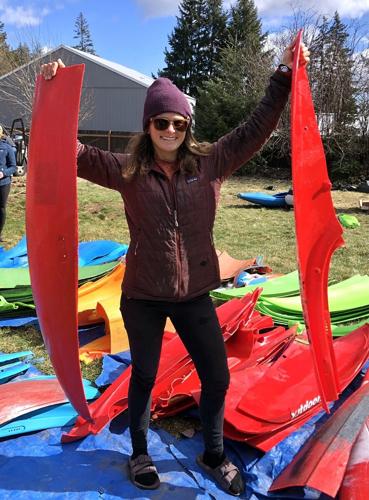
Volunteer Danielle Peecher holds up a couple pieces of shiny, clean, processed plastic that are ready for transport to the east coast.
Emma Renly photo
Kayakers Adam Edwards of Portland and Melissa Vaughn of White Salmon spearheaded the event through outreach work in search of sponsors and volunteers. Northwest River Supplies (NRS) provided food from Big Man’s Food Truck to drive volunteers and also rented the space from The Missing Corner.
As part of the event, Jeremy Bisson led a donation-based class on how to weld kayaks using old plastic and a heat gun. Bisson, of Trout Lake, is a Board Member of Friends of the White Salmon River and whitewater enthusiast.
“Welding is the first step in recycling kayaks,” he said. “It offers boats at a lower price point for those getting into the sport because kayaks are expensive. Instead of needing to purchase a $1,500 boat, someone could start with a $100 boat with a water-tight weld on it. That’s huge.”
Bisson is a strong advocate for boat welding. After damaging his last kayak in a year, he welded the crack and was able to continue using that same kayak for the next year and a half.
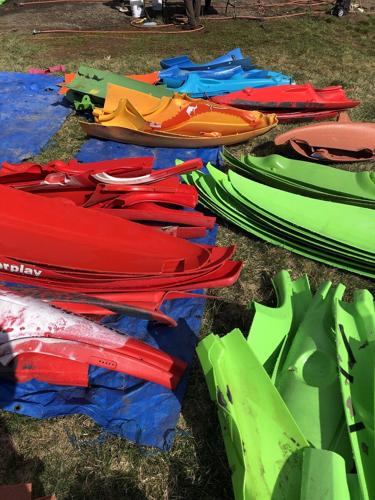
Kayaks cracked beyond repair were washed down and decontaminated, with removal of any debris or stickers. Circular saws were used to cut large plastic pieces into smaller ones and microplastic shavings were disposed of in the waste bucket. The colorful plastic was then organized and tied together for easy transport for any east-bound kayaker.
Reusable old outfitting such as ratchets, seats, foam and drain plugs, will be advertised online for people to take for free.
Lots of sliced up and processed kayak plastic ready for a new life.
Photo by Emma Renly.
Danielle Peecher, a resident of White Salmon with a passion for kiteboarding and whitewater kayaking, volunteered her day to process the plastic.
“It’s a nice way to hang out with the kayaking community outside on a beautiful sunny Sunday,” she said. “I didn’t realize that parts of the boats could be made into other things like hand paddles, which is cool.”
It’s estimated that around 15-20 kayaks were donated and processed during the event.
The plastic will be transported to Boats2Boards and Team River Runner (TRR) Hand Paddles. Both organizations process old kayak plastic to raise money for nonprofits. As of now, there are no locations on the west coast that offer the service.
At Boats2Boards, based in Syracuse, N.Y., Alex Barham creates vibrant cutting boards and bowls for purchase. He estimates that they have upcycled and sold around 600-700 pounds of kayak plastic and raised $12,600 for various organizations, primarily split between American Whitewater and TRR. Barham is happy to donate pieces to other causes and said he’s happy to help anyone who needs funding.
Barham works closely with John Su, the creator of TRR Hand Paddles based in Rockville, Md. From hand paddle sales alone, Su donated 122 usable kayaks and seven enclosed trailers to TRR.
“I figured this way I could spend time with my family and give time to the organization when I have a spare hour here and there,” Su said, emphasizing that he and Barham are looking for more ways to repurpose the plastic.
To follow along for future events, follow The Missing Corner on Facebook, @themissingcorner on Instagram, or check out the website at themissingcorner.squarespace.com.
Those still interested in donating broken whitewater kayaks can be drop items off at The Missing Corner, located at 1256 Highway 141 in BZ Corner, or at Immersion Research in Hood River, located at 105 Fourth St.



Commented