THE DALLES — In preparation for progressively less snowpack on Mount Hood, the city plans to replace its water treatment plant and expand its reservoir.
Officials have considered bolstering Crow Creek Reservoir ever since the 1990s. A 75-year-old catchment on upper Mill Creek, it accounts for 78% of the city’s total water supply — with the rest coming from three wells, all within a state-designated Critical Groundwater Area inside city limits.
In order to do so, however, they’ll need 150 acres of Forest Service land surrounding the reservoir, “so we own it and we can control it, and we wouldn’t have to go through all the red tape and permits and special use stuff with the Forest Service,” said Mayor Rich Mays.
Rep. Cliff Bentz of Oregon’s 2nd Congressional District introduced a federal bill to transfer ownership of that land to the city early last year. After passing the House, it was read to the Senate on Dec. 10, then sent to the Committee on Energy and Natural Resources.
If unsuccessful, the city would then have to find some parcel(s) of equal value for a swap with the Forest Service. The decades-long Government Camp-Cooper Spur land exchange, as previously reported by Columbia Gorge News, demonstrates just how slowly that process can move.
The Forest Service has been supportive and worked with the city to avoid that situation, even backing The Dalles Watershed Development Act with testimony in D.C., Public Works Director Dale McCabe said.
It’s a three-step project: First, replace the whole treatment plant with a brand-new facility and a different purification method. This alone will take almost 10 years, McCabe said. Construction would start around 2029. The new facility will be in the same place, and covering the same area.
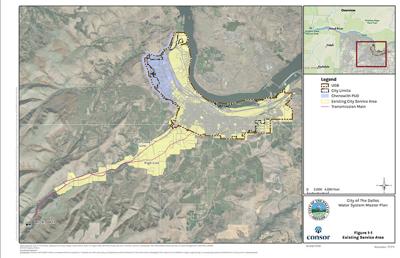
Then, address the pipes. They’ll dig on Mill Creek Road to replace two steel lines with a single, 24-inch ductile iron pipe in the county right of way. Some of the existing infrastructure is more than a hundred years old.
“There actually are sections of pipe that have a repair band, a repair band, a repair band, just like right next to each other,” McCabe said, and they’re still leaking.
Finally, raise the dam by 35 feet. Currently, the reservoir holds about 260 million gallons. The new, bigger lake would hold 640 million, and McCabe said the whole project, outlined in the publicly-available water master plan, will take about 20 years.
Funding will come from a combination of raising water rates, offset with as much as possible with money from Google’s data center fees. They may also seek a smaller amount of grant money.
The goal is to catch more of the rainwater and snowmelt flowing off Mount Hood in the face of climate instability, which is bringing snowmelt earlier and earlier, lengthening summer droughts. The city pulls water from South Fork Mill Creek, which includes water diverted from Dog River, part of the Hood River Basin.
By century’s end, most of the precipitation on Mount Hood will fall as rain, peaking in February, according to a climate change impacts report in the Water Master Plan. Temperatures up to 5.5 degrees Celsius hotter could strip year-round ice off Mount Hood.
That means less water to feed the city’s growing demands for residences, businesses, and industrial uses.
The city’s solution: Make space to collect more rainwater and store it longer.
“This is just something that’s been in the works for, you know, 20-plus years,” McCabe said. “It’s just something that has been discussed, of needing to increase the storage capacity for future demands of the city ... as the city continues to grow, on all phases.
For now, projects are still in the early design stage.



Commented