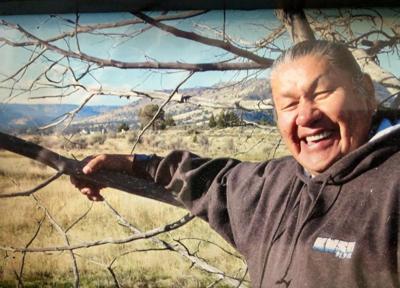
Delson Suppah Sr., Tyx’ Band, Warm Springs Tribe, spoke at the Balch Hotel in Dufur the day after Thanksgiving. The event was titled, “A Native Perspective During the Thanksgiving Season.”
Delson Suppah Sr., Tyx’ Band, Warm Springs Tribe, spoke at the Balch Hotel in Dufur the day after Thanksgiving. The event was titled, “A Native Perspective During the Thanksgiving Season.”
DUFUR — “As you walk this land, you walk on my ancestor’s blood,” said Delson Suppah Sr., Tyx’ Band of the Warm Springs Tribe.
On a quiet, overcast night at the Balch Hotel in Dufur, Suppah explained how the United States came to be and the legacy of Thanksgiving from an Indigenous perspective Nov. 29. Often romanticized as a celebration of Pilgrim survival and newfound peace with Native Americans, Thanksgiving is a Day of Mourning for First Peoples — a reminder of the colonial theft, genocide and assimilation following the Mayflower.
Suppah began by sharing their unwritten law: “We are one, all made by the same maker and must share all his creation equally.” Though water is life for the Nch’i-Wána Pum, or People of the Big River, First Foods are also essential. Every year, Tribes gather roots, followed by salmon and berries as they become available.
Each day is one of thanksgiving for Indigenous peoples who, according to Suppah, must hold a ceremonial feast to express their gratitude for the Creator prior to harvesting. Without a significant portion of their ancestral territory, however, the Confederated Tribes of Warm Springs struggle to access these foods, sometimes even on their own reservation. “We’re getting encroached by non-Indians. They like some of these foods, especially huckleberries,” said Suppah. “They have no honor or respect for it. The capitalist system runs their life, so they want to make money.”
Along with the Tribes of Middle Oregon, the Warm Springs Tribe signed a treaty in 1855, ceding 10 million acres of their land to the United States while enshrining their right to gather on the reservation and fish all streams running through it. Codified prior to Oregon’s statehood in 1859, Suppah reminded those circled around him that treaties “shall be the supreme Law of the Land,” as stated in Article 6 of the Constitution.
Suppah encouraged listeners to open up their private property — to give Indigenous peoples more space to hunt, gather and sustain their way of life — emphasizing they would be in compliance with the law. In the room, heads nodded and people talked about making signs expressing their intent to share.
“When it comes our time to be part of this land and pass on, we want some good, powerful blood to be there to nourish and give back to future life that’s going to be here,” said Suppah. “That’s what our foods do for us.”
Suppah then told an Indian legend, stories that often draw on the wisdom of animals, about a mouse. As the legend goes, the mouse was out playing as a young child when he suddenly heard a hawk’s screech. Recalling his father’s advice, to run home as fast as possible whenever you heard that sound, the mouse took off but inadvertently collided with another “big, fat, ugly, blind mouse.”
As a result, the mouse narrowly escaped the hawk’s talons. The cycle repeated the next day, and when the mouse complained to his father, the father said, “If you do good for something that you don’t like, if you can give something of yourself to that which you don’t like, you will see the world as no other mouse has ever seen it.”
On the third day, the mouse gave the blind mouse his eyes. Able to see the world, the blind mouse admired the sky, trees and flowers, but then the hawk screeched. Now sightless, the mouse kept running into sagebrush and rocks until the hawk snared him by the stomach.
Angry for listening to his father, the mouse then transformed into an eagle and soared above the hawk, never fearing for his life again.
“When you see a mouse, remember, listen to your elders,” said Suppah. “Let’s give something of ourselves to each other so we can have a better place to be.” He stressed the importance of educating, remembering and taking action in support of Indigenous peoples, and seldom do days serve such a stark reminder as Thanksgiving.



Commented