
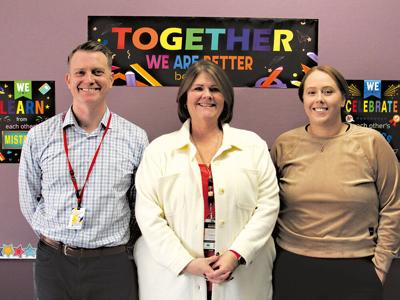
THE DALLES — When it comes to early childhood education, social-emotional skills can be just as vital and important as traditional academics. At North Wasco County School District (NWCSD), that is where the Culture Teacher on Special Assignment (TOSA) come in.
“The children that we’re facing now are far different than the children that I worked with 14 years ago when I first started [in education],” said Jared Burrow, Culture and Climate TOSA for NWCSD. “The needs of the children now are far more dynamic and significant than what I started out with at the beginning of my career.”
Burrow, along with Kirky Stutzman and Abigail Cates, work full time as TOSAs within each of NWCSD’s three elementary schools. These positions are contracted for three years, and are grant-in-aid funded through the Intensive Program, funded by the Student Investment Account (SIA) under the Student Success Act. According to the Oregon Department of Education (ODE), the Student Success Act “includes $200 million to enhance the State School Fund,” with the remaining funds divided among three key accounts, with “at least 50% towards the SIA.” According to the district, the goal is to “create a positive, consistent school culture that meets students’ unique needs and fosters a better overall school experience.”
The TOSAs themselves describe their role as providing support systems to both students and teachers. For students, that means working to address their social-emotional needs and skills, such as self-regulation and conflict resolution, while also working improve their experience as students to allow them to feel safe in school environments.
Social-Emotional Learning (SEL), Burrow noted, is building skills surrounding emotional self-awareness. “Like, how am I feeling in a specific moment? It could be that self-management, how do I regulate myself when I feel dysregulated? It might be a social engagement, and it might be even some social efficacy, as well as that growth mindset,” he said. “Those are some of the social-emotional standards that are associated in the State of Oregon with ODE that we are helping develop within our students, but also capacity for instruction that’s happening.”
Addressing student attendance and reducing chronic absenteeism is another facet of their work. “I’ve been reaching out to families to understand what are some of the barriers that they are experiencing, either sending their kids to school or even with tangible resources that they might need,” Burrow said. He also noted that they partner with Youth Outreach Workers (YOWs) from The Next Door Inc. to perform home visits.
“There’s a lot of collaboration that’s occurring with different stakeholders here, to really, at the primary goal, to help kids learn and to feel welcome and safe at school, and to get consistent attendance,” he said.
Consistent attendance, is when students attend 90% of school time and are missing no more than 18 days in the school year. “So that’s a primary goal that we have in trying to address some systemic issues that we’re seeing here in North Wasco School District,” Burrow said.
Their systems of support extend not only to students, but also to staff. Along with providing guidance, TOSAs also work to support teachers through means recognition and offering assistance or help with day to day tasks, such as covering classrooms or simply finding ways to improve morale.
Stutzman noted that she often facilitates games for staff, as well as names a teacher and assistant of the week. All three TOSAs often find themselves covering classrooms when teachers need to step out for any reason.
“It’s … being there to support your staff, and the staff is just not the teachers, it’s the assistants, and it’s also your admin ... kind of just being there as an overall person, just to let them know that they’re fabulous and they’re doing amazing things,” Stutzman said.
A large part of their jobs is to guide staff on subjects such as social-emotional learning and restorative practices.
“One of the second-grade teachers at Colonel Wright has welcomed me and our admin in his classroom, and so I’m kind of coaching him on tier one SEL stuff in his classroom, and that includes, like, modeling lessons, but also going over lessons with him so he feels confident in teaching them to the class” Cates said. “It’s like a collaborative relationship between us and the teacher that just works together for their classroom and students.”
In the NWCSD, the TOSA positions are to “organize and provide assistance for all staff in using a restorative approach to support the unique needs of our student population and improve the overall school experience for them.”
As previously reported by Columbia Gorge News, ODE describes restorative practices in schools as a “system-wide approach to cultural over-reliance on exclusionary discipline practices in schools.” According to the website Learning Policy Institute, restorative practices in education are “designed to build a strong sense of community in schools, to teach interpersonal skills, to repair harm when conflict occurs and to proactively meet students’ needs — including those that result from trauma in or outside of school — so misbehavior is less common.”
Restorative practices were identified as part of the district’s adopted 2022-27 strategic plan, with “begin work on restorative practices” listed as one of Superintendent Carolyn Bernal’s Year One strategic plan priorities in September 2022.
According to the district’s recommendation, a survey of administrators showed that “restorative approaches were currently unevenly supported and implemented” within the district, with staff union leadership speaking on disruptive learning “suggesting that restorative practices is a positive step in the right direction but needs to be balanced with expectations and consistency in implementation of expectations,” requesting support in the form of coaches, social workers and or on site therapists to support students, families and teachers on how to properly integrate restorative work into their day to day routines.
As TOSAs, Burrow, Cates and Stutzman are attend trainings on restorative practices and social-emotional learning, and coach other staff on how implement it.
“A lot of people are already doing it, and it’s not this big curriculum we need to learn, but it is something is that can help our students feel safe and welcome at school and staff as well and teachers” Cates said. “Based on a lot of conversations I’ve personally had with other co- workers … they’re like, ‘Oh, yeah, I’m already doing that.’”
They noted the intention of restorative practices is a method of addressing student’s social-emotional needs and skills within the context of learning and dealing with conflict, and are not intended to absolve students of accountability when conflict arises.
“I think … a big misunderstanding a lot of people had was that restorative justice was to replace disciplinary actions,” Cates said, “and so I could understand why a lot of people would freak out if that’s what they assumed or thought … I think restorative justice is just another tool in our toolbox.”
“Post-COVID, education has changed,” Burrow said, “and we’re not just teaching students academics, we’re teaching the whole child. And when we’re teaching the whole child, there’s a social, emotional and relational piece that needs to be addressed. So when kiddos have conflict, whether it be on the playground, in the hall, on the bus, in the classroom ... we’re giving them tangible skills and helping to facilitate restoration between you know, where there’s harm that has been done so that these kiddos not just feel good and safe, but they’re developing these skills, which, during COVID, was a huge loss.”


Commented