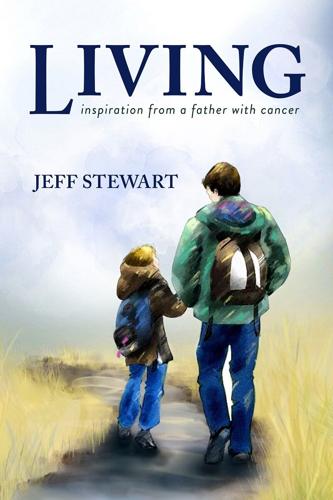
Pictured is the cover of The Dalles native Jeff Stewart’s book of life lessons that he wrote for his seven children upon discovering he had cancer and possibly only months to live.
Pictured is the cover of The Dalles native Jeff Stewart’s book of life lessons that he wrote for his seven children upon discovering he had cancer and possibly only months to live.
Contributed photo
Last July, The Dalles native Jeff Stewart was embarking on a long-term goal of becoming a kidney donor when testing revealed he had cancer. Not just one kind, but two.
And he is grateful for it.
It’s a blessing that gave him “the time and will” to write a book, “Living: Inspiration from a Father with Cancer,” that he’s dedicated to his seven children and “someday grandchildren in case I can’t tell you myself.”
The book, which publishes May 15, is three powerful stories woven into one page-turner: His own fascinating life story; his 100 pearls of wisdom to his children that give the book its title; and his unblinking account of his cancer diagnosis and treatment.
He has a rare gift for explaining complex things simply. And he doesn’t shy away from hard topics, be it his own deep regrets or his own mortality.
Early on he talks about waiting to hear what stage his cancer is: “Tumor staging is going to set the clock of my life.”
Treatments are now done, and a scan has shown no cancer. If it comes back, he’s got months to live. If he makes it to the two-year mark cancer-free, he’s looking at a full lifespan.
The book will be available to order at bookstores and on Amazon May 15. It will be available on Audible this summer.
Stewart, who lives in Cary, N.C, where he is a pharmaceutical consultant, gained fame in 1994 when he won Collegiate Jeopardy! Shortly after that, he narrowly lost in a Jeopardy! Tournament of Champions.
Nearly 30 years later, when COVID hit, he began commenting tirelessly on community Facebook pages in The Dalles. Unfailingly kind in the face of vitriol, he used his scientific background and trademark simple explanations to counteract the endless amount of COVID misinformation.
“I spent every bit of my local fame from winning on Jeopardy! to undo COVID lies,” he wrote. “They told lies that tricked people into a gruesome death by suffocation.”
In telling his remarkable life story, Stewart describes the fierce work ethic and strong moral code learned from his parents, Joe and Sharon Stewart.
A reader by age 2, Stewart was “smart, and I liked it. I didn’t mind telling you how smart I thought I was.” He acknowledges, “My face must’ve been completely punchable.”
His inquisitive mind is on full display. He marvels at scientific explanations of how insects fly, despite their huge bodies and tiny wings. (They create cyclones under their wings that cause lift).
Jeff Stewart
Franklin Knox
He thinks about how incredibly physically strong and scrappy our ancestors had to have been just to survive, even though their nutrition was terrible. He thinks about the sacrifices made during the D-Day landing in World War II.
Forming the heart of the book are his 100 life lessons for his children. Imagine if you had a deeply caring friend with encyclopedic knowledge and the insights of a sage, who just wanted the very best for you.
This is the list you’d get.
It’s a stunning breadth of wisdom, stretching from the practical to the profound.
Some samples:
Propaganda victims are victims. Don’t blame victims.
All breakups are bad. Feeling terrible doesn’t mean you should get back together.
Be excited to seek expertise and be open to changing your mind and learning new things.
Buy term life insurance. All other life insurance is term life plus overpriced investment.
Don’t cook a turkey intact.
Failure is the tuition we pay to learn compassion.
Wish everyone well. The line between Us and Them fades.
Be wary of confidence, it’s possessed by experts and incompetents alike. The key: Look for expertise.
Sometimes we wait too long to quit something.
Switch therapists if it’s not working out.
Be friends with anyone, but choose who you follow carefully.
His final, most important missive: Be kind.
He offered another insight, “Physically attractive people aren’t always taken seriously. Just ask your mother.”
He met his wife, Jen — the first person to ever beat him at Trivial Pursuit — when both played on the Brigham Young University trivia team.
She turned down her law school admission to Columbia University, the nation’s top law school at the time, to raise their growing family.
His Jeopardy! win is well known. He was recognized all over the world. “Fame is fun and creepy,” he wrote. “People stared.”
Less well known is that as a lab assistant at Princeton, he discovered one of the keys to the causes of autoimmune disease in women. When his theory — which came to him like a thunderbolt — was borne out by studies seven years later, “I cried.”
And, like a modern-day Renaissance Man with expertise across disciplines, Stewart also invented what has become the most used valuation method used in biotech today.
That’s not to say it’s all been a bed of roses. He was kicked out of Princeton after depression overwhelmed him and he failed exams, a mortifying experience. Despite three years of trying, he never got back into Princeton’s Ph.D. program. They did, however, award him a master’s degree, “which is kind of a booby prize in molecular biology.”
His cancer journey is dispassionately explained, again in simple and stark terms.
Stewart’s two cancers were in the stomach and kidney. He’s had surgery, chemo and radiation.
Chemo side effects, including nerve damage that zapped his hands when he touched things, and a painful cold sensitivity, got so bad he had to stop the treatment. His eye muscles cramped when he yawned.
He writes poignantly, “I’ll try to live the best life I can with whatever time I have. That should be enough. I want it to be enough. I know it’s not enough.”
Humor makes a regular appearance in his cancer story. He described the chemo infusion chair: “Think dentist chair plus La-Z-Boy. You can recline without it actually being comfortable.”
He explained why he was writing: “I don’t want to be forgotten …. I’m trying to live on in my kids’ minds. I want to leave them with my mental tools to pull out when they need. I want my language to live on in my kids, I want them to carry my world with them.”
The horror of a cancer diagnosis yielded the beauty of this engrossing page-turner. The wisdom and caring spun across the nearly 300 pages conjures up the title of a famous 1950s TV sitcom (and possibly a Jeopardy! answer), the very fitting Father Knows Best.




Commented
Sorry, there are no recent results for popular commented articles.