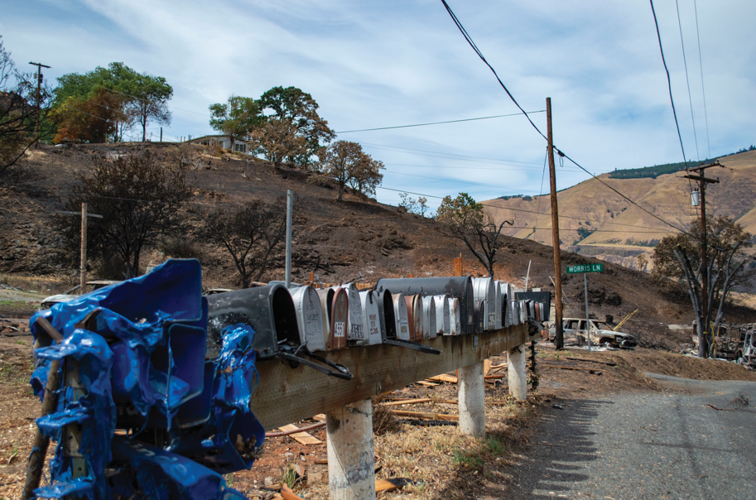
A row of mailboxes, some melted, still stood in the Tooley Terrace neighborhood after the Rowena Fire significantly damaged it in June. Just over six months later, phase two of the cleanup effort has commenced.
A row of mailboxes, some melted, still stood in the Tooley Terrace neighborhood after the Rowena Fire significantly damaged it in June. Just over six months later, phase two of the cleanup effort has commenced.
THE GORGE — Following a months-long wait, phase two of the state-backed, county-led Rowena Fire cleanup has finally begun, but the Columbia River Gorge Commission (CRGC) has yet to amend its management plan and pave the way for expedited disaster recovery, even after a second meeting with action possible.
Gov. Tina Kotek announced on Dec. 4 that cleanup funding was available for Rowena residents. While hazardous material had already been removed from affected properties, the second phase, which addresses ash and all other debris, had been delayed since early August, as previously reported byColumbia Gorge News. There has been no communication from the state since Kotek directed agencies to “expeditiously begin” phase two on Aug. 29.
Oregon does not have a dedicated debris removal fund, so paying for debris removal is largely left up to municipalities, which are often reimbursed later. But Wasco County couldn’t front the total cost, and it also wasn’t eligible for federal support. That required the state to create a new, grant-based funding mechanism specifically for Rowena, according to Erin Zysett, a public information officer for Oregon’s Department of Emergency Management.
“Working with Wasco County to develop that mechanism — including fiscal controls, legislative approval, and accountability requirements — took time but was necessary to ensure public funds could be used appropriately,” she said over email.
The county and Oregon’s Department of Environmental Quality were simultaneously working on a cost-effective cleanup plan that still met environmental and public health standards. Those two factors drove the prolonged timeline, Zysett said.
“We’re really excited to be able to move into this phase so that we can get those properties cleaned up, and people can decide whether they’re ready to move back home,” said Stephanie Krell, Wasco County’s public information officer. “We just really appreciate their patience to get to where we are today.”
Originally slated at $5.5 million, Krell said the county dropped that figure to $3.5 million by pushing for a local contractor, Crestline Construction, to take on the project instead of a state-identified company.
Crestline started removing debris from the first six properties on Dec. 15, and just over half of affected residents had signed up for the no-cost service as of last Thursday.
The Rowena Fire destroyed 61 homes and 91 outbuildings. The second phase should be complete in about two-and-a-half months, Krell said.
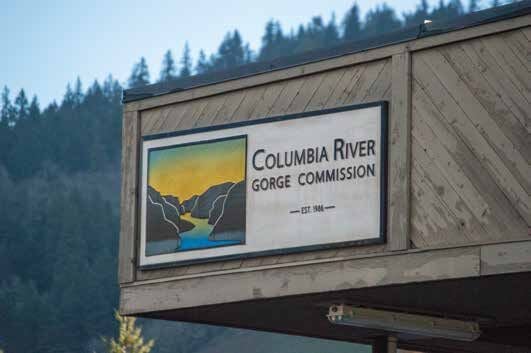
Outside of the Columbia River Gorge Commission's office in White Salmon.
Nathan Wilson / file photo
Gorge Commission
The dynamic that dominated last month’s session persisted at CRGC’s Dec. 16 meeting: While the amendment text is largely finalized, tribal consultation is still ongoing, and frustration on all sides was plainly evident.
At staff’s direction, Chair Michael Mills originally moved to postpone the meeting because the Confederated Tribes of the Umatilla Reservation raised concerns about how the expedited rebuilding process could impact cultural resources, which remained unresolved. The Confederated Tribes and Bands of the Yakama Nation and the Confederated Tribes of the Warm Springs also requested more time to review the amendment a few days earlier, as they did in November.
Some commissioners, however, urged the session to take place as planned. But the United States Forest Service, which regulates ecologically sensitive, or special management, land within the National Scenic Area and must produce a separate amendment in tandem with CRGC, had not completed tribal consultation either.
As such, gridlock was all but inevitable.
“I’m thinking about how I’m feeling if I’m in an unheated horse trailer right now, hoping to get back on my land,” said Commissioner Valerie Fowler, referring to a Rowena resident she’s spoken to. “And what I’m hearing is, I don’t know when I’ll be able to get you an answer.”
Once enacted, the amendment will ensure that residents impacted by the Burdoin and Rowena fires can avoid a full review from the permitting entity, which can take anywhere from two to four months, by rebuilding their homes in the same location and to the same size, with some exceptions. As previously reported byColumbia Gorge News, it would also provide 10 years for people to commence construction post-disaster and still qualify for the expedited rules.
Commissioners spent little time discussing those provisions and the others last Tuesday; rather, the ambiguity surrounding CRGC’s tribal consultation standards, perceived or intentional, and whether to move forward regardless, were core issues.
The National Scenic Area Act of 1986 directs CRGC to exercise its delegated responsibilities “in consultation with federal, state and local governments having jurisdiction,” and with the four “Indian tribes.” Absent further detail in the act, Jeff Litwak, the commission’s counsel, said he couldn’t offer direction on what that exactly means. And while CRGC has a 30-day standard for the development review process, no such rule exists for tribes regarding an amendment.
“Certainly, the citizens whose houses and barns burned down have the utmost right to be really frustrated with the fact that there’s so much process attached to rebuilding,” said Commissioner Alex Johnson. “It’s not the treaty tribes’ fault that the established process that includes them doesn’t have specificity … Sovereigns themselves are the only ones that get to determine what is good enough.”
Johnson and others also emphasized that the tribes are stretched thin capacity-wise. The Yakama Nation, for instance, is contesting several renewable energy projects along with a decision by the Bonneville Power Administration to withhold $50 million in salmon restoration funding, and all tribes were impacted by the government shutdown in November.
“We cannot set a precedent of allowing emergencies to take precedence, or trump, the rights of other government entities,” said Commissioner Amy Weissfield. “What happens now, in these emergencies, sends a big signal and can undermine years of effort and years of lip service, so to speak, in building those partnerships.”
Eventually, Fowler moved to vote on the amendment, seconded by Commissioner Rodger Nichols. Along with pushback from some of their seatmates, CRGC staff and Commissioner Donna Mickley, who represents the Forest Service, highlighted a key procedural barrier.
Even with an affirmative vote — and assuming the Forest Service and CRGC submitted their amendments as a package, which Mickley indicated she wasn’t comfortable doing — the U.S. Department of Agriculture must sign off on both, as required in the act. It’s unlikely that Secretary Brooke Rollins would respond favorably if tribal consultation was clearly ongoing.
With only about a half-dozen applications approved so far, and nearly 80 homes lost this summer, commissioners made a last-ditch effort to provide at least some relief by allowing for the use of temporary storage structures on affected properties and extending the 60-day RV limit. That meant a separate amendment from both agencies, however, and would have delayed passage of the larger changes further.
Ultimately, commissioners unanimously voted to hold the motion until their next meeting on Jan. 13.




Commented