E-bikes have become increasingly popular in Hood River, both for recreation and as an eco-friendly replacement for a car, and the Port of Hood River is working to figure out how to treat this transportation method in regard to the bridge.
After hearing from Jodie and Steve Gates of Big Winds and Andrew Bryden, design director at Mosko Moto in White Salmon, the Port of Hood River is considering some sort of test program to see how e-bike commuters could fit in with the Hood River-White Salmon Interstate Bridge.
“I believe personally that it would be a first minor step” to allowing e-bikes on the bridge, Executive Director Michael McElwee said at a Feb. 5 port commission meeting, “There’s no illusion that this is easy, but I think that it’s worth the council talking about.”
Bryden requested permission to use his e-bike to commute across the bridge last summer; unsure what the implications would be if e-bikes were allowed across the bridge, the port commission invited Bryden and the Gates to their Feb. 5 meeting to provide more information on e-bikes.
“It’s not for the faint of heart, and the same could be said about riding across the bridge amidst the elements or frequent wind,” said Jodie Gates about commuting with an e-bike during the winter months. The port would likely wait until summer before debuting a test program, McElwee said.
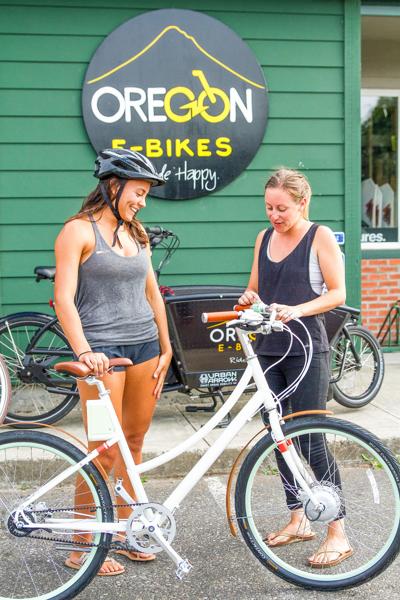
This year marks the third that Big Winds, partnered with Oregon E-Bikes, has offered e-bike rentals, Gates said, and the majority of renters use the e-bikes on the Old Columbia River Highway.
“It’s so stress-free to go somewhere with no cars,” she said.
While Oregon has yet to adopt an official class system for e-bikes, most manufacturers follow Washington and California’s, categorizing bikes by their maximum speed, Gates said. Most e-bikes fall into Class 1, which allows pedal-assist up to 20 miles per hour, but some “speed” bikes can go up to 28 miles per hour. These fall into Class 3, and are often designed under the assumption that they’ll be ridden in traffic, she said.
Bryden brought in his personal e-bike for the commissioners to examine — a Class 1 “cargo bike” model from a Seattle-based company. He said that his e-bike has entirely replaced his car — with the exception of his commute to work from White Salmon to Hood River. “These things really equalize everything,” he said of the e-bike. “You don’t feel as exposed in traffic because you’re roughly going the same speed.”
Hood River resident Erin Gosset uses cargo e-bike similar to Bryden’s to commute to and from her job at Providence Memorial Hospital.
“Usually, I feel good and safe on it” when riding in traffic, she said, adding that she does exercise caution around cars that might not see her.
When asked, she said she would definitely be interested in taking her bike across the bridge, but worried about the wind and the steel grating.
She also expressed concern about the toll, and wondered if it would be reduced for e-bikes.
The port has not yet decided on toll rates for the new bridge, which will likely allow pedestrian and bicycle crossing.
While commissioners expressed some safety concerns such as wind and vehicular traffic for e-bikes on the bridge, there was a consensus for staff to continue talking with experts about a potential test program.
“We’ll need it for the future bridge, if nothing else,” said Commissioner Ben Sheppard.
McElwee proposed a test program allowing eight or so vetted e-bike commuters, each with a vest or something else to indicate them, to cross the bridge for a period of time.
“These are certain people who are specifically authorized,” McElwee clarified.
Bryden recommended additional signage to discourage standard bike riders and other e-bike riders from crossing the bridge.




Commented