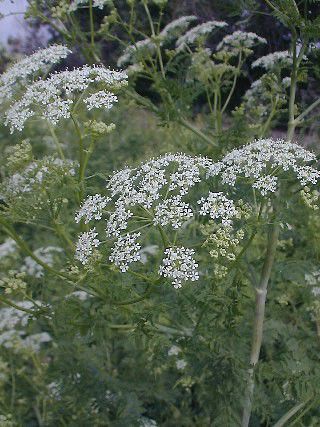
Poison hemlock (Conium maculatum) is currently flowering throughout Hood River County. It is important to be able to identify poison hemlock to prevent accidental ingestion. It can be confused with wild carrot (or Queen Anne's Lace), and other members of the parsley family.
Poison hemlock has smooth hollow stalks with purple blotches and no hairs on its stems. It can get quite tall, sometimes up to 8 feet or higher. It produces many flower heads in a more open and branching inflorescence than other look-alike plants. Poison-hemlock starts growing in the spring time, producing flowers in late spring, while wild carrot produces flowers later in the summer.
Poison hemlock is considered to be one of the most poisonous plants in North America, and is often mistaken for water-parsnip or other edible members of this family. Several deaths of livestock and humans are attributed each year to this species. All parts of the plant are poisonous and even dead canes remain toxic for up to three years. Toxins can also be absorbed through the skin and respiratory system, so always wear gloves, glasses, and a mask when handling this plant.
Poison hemlock can be controlled by mechanical means such as removal of flowers and seeds by hand pulling, digging the root crown, or repeated mowing. Elimination of seed production is the goal. The toxins will remain potent in dried plant material, so bag and dispose of dead plants.



Commented