
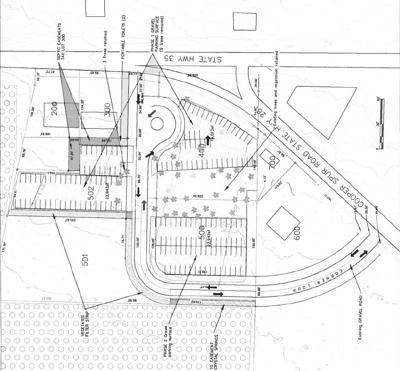
An appeal of Mt. Hood Meadows’ plan to build a park and ride in the community of Mt. Hood has failed after Hood River County Planning Commissioners weren’t able to muster enough votes to arrive at a decision during a public hearing Wednesday evening.
With a skeleton crew of four commissioners — the bare minimum required for a quorum — the body voted 3-1 to uphold the appeal filed by Libby Rossknecht, which had accused the Hood River County Planning Department of making missteps when it approved Meadows’ application back in late September.
However, with four affirmative votes required to make a decision, the motion to uphold the appeal failed after receiving testimony from several citizens, all of whom were opposed to the project.
Rossknecht indicated on her Facebook page, “Park and Ride at Mt. Hood Corner,” that she has already decided to file an appeal of the planning commission’s decision with the Hood River County Board of Commissioners and appeal further, if necessary.
“Next step is appealing to the board of commissioners. (Oregon Land Use Board of Appeals) is an option after that,” she said on her page the morning after the decision, “and we have so many areas identified where the county has broken their own rules, we are ready for either.”
Rossknecht filed the appeal last month after the county approved Meadows’ application to construct a 179-space park and ride off Corner Loop Road near the intersection of Highway 35 and Cooper Spur Road. The lot would be used for parking primarily on peak days and serve as a pickup point for busses that would shuttle guests and employees 21 miles south to the resort.
As owner of the Mt. Hood Guest House — a vacation rental property located adjacent to the planned park and ride — Rossknecht has aired concerns that the proposal would harm her business by increasing noise and congestion in the area and harming the character of Mt. Hood.
In her appeal, Rossknecht stated the county’s decision is “not consistent with the provisions of the Mt. Hood Community Plan and violates provisions of Article 72” of the county zoning ordinance, which details the planning department’s approval procedure for project applications. She added that the county’s record of the decision to approve the commercial land use permit for the park and ride does not contain any “findings” as required by Oregon statute, and contains “other deficiencies.”
During her testimony, Rossknecht criticized numerous aspects of the approval of the park and ride, arguing that the proposal violated both county zoning ordinance and the Mt. Hood Unincorporated Community Plan, which codifies land use in the Mt. Hood area.
Rossknecht asked that the planning department evaluate the park and ride as “a variance or a conditional use” and stated that planning department staff erred when determining that the park and ride should be considered a commercial use permitted outright. She argued that the planning department tried to inappropriately “fit in” the designation for the parking lot and that there are no ordinances that “specifically allow park and rides” in the county.
“State administrative rule regarding unincorporated communities defines commercial use as ‘the use of land primarily for the retail sale of products or services, including offices,’” she told the commission, reading from her prepared arguments. “The fact is, that while Mt. Hood Meadows is a commercial service establishment, the parking lot is not — it is a lot auxiliary to Meadows and will not, itself, produce any revenue.”
Rossknecht also pointed to a provision of the county’s parking ordinance as evidence that the lot violated zoning laws, which states that “off-street parking spaces shall be located on the same or abutting lot with the building or use they are intended to serve.”
“This is not located on the same or abutting lot with a commercial service establishment it serves,” she said. “Therefore, it is not a permitted use, outright or otherwise.”
Traffic was also a concern of Rossknecht’s, who argued school buses and traffic produced by resort guests and employees heading up to the mountain would create congestion and increase the chance for accidents. She claimed traffic turning onto Cooper Spur Road from Hwy. 35 “is typically exceeding the 40 mph speed limit” and has resulted in “close calls” near the intersection.
“Even if you don’t see anyone coming around that corner, you still have to make your turn quickly to get out of the way,” she said. “How are 179-plus cars and two school buses per hour going to fare?”
Several others testified in favor of the appeal and criticized the county’s interpretation of zoning laws. Tracy Kochevar, who lives in Mt. Hood, testified that Meadows’ application should have been treated as a variance since there was “nothing that addresses a non-adjacent parking lot” in the county zoning code. She noted that people travel to Mt. Hood to get a country feel and argued the park and ride’s aesthetics would harm the rural character of the community.
“They’ll see a parking lot, a gravel parking lot at that,” she told commissioners, “and two handsome porta potties.”
Jude Russell, another resident of Mt. Hood, focused her criticism toward Meadows. She spoke of her skepticism regarding Meadows adhering to their stated “core value of sustainability” and asked, “How can you reconcile this core value of sustainability with this destruction?”
Others criticized what they viewed as favoritism by the county towards Meadows. Mt. Hood resident Jane Bratt referred to the planning department staff report, which recommended commissioners deny the appeal, as a “rally squad” for the resort. Bratt also skewered the commission for only having four members present.
“Boy, having only four commissioners, doesn’t that get you excited?” she asked the audience of about 30 people who came to watch the proceedings.
In a separate interview, Planning Director Michael Benedict said commissioners Jennifer Euwer, Erick von Lubken and Chair Bob Schuppe all had excused absences, but could not recall immediately why they were absent. He confirmed that a request from Rossknecht to move the meeting to another date had been denied, because Meadows would not agree to move it.
“We gave both sides the option to reschedule the meeting, with the caveat that both sides had to agree,” Benedict explained.
During testimony, no one spoke in favor of the proposal, although a handful submitted written comments in favor of the park and ride during the comment period that ended last month. Representatives of Mt. Hood Meadows were present during the hearing, but chose not to testify, although CEO Matthew Drake was on hand to answer questions from the planning commission and allowed the audience to ask him questions about the proposal, although it was not required by the commission.
One of the questions asked of Meadows was why the resort was building the park and ride when it already had plans to build the 878-car Twilight parking lot near the resort, which was approved by the U.S. Forest Service earlier this year.
Drake said the Twilight lot was still “several years down the road” due to federal funding needed for a fish passage project for a culvert that runs underneath Hwy. 35. He added that the resort was following the state’s multi-modal transportation plan for Mt. Hood, which he said includes long-term planning for multiple park and rides in an attempt to reduce traffic on Hwy. 35 and U.S. Route 26.
“Essentially, the idea is to have a structured system of park and rides that tier up the mountain and allow for guests to park there and then we shuttle them to the permit area and allow them to safely return,” he explained. “The reason that we’re doing this project now and why it will not be abandoned even when the Twilight Lot comes into play is that ultimately the main lot, which is up by the ski resort, actually up by the lodge, will turn more into a bus staging area and drop-off zone for guests, families, etc. to allow safe ingress and egress.”
He added that Meadows had looked at “pretty much every relevant site” to put the park and ride, including the Event Site at the Port of Hood River, which some critics of Meadows’ plan have suggested would be a more suitable site. Drake said the resort had tried to use the location in the past, but received few riders and noted that any park and ride location had to be adjacent to U.S. 26 or Hwy. 35.
“If it is not, it will not be successful,” he said.
Despite all the issues that were raised during the meeting, commissioners essentially only ended up deliberating on two: Was the parking lot a commercial use? Was it suitable for Mt. Hood?
Commissioner Kathie Alley did not comment on the commercial issue, but stated her opinion that the park and ride was “not a good use for this property.” Commissioner Peter Frothingham agreed and said that “enough concerns have been raised about the appropriateness and viability of this site that I can’t support it.” He added that he didn’t believe the park and ride functioned as a “freestanding commercial facility.”
Commissioner John Brennan said he believed the park and ride did qualify as a commercial use, but did not think its location was the “right answer,” asserting the location would not get enough use to qualify its existence.
“We have this corporation putting this parking lot in this little community that they only need a few weekends a year,” he said, “but the parking lot is going to be sitting there year-round.”
Commissioner Stanley Benson was the lone dissenting vote, arguing that it was an allowed use. He suggested that Rossknecht was perhaps not aware of the extent of what could be permitted within commercial zones when she bought her property and said that his “heart bleeds” for landowners that might find themselves in a similar situation.
“There are too many things that can go into a commercial zone… and I think this is a case where some of that caught up with somebody, unfortunate for them,” he said.


Commented