Roughly a year after Pacific Power announced that they were including a controversial planned de-energization protocol — the Public Safety Power Shutoff (PSPS)— into their Wildfire Mitigation Plan, Pacific Power has announced that downtown Hood River has been removed from the potential shutoff area, reducing the number of impacted power customers from 8,000 to 1,400.
“It’s a big relief if the Hood River Central/City area is removed from power outage plans,” said Hood River County Emergency Manager Barb Ayers, “because in the urban area, outages impact 85 percent of public safety and critical infrastructure we all rely upon — everything from emergency communications to signal lights to water, sewage, in addition to business/residential impacts during tourism and agriculture season.”
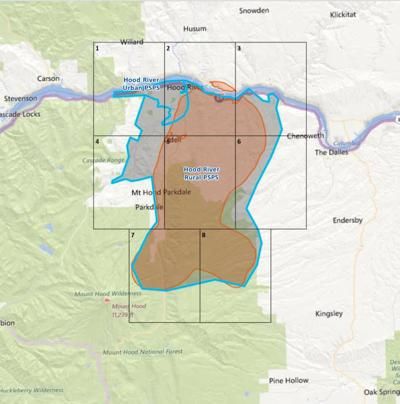
During a PSPS event, Pacific Power would shut off electricity in pre-identified wildfire high-risk areas during extreme weather conditions, with the intent of preventing catastrophic wildfires from starting and spreading. Those pre-identified areas currently cover western Hood River between Country Club Road and Viento State Park; southern Hood River between the airport and Odell; Highway 35 up to Paasch Drive (excluding Hood River Electric Co-Op territory, which is not powered by Pacific Power); and I-84/Highway 30 up to Rowena Crest Point — including all of Mosier (a map of the shutoff area is available at www.pacificpower.net/outages-safety/wildfire-safety/public-safety-power-shutoff.html).
Pacific Power was able to remove the downtown section of Hood River from the shutoff zone due to recent structural improvements that allowed Pacific Power to sectionalize power in that area — specifically, installing a switch that allows Pacific Power to sectionalize power, and installing insulated overhead wire.
“Our objective with these improvements is to make our system — and your community — safer,” said Kari Greer, senior community relations manager for Pacific Power in a written statement.
Pacific Power has also been working on other structural improvements, such as installing weather stations and building insulated conductors, to reduce the size of the designated PSPS zones. According to Greer, Pacific Power intends to finish several more improvement projects in the coming year, which would allow them to to remove the rest of Hood River and Wasco County areas from the PSPS zone by the end of 2021.
“This is great news,” said Ayers, “After months of working with Pacific Power to reduce the impact of their PSPS outages to county-wide people and critical infrastructure, we appreciate that Pacific Power took action. Hood River County and our public safety partners worked together to protect our community. Our team spoke up about concerns, and now we feel heard.”
Hood River and Wasco officials’ major concerns surrounding a potential PSPS center around a lack of available backup power for essential public services, such as 911 or Citizen Alert notifications; as well as potential negative impacts to businesses and vulnerable populations. According to Ayers, those concerns still stand for the areas left within the outage area.
“After watching last fall’s wildfire season in California and the PSPS recurring incidents, we saw how high the PSPS impacts were,” said Ayers, adding that a public outreach plan to help locals better prepare for fire season was planned for this summer, but COVID-19 and the activation of the Emergency Operations Center put that outreach on hold. “Bottom line is, we hope residents and businesses will prepare for wildfire season, and power outages,” said Ayers. “Any preparedness will benefit you in any emergency, any time of year ... As a community, we’ve already been through so much this year with COVID, we only hope fire season, and outages, go easy on us.”



Commented