
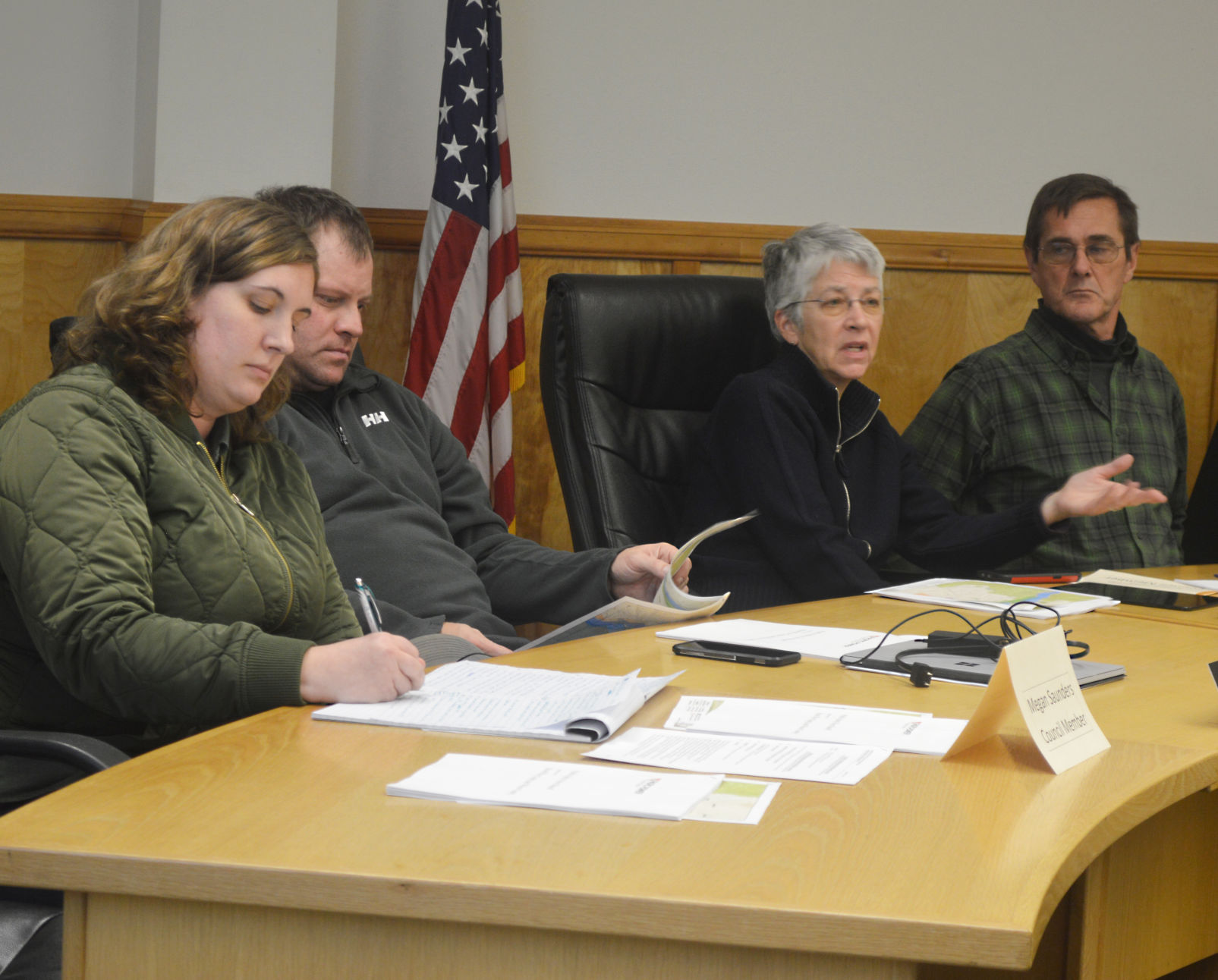
The first fire season of Pacific Power’s new Wildfire Mitigation Plan for Hood River and Wasco counties is past and, with the plan still in place and next year’s fire season already looming, a panel of Hood River elected officials sat down with Pacific Power representatives to discuss the frustrations of last fire season and the future of wildfire mitigation in Hood River County.
The Hood River City Council and the Hood River County Board of Commissioners met for a joint work session to hear from Pacific Power representatives Allen Berreth, director of transmission and distribution support, Carrie Laird, director of Northwest Field Operations, and Kari Greer, senior community relations manager.
Much of the discussion centered on one policy that has worried local elected officials and emergency management personnel alike since it was announced last May: The Public Safety Power Shutoff (PSPS).
The policy lays out a procedure for proactively shutting off the power in certain pre-identified areas in order to reduce the risk of utility-caused catastrophic wildfires.
“This isn’t reduction or elimination of all fires. We’re trying to eliminate that catastrophic fire like we’ve seen in California. That’s the risk we’re trying to narrow in on. That’s the risk we’re trying to reduce through this program,” said Berreth.
Approximately 40-square-miles in Hood River County were identified as fire high consequence areas and included into Pacific Power’s PSPS-zone.
The bulk of Pacific Power’s Wildfire Mitigation Plan involves a variety of measures intended to reduce wildfire risks, such as system maintenance, system hardening and vegetation management, and Pacific Power intends the PSPS to be “The final and last tool in the company’s toolbox, as it relates to (fire) risk mitigation” said Laird.
The PSPS would be triggered by certain extreme-risk weather conditions, such as high winds, but “there are not any single condition that drive this termination. Each situation is unique,” said Laird, adding that Pacific Power relies on “situational awareness” to determine a shutoff, and that a PSPS is an “incredibly infrequent occurrence.” Based on analysis of local weather data, Pacific Power representatives have previously stated that a PSPS would not have occurred in Hood River County anytime within the last 10 years.
In response to a question by Council Member Megan Saunders, Berreth said that system hardening could eliminate the need for the PSPS.
“So, there is a point in the future where this is something we would never have to do?” Saunders asked.
“I would say that’s the objective,” Berreth said. “It goes against a utility’s nature to say part of our plan would be to shut off power, so we very much want to be able to remove that from any plan we have.”
Pacific Power does not have a timeline in place for removing the PSPS policy from its plan, but Pacific Power has been working on isolating downtown Hood River’s electricity so that it can eventually be removed from the PSPS boundary, Berreth said, and additional system hardening measures could potentially allow Pacific Power to reduce the PSPS boundary further.
Mayor Kate McBride asked Pacific Power to come up with a timeline for when the PSPS could be removed from the Wildfire Mitigation Plan.
“If we knew it was going to be three years, then we as a community can do what we need to do,” McBride said. “If we know that it’s going to be 10 or 15 or 20 years before we can really not be in that danger, then we may have to do some other more drastic measures ourselves. I think that’s why, to get some better numbers and timeframes on your end on when you might come to a point where you feel like you aren’t going to shut anything off, would help us plan better.”
Highlights of the plan are available online at www.pacificpower.net/outages-safety/wildfire-safety/public-safety-power-shutoff.html, but one part of the communication issue is that the plan itself has been largely confidential; the city council members and county commissioners present at the Dec. 17 meeting stated that they did not receive the plan until just days before the meeting — with specific instructions not to share it — and newly-appointed Council Member Gladys Rivera said she did not receive her copy of the plan until the night before the meeting.
“The Hood River / Wasco County Public Safety Power Shutoff document that was developed by Pacific Power and in collaboration with local public safety and health authorities includes critical infrastructure and contact information. For this reason, it was agreed upon by all contributing parties to not make the document public. This was a joint decision,” said Drew Hanson, senior communications representative for Pacific Power’s parent company, PacifiCorp, in an email-statement following the meeting. Saunders requested that the sensitive information be removed so that a redacted version of the document could be shared, and Hanson has confirmed that that document is being prepared.
One of the primary concerns with the plan itself was the short timeline for notifying local emergency management and customers of an impending power shutoff: Emergency management is notified up to 72-hours in advance, customers are notified 48-24 hours in advance.
“I would like you to take input from our emergency people here in the city and the county because I think they may think that there are certain populations that need more notice than that,” said McBride. “I would strongly have you consider something that’s longer.”
The need to properly weather forecast largely limits how much notice Pacific Power is able to give. There has been talk about creating a publicly-available dashboard that allows the public to view the same weather information that Pacific Power is using to make their decisions, but Berreth expressed concerns about “creating unnecessary anxiety” by sharing too much information with customers, and said they are working to figure out how to curate information so that what is provided to the public remains meaningful.
“I would rather have customers have more information than less information,” said County Commissioner Les Perkins. “I know you are a private company, so you are used to being a little more guarded; we’re used to being pretty open with information, so it just creates this fun situation,” he said.
Since the policy was announced within Pacific Power’s Wildfire Mitigation Plan at the start of the 2019 fire season, local emergency management officials have expressed frustration about a lack of effective communication with Pacific Power that made it difficult for them to prepare the community for a PSPS.
“So far, I have been underwhelmed with the outreach,” said Perkins. “My concern is that the general public is not receiving information at all and there has been a bit of a disconnect between us and Pacific Power in terms of service providers and what we should be telling the community.”
Perkins specifically referenced a situation that occurred in California in October, when Pacific Gas & Electric initiated a PSPS in northern California that affected an estimated 2.5 million people — including the small community of Humboldt County, which was thrust into chaos during the shutoff.
“I agree with you that the lesson learned out of California was that communication was a huge component of that,” said Berreth.
Pacific Power representatives have been meeting regularly with local emergency management personnel for workshops, tabletop drills and other discussions on the plan.
“The plan will change through coordination, communication with you, with communities,” said Berreth. “We’ll figure out what needs to change within the plan and then we’ll change the plan as we move forward … this isn’t a one-time developed plan.”
Officials in Hood River and Wasco counties first heard about the PSPS from PacifiCorp on May 30, and the plan went into full effect in Hood River County on June 25; since then, Hood River Emergency Management has held weekly meetings with a coalition of nearly 30 Hood River and Wasco county agencies that have a role in emergencies, including sheriff’s departments, school districts, public health departments, local government officials and fire districts in both counties, to talk about issues and concerns about the PSPS and plan for emergency response impacts.
The coalition held four tabletop drills — one in July, two in August, and one in late September — to better understand potential response implications of a PSPS. Of these, Pacific Power representatives attended two.
Backup power has been one of the primary focuses of PSPS preparation, with both Hood River County and the Hood River Energy Council looking to acquire grant funding for microgrid, solar and battery generator studies and installations at critical facilities county-wide. The Emergency Management Department is also working to grant-fund a partnership with Columbia Gorge Community College (CGCC) to create an emergency shelter and backup emergency response site at the school’s Hood River campus.
Future prep will involve creating plans to help vulnerable populations during a significant outage, and extensive public outreach.
Pacific Power is currently preparing for the launch of their 2020 communication plan. While public meetings intended for the 2019 fire season were not held, Hanson said that they are currently planning for a spring community safety and preparedness fair in partnership with NW Natural, the Hood River office of emergency management and other local public health and safety groups. “This event will kick off a series of public meetings in each identified Public Safety Power Shutoff area in Hood River and Wasco counties,” said Hansen.
“We will continue to work in partnership, be present when called upon and deliver on our number one priority, which is delivering reliable energy while keeping our communities safe,” said Hansen.


Commented
Sorry, there are no recent results for popular commented articles.