
(Yorick Veenma via SWNS)
By Stephen Beech
One of the oldest known 3D animal fossils dating back 560 million years has been found in a sheep field.

(Yorick Veenma via SWNS)

(Yorick Veenma via SWNS)

(Yorick Veenma via SWNS)
By TalkerBy Stephen Beech
One of the oldest known 3D animal fossils dating back 560 million years has been found in a sheep field.
The astonishing discovery of the creature that looked like a "goo-filled bag" when it was alive was made in northern Norway.
Scientists say the "exquisitely preserved" fossil is the first of its kind found anywhere in Europe for decades.
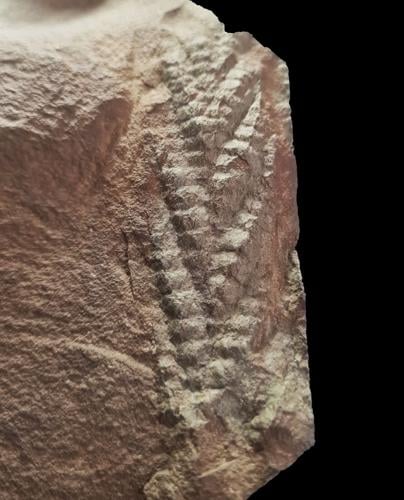
The fossil, known as Charnia, looks more like a fern than anything we would recognize as an animal today.
Researchers explained that Charnia didn't have a mouth, organs or any visible means of movement, and was essentially a "goo-filled bag" — like a sedentary jellyfish.
However, it is thought to be one of the earliest animals to exist — dating from the Ediacaran Period when complex forms of life first appeared on Earth.
Many fossils dating from that period are found as flat impressions, like a flower pressed between the pages of a book.
But the new fossil — the first confirmed Charnia find in Scandinavia — is preserved in three-dimensional detail, which scientists say is" incredibly rare" for soft-bodied organisms, especially of such an age.
(Yorick Veenma via SWNS)
By TalkerThey believe the creature was swept up in an ancient underwater avalanche and quickly buried in the seabed, filling its body with sediment while preserving its three-dimensional form.
The "extraordinary" preservation allowed researchers, led by University of Cambridge scentists, to study it in detail.
Their findings, published in the journal Palaeontology, showed that the fossil contain subtle ridges — known as "keels" — along each of its branches, a feature that hadn't been detected in other, flatter fossils.
Study lead author Yorick Veenma said: "When you see the same species preserved in a different way, you start noticing properties you hadn't seen before."
While Ediacaran fossils have been found in different places worldwide, he said the discovery of a new location in Finnmark, Norway, suggests that the earliest animals may have been far more widely spread than was previously known — and that other unexplored areas could hold similar surprises.
Veenma, from Cambridge's Department of Earth Sciences, said: "As scientists, we tend to go to the same well-known sites again and again to look for fossils like these.
"This find shows that there is still potential for discoveries in less familiar places."
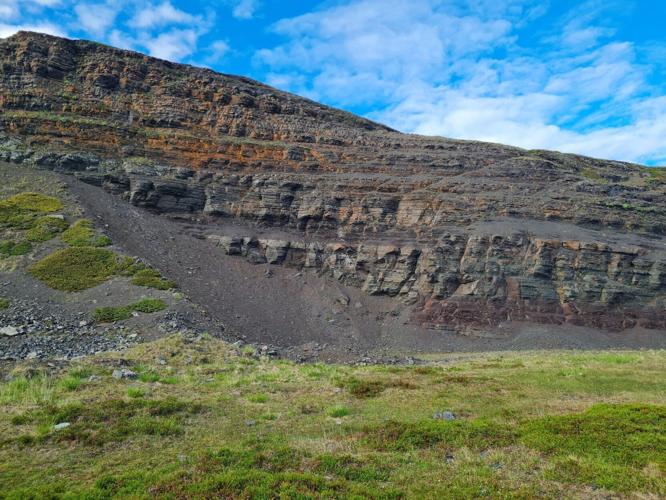
He said the region of Norway where the fossils were found is near an outcrop where hints of Ediacaran life had been seen before, such as strange anchoring structures made by organisms as they attached themselves to the ancient seafloor.
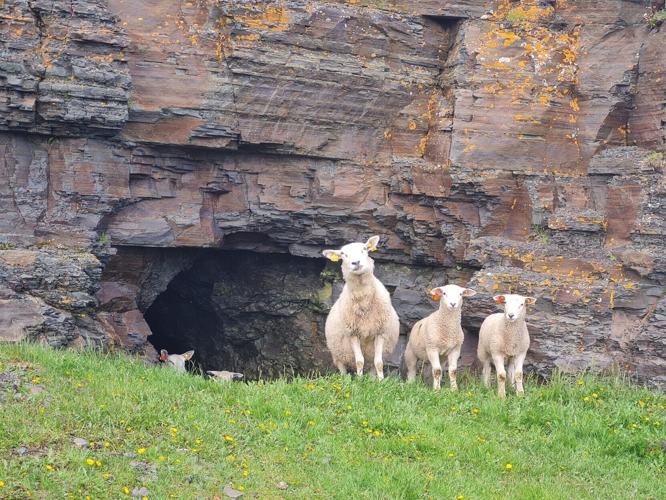
However, fossils of the organisms themselves had never been found — until a chance find in a sheep field revealed a rich new seam of fossils.
Some rocks had fallen off a cliff, split open and revealed the Charnia fossil within.
Study co-author Neil Davies, also from Cambridge's Department of Earth Sciences, said: "As a fossil record, the Ediacaran has several things working against it, primarily that most organisms were soft-bodied and skeletons hadn't evolved yet, so that they are harder to preserve.
"A lot of fossils from the period occur as impressions where they've been squashed down under layers of rock."
(Yorick Veenma via SWNS)
Veenma added: "This time period also does not have a widespread rock record.
"Fossils need to be embedded within sedimentary rocks to be found, so if the rocks themselves are less common, then that makes the fossils harder to find.
"Most Ediacaran fossils come from just a handful of locations, which makes it exciting to find them somewhere new."
As well as the Charnia, the research team also identified several other parts of the fossil ecosystem.
Davies said: "There may be a whole undiscovered community of these very early organisms preserved up there.
"Weird little umbrella-shaped blobs, things that don't fit with what people know from elsewhere.
"There are a whole host of different things that were not known before."
Originally published on talker.news, part of the BLOX Digital Content Exchange.
Information from the News and our advertisers (Want to add your business to this to this feed?)
Success! An email has been sent to with a link to confirm list signup.
Error! There was an error processing your request.
Sign up to receive notifications when a new Columbia Gorge News e-Edition is published.
Would you like to receive our news updates? Signup today!
Receive weekly updates on obituaries and death notices.
Oregon Capital Press presented by Columbia Gorge News
Receive updates on upcoming promotions and special sections.
Receive weekly updates on local sports news.


Sorry, an error occurred.
Already Subscribed!
Cancel anytime
Thank you .
Your account has been registered, and you are now logged in.
Check your email for details.
Submitting this form below will send a message to your email with a link to change your password.
An email message containing instructions on how to reset your password has been sent to the email address listed on your account.
No promotional rates found.
Secure & Encrypted
Thank you.
Your gift purchase was successful! Your purchase was successful, and you are now logged in.
| Rate: | |
| Begins: | |
| Transaction ID: |
A receipt was sent to your email.

Commented
Sorry, there are no recent results for popular commented articles.