A survey of 2,000 homeowners revealed that 20% are thinking of ending their “relationship” with their home due to changes in their financial situation (24%) and their home needing too many repairs (22%).
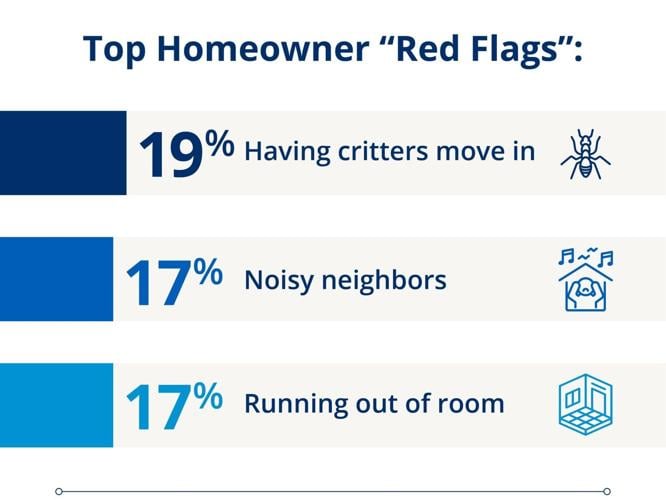
On top of that, respondents also see “red flags” in their current home, including having critters move in (19%), noisy neighbors (17%) and running out of room (17%), which all contribute to how they’re feeling about their homes.
Still, homeowners rate their current homes a 7.5 out of 10 on average and aren’t necessarily acting on these thoughts. Factors like missing memories (33%) and missing their house itself (27%) play into why people hesitate to leave their homes.
But the good news is that more flags are green than red, with some homeowners saying they are in love with their current home because of qualities like size (36%) and a perfect backyard (30%).
Nearly a quarter (24%) even state some more unique things in their home, like having a private or separate toilet in their master bedroom, as a green flag.
These green flags mirror the qualities that homeowners say are their favorite things about their current home: the backyard (40%), living room (39%) and the size of the kitchen (33%). One quarter (25%) would even go so far as to say they’d brag about their backyard.
Commissioned by Chase Home Lending and conducted by Talker Research, the study also found that two-thirds of homeowners say they still love their home as much as they did when they got it and in fact, over half of respondents (54%) can see themselves living in their current home for over 15 years.
So, what does the average American home look like? The majority of respondents (70%) live in single-family homes that are an average of about 1,900 square feet, with three bedrooms and two bathrooms.
(Talker Research)
By Talker
“Similar to the ups and downs of any relationship, owning a home is a worthwhile investment for many even though it can present challenges along the way,” said Ryan Hayes, Head of Field Sales at Chase Home Lending. “Homeownership can provide stability, independence and the opportunity to build generational wealth that can be passed down. It’s valuable for homeowners to connect with a home lending advisor throughout the homebuying process and afterwards to help them navigate the full homeownership journey, ensuring they can sustain the investment over time.”
Although some find themselves fantasizing about where they’ll live next (43%), almost half of the respondents (46%) are actually turning their current home into their dream home.
For those ambitious homeowners, projects like landscaping their yard (24%), updating the kitchen (22%), repainting the interior (20%) and changing flooring (20%) are the first steps in the transformation.
And these projects are no easy feat, as those working towards this goal say it’ll take around four years to do so.
Others aren’t as optimistic, though, stating it will take over five years (13%) or that it will never be fully completed at all (10%).
Regardless of where they stand on renovations, current homeowners describe their relationship with their home as “happy” (42%), “appreciative” (36%) and “good” (33%). And about one in 10 (11%) describe theirs as “complicated”.
“As the market fluctuates, some homeowners may feel stuck in their current homes, unable to move up due to higher rates, rising prices and other factors,” said Ryan. “Even if you’re not yet in your ‘dream home,’ there are still ways to make your current home work for you. There are many resources, tools and financing options available to make upgrades possible.”
TOP HOMEOWNER “RED FLAGS”
Having critters move in (19%)
Noisy neighbors (17%)
ââWall cracks (17%)
Running out of room (17%)
Water damage issues (16%)
TOP HOMEOWNER “GREEN FLAGS”
Fits everything I need (36%)
Perfect backyard (30%)
Separate/private toilet in master bedroom (24%)
Huge kitchen (23%)
Big closet(s) (19%)
Research methodology:
Talker Research surveyed 2,000 homeowners who have access to the internet; the survey was commissioned by Chase Home Lending and administered and conducted online by Talker Research between June 18 and June 24, 2026. A link to the questionnaire can be found here.
To view the complete methodology as part of AAPOR’s Transparency Initiative, please visit the Talker Research Process and Methodology page.



Commented