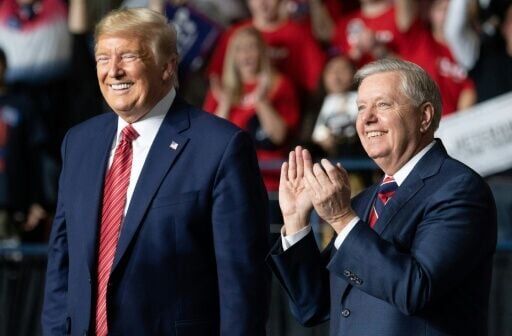
US Senator Lindsey Graham (R), one of the most loyal supporters in Congress of President Donald Trump (L), has spoken out in favor of the US strikes on Iran
A man holds an Iranian flag amid the debris of a destroyed building following airstrikes in central Tehran on March 4, 2026
-
US Senator Lindsey Graham (R), one of the most loyal supporters in Congress of President Donald Trump (L), has spoken out in favor of the US strikes on Iran
The US Senate is set to vote Wednesday on a resolution aimed at curbing President Donald Trump's authority to continue military strikes on Iran, in the first congressional test of support for a conflict launched without explicit approval from lawmakers.
The bipartisan measure, introduced by Democrat Tim Kaine and Republican Rand Paul, would require the withdrawal of US forces from hostilities against Iran unless Congress authorizes the campaign.
But with Republicans holding a 53–47 majority in the upper chamber of Congress and largely backing the president's decision to attack Iran alongside Israel, the resolution is widely expected to fail.
The vote comes five days into a rapidly expanding conflict that has already killed Iran's Supreme Leader Ayatollah Ali Khamenei and several senior figures in Tehran, while US troops have died in Iranian strikes and a drone attack on a US base in Kuwait.
Democrats argue Trump unconstitutionally bypassed Congress when he ordered the air campaign and say the administration has offered shifting explanations for the war.
"Let me say it this way, there was no presentation of any evidence in that room...that suggested that the US faced any imminent threat from Iran," Kaine told AFP after a classified briefing from administration officials.
Republicans have largely rallied behind their leader, though some have signaled their support could erode if the war expands or drags on.
"Roadside bombs coming out of Iran have maimed and killed hundreds, if not thousands, of Americans," Lindsey Graham, one of Trump's top loyalists in the Senate and a longtime advocate of confronting Iran, posted on X.
"They mean it when they say 'death to America.' I'm glad we didn't let it go further. I'm glad we didn't let them build more missiles."
- 'Knocked out' -
For the resolution to pass, Democrats would need at least four additional Republicans to join Paul if every senator votes. At least one Democrat, Pennsylvania centrist John Fetterman, has already said he will oppose it.
Even if the measure cleared both the Senate and the House -- where a vote on a similar resolution is expected Thursday -- Trump could veto it, and Congress would need an almost certainly unattainable two-thirds majority in both chambers to override him.
Governments around the world have scrambled to evacuate citizens stranded by the war in the Middle East, triggered by the US-Israeli strikes that killed Khamenei and prompted retaliatory missile and drone attacks across the Gulf.
Cities such as Dubai and Riyadh -- long seen as insulated from the region's turmoil -- have been drawn into the crisis as the conflict spreads across Iran's neighborhood.
The debate in Congress over Trump's authority to wage war reflects broader unease on Capitol Hill about the scope and duration of the military campaign.
Administration officials told lawmakers in classified briefings this week that the operation could last weeks and may require additional funding from Congress.
Lawmakers from both parties say the Pentagon could soon seek emergency funds to replenish weapons stockpiles and sustain the campaign.
The war powers resolution invokes the 1973 War Powers Act, passed after the Vietnam War, which allows Congress to force votes on military engagements and limits unauthorized conflicts to 60 days.
Democrats acknowledge the measure faces steep odds but say forcing lawmakers to take a public position on the war is essential.




Commented