
Mac Cervantes
By Stephen Beech
Tyrannosaurus rex was a late developer who kept growing until the age of 40, reveals new research.

Tyrannosaurus rex

Mac Cervantes

Tofan Teodor

Mac Cervantes
By TalkerBy Stephen Beech
Tyrannosaurus rex was a late developer who kept growing until the age of 40, reveals new research.
The largest-ever study of how the “king of dinosaurs” grew shows a much longer, slower path to adulthood than scientists previously thought.
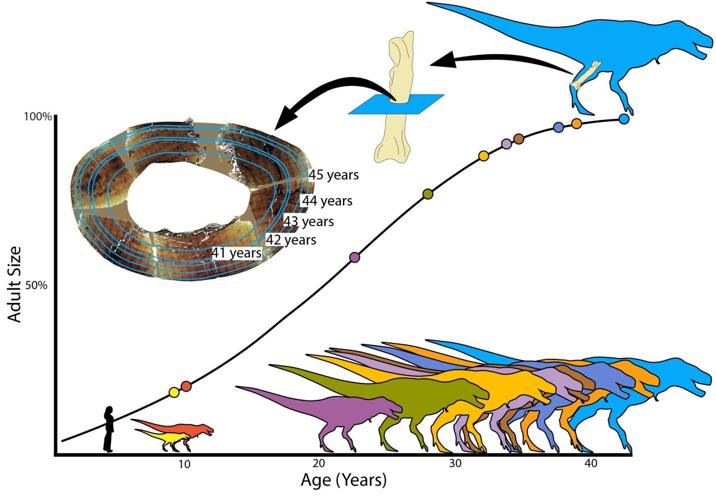
For decades, researchers have been counting annual growth rings - similar to tree rings - inside fossilized T. rex legbones to estimate how old the giant carnivores were when they died, and how quickly they grew to adulthood.
The best estimates from previous studies were that T. rex typically stopped growing at around age 25.
But the new study of 17 tyrannosaur specimens, ranging from early juveniles to massive adults, now concludes that the king of carnivores took 40 years to reach its full-grown size of around eight tons.
The analysis - the most complete life history ever conducted on T. rex - was able to assemble a more complete and accurate picture of tyrannosaurs’ growth.
Tyrannosaurus rex
By TalkerResearchers used advanced statistical algorithms and examined slices of bone under a special kind of light, which reveals hidden growth rings not counted in previous studies.
As well as extending the growth phase of Tyrannosaurus by 15 years, the results suggest that some of the specimens may not be T. rex at all, but rather members of other species or different for some other reason.
Study leader Professor Holly Woodward, of Oklahoma State University, said: “This is the largest data set ever assembled for Tyrannosaurus rex.
“Examining the growth rings preserved in the fossilized bones allowed us to reconstruct the animals’ year-by-year growth histories.”
Unlike the rings visible on a tree stump, she explained that a cross-section of T. rex bone records only the last 10 to 20 years of the animal’s life.
Dr Nathan Myhrvold, a mathematician and paleobiologist who led the statistical analysis, said: “We came up with a new statistical approach that stitches together growth records from different specimens to estimate the growth trajectory of T. rex across all stages of life in greater detail than any previous study.
“The composite growth curve provides a much more realistic view of how Tyrannosaurus grew and how much they varied in size.”
Mac Cervantes
By TalkerRather than racing to adulthood, the findings suggest that T. rex grew more slowly and steadily than previously believed.
Study coauthor Jack Horner, of Chapman University, California, said: “A four-decade growth phase may have allowed younger tyrannosaurs to fill a variety of ecological roles within their environments.
“That could be one factor that allowed them to dominate the end of the Cretaceous Period as apex carnivores.”
Although Tyrannosaurus rex is probably the best-known dinosaur species, recent studies have proposed that some specimens previously identified as T. rex may in fact be members of other related species.
For example, Some scientists have argued that certain smaller specimens represent a small-bodied species, dubbed Nanotyrannus, rather than juvenile specimens of T. rex.
Others have suggested that even the large specimens might belong to two or three different species.
But those proposals remain controversial.
Tofan Teodor
The new study, published in the journal PeerJ, includes data from 17 specimens as part of the “Tyrannosaurus rex species complex,” noting that the complex could include other species or subspecies.
An important finding of the study is that the growth curves of two of the more famous specimens- known by their nicknames “Jane” and “Petey” - are statistically incompatible with the others.
Although growth records alone can't establish whether they were separate species, the evidence suggests that possibility, among other possible explanations.
An independent analysis in a recent paper used different methods to classify Jane and Petey as each belonging to a different species of Nanotyrannus.
The new discovery that circularly polarized and cross-polarized light reveal a new kind of dinosaur growth ring helps to resolve longstanding problems reconciling the growth of some specimens.
The research team say the finding could be important in re-evaluating the growth of other dinosaur species.
Dr. Myhrvold added: “Interpreting multiple closely spaced growth marks is tricky.
“We found strong evidence that the protocols typically used in growth studies may need to be revised.”
Originally published on talker.news, part of the BLOX Digital Content Exchange.
Information from the News and our advertisers (Want to add your business to this to this feed?)
Success! An email has been sent to with a link to confirm list signup.
Error! There was an error processing your request.
Sign up to receive notifications when a new Columbia Gorge News e-Edition is published.
Would you like to receive our news updates? Signup today!
Receive weekly updates on obituaries and death notices.
Oregon Capital Press presented by Columbia Gorge News
Receive updates on upcoming promotions and special sections.
Receive weekly updates on local sports news.


Sorry, there are no recent results for popular videos.


Sorry, an error occurred.
Already Subscribed!
Cancel anytime
Thank you .
Your account has been registered, and you are now logged in.
Check your email for details.
Submitting this form below will send a message to your email with a link to change your password.
An email message containing instructions on how to reset your password has been sent to the email address listed on your account.
No promotional rates found.
Secure & Encrypted
Thank you.
Your gift purchase was successful! Your purchase was successful, and you are now logged in.
| Rate: | |
| Begins: | |
| Transaction ID: |
A receipt was sent to your email.


Commented