Thanksgiving dinner is likely to be served with a side of political disagreement
Matthew W. Kreuter, Washington University in St. Louis; Kimberly Johnson, Washington University in St. Louis, and Rachel Garg, Washington University in St. Louis
Every year as Thanksgiving approaches, news stories are written about how holiday gatherings bring together people who see the world very differently, sometimes leading to uncomfortable dinner conversations. The stories usually include advice about avoiding awkward moments and topics that are off-limits, and navigating heated conversations if they arise.
Although studies have demonstrated that Thanksgiving meals involving people with diverse political viewpoints were shorter by 24 minutes than meals among people holding similar views, we found no estimates of how often these conversations occur.
Our survey of 354 adults from 17 states found that over half – 57% – will share a Thanksgiving meal this year with at least one person from outside their household who sees the world very differently than they do. In 4 out of 5 of these cases, the way their viewpoints differ is politics.
The survey participants were initially recruited to represent differing perspectives on health; they were not randomly selected to represent the general population. That means the survey’s findings may not be generalizable beyond the study sample.
Table talk: What do Americans expect this Thanksgiving?
From Nov. 7-9, 2026, we surveyed 354 adults from 17 states about their plans for this year’s Thanksgiving. Respondents were part of an ongoing health knowledge monitoring and response system. Their mean age was 47.1 years; three-quarters of them were women; and they were racially and ethnically diverse, with 44% white, 33% African American, 15% Hispanic ethnicity and 8% another race or ethnicity. About 1 in 10 were rural residents, and 43% had children under 18 living in their home.
The questions about Thanksgiving meals were sent to 430 people on Nov. 7; 354 completed a survey, which is an 82% response rate.
Of the 354 respondents, 80% expected to share a meal with family members or friends from outside their household during the upcoming Thanksgiving holiday.
Those planning to share a meal with others from outside their household were then asked, “Holiday meals sometimes bring together people from different generations, with different views, or different life experiences. Thinking about your upcoming Thanksgiving meal, will anyone be there who sees the world very differently than you do?”
Almost 71% of those planning to share a meal with others outside their household said yes.
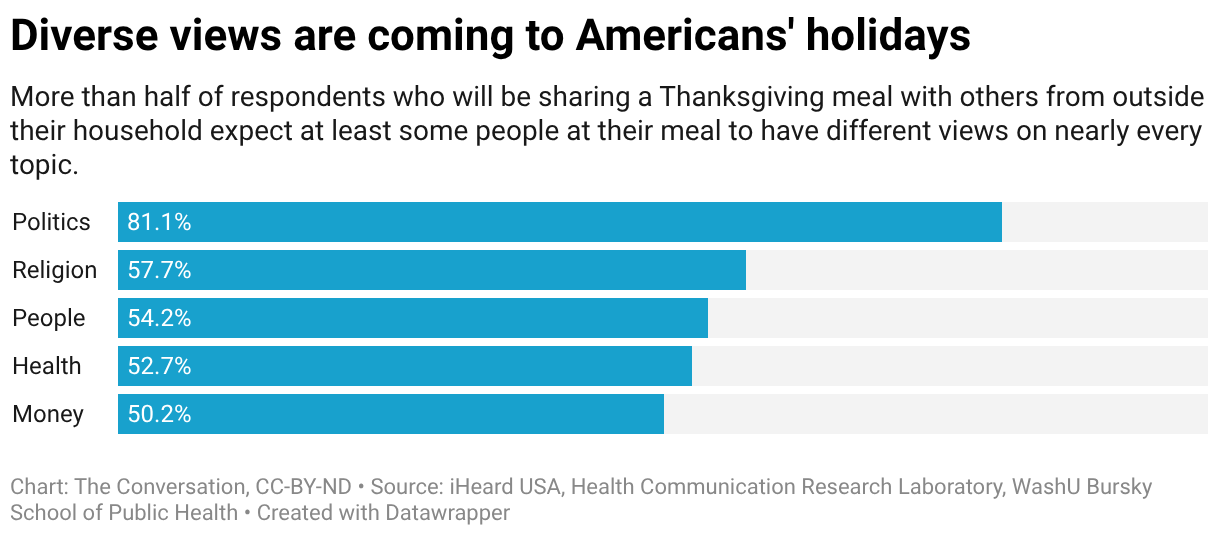
Asked “What are those differences about?” by far the most common response was politics, at 81%, followed by religion at almost 58%, differing views about people such as their career choices or relationships at 54%, health at 53%; and half of the respondents said money. A few mentioned other differences such as “raising children” and “parenting” and “gender expression” and “LGBTQ.”
Asked if they think any of those differences will be expressed during the meal, almost 60% said yes. This was especially true for differences in politics. A large majority – 79% – of respondents said that differences in politics would be expressed during the meal. Fewer respondents – 40% or less – expected that differences in views about people, money, religion or health would be expressed.
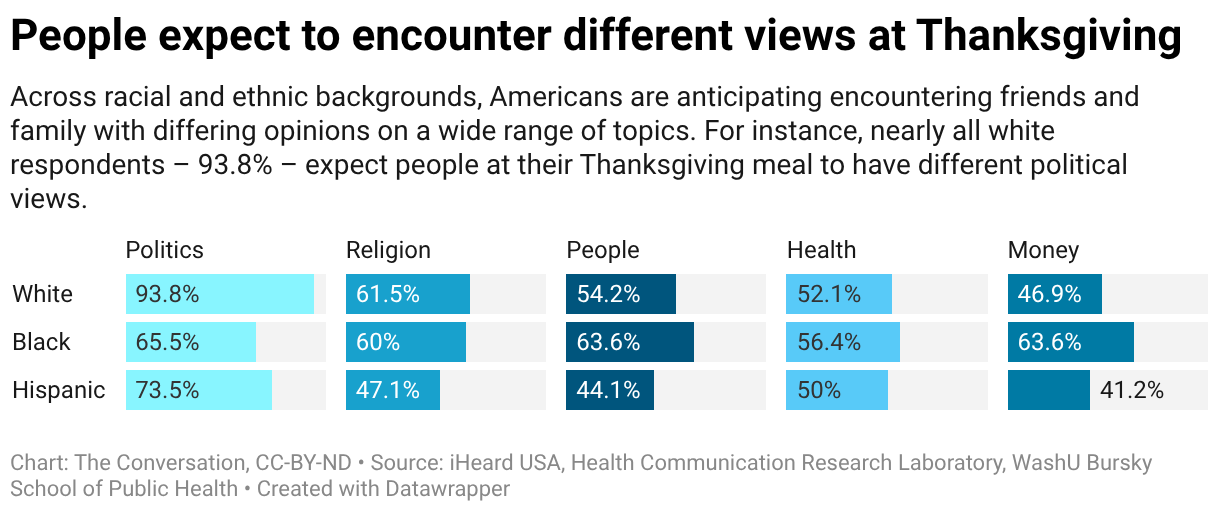
Then our questions got to who is expected to disagree – and what respondents anticipate the disagreements will be about. These responses varied by race and ethnicity.
White respondents were more likely than African American or Hispanic respondents to say that others at their Thanksgiving meal will view politics differently from them. African American respondents were more likely than White or Hispanic respondents to say that others at their meal will view money matters differently and were more likely than Hispanics to say that others at their meal will view certain people differently.
In short, it’s highly common for those gathered around any Thanksgiving table this year to have different views on key matters, but the differences you’re most likely to hear about during mealtime conversation are political.
As one panel member commented: “I don’t keep people around just because they agree with me on something. I don’t cut people away because we disagree about something.”
Matthew W. Kreuter receives funding from the National Institutes of Health.
Kimberly Johnson and Rachel Garg do not work for, consult, own shares in or receive funding from any company or organization that would benefit from this article, and have disclosed no relevant affiliations beyond their academic appointment.



Commented