
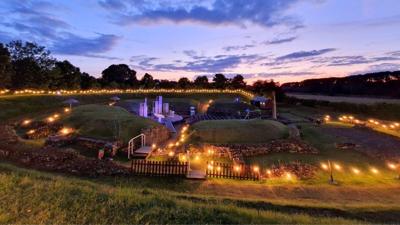

The Roman Theatre of Verulamium in St Albans glows at dusk during OVO’s summer open-air festival. Photo credit: Elliott Franks
More than 15,000 theater lovers pour into the Roman Theatre of Verulamium every summer for OVO's annual Roman Theatre Open Air Festival. Built in the year 140AD as part of the Roman city of Verulamium, now St Albans, OVO’s stage is believed to be the oldest theatre in the country still currently producing shows.
Any of these individually would be significant accomplishments, but they barely scratch the surface of the theatre’s, city’s and company’s historic triumphs. St Albans is one of the three largest Roman cities in Britain, along with London and Cirencester. The ruins of the original city date back to at least 50 BC.
The Verulamium isn’t just the oldest theater in Britain, The Telegraph named it No. 1 of the greatest surviving outdoor theaters on the British Isles two years running. Founded in 2003, OVO has staged well over 100 bold, imaginative and surprising new versions of classic plays and stories over the past 23 years.
Educator, Entrepreneur, Cultural Savior
Adam Nichols’ route to the Roman Theatre has been anything but conventional. He began as a child actor, appearing opposite Antony Sher in the Royal Shakespeare Company’s 1985 production of Richard III, where his character met a grisly end as one of the princes in the Tower.
The stage eventually gave way to a career that moved between education, public policy and entrepreneurship. Nichols founded a chain of schools across East Africa, advised Prime Ministers Gordon Brown and David Cameron on education and youth policy, and has served on the boards of education organizations in Britain and overseas.
The same instinct to build and preserve institutions followed him back into theatre. Nichols created OVO’s annual summer festival at the Roman Theatre of Verulamium, helped save St Albans’ Maltings Theatre from closure and was part of the team that transformed the former Hornsey Road Baths in London into an arts venue. In 2020, he co-founded the Coalition for Open Air Theatre, which helped persuade the British government to allow outdoor performances to resume after the first COVID lockdown.
“I don’t think there’s anywhere else really, well certainly in the UK, maybe even in the world where you can really feel that sense of history on your shoulders whether you’re a performer, creative or an audience member,” Nichols says of the Roman Theatre.
Working on a scheduled ancient monument also comes with restrictions, including a ban on putting anything into the ground for rigging or stabilization. Nichols sees those constraints differently. “Sometimes those limitations force you to be creative in ways that you might not be otherwise.”
“I like to think that the work that we’re doing flows very naturally from the historical legacy of generations of theatre going all the way back to the Romans and even before the Romans,” he says.
His work earned him a place on The Stage 100 in 2021, the publication’s annual list of influential figures in British theatre and the performing arts. Now Nichols is helping convert an 18th-century barn and sports pavilion into a permanent repertory theatre, extending OVO beyond its summer season at the Roman Theatre.
From the Egg to the Apples
Nearly 2000 years ago, when the Romans first set foot on the islands we know today as Great Britain, they were home to the Celtic tribe Catuvellauni. Not everyone took their presence well. After Boudicca burned the young city of Verlamion to the ground, the Romans rebuilt it as Verulamium. This time, they decided to convert the native tribes by bringing not just centurions and roads, but culture. Unlike other territories, however, there was no natural amphitheater, so in 140 AD, they built the first man-made stage to offer performances.
Unfortunately, as the power and influence of the Romans dwindled, so did the city and the theater. By the 4th century, the stage had become little more than a trash dumping site. Some 300 or so years after the Romans were expelled in the 5th century, King Offa of Mercia founded St Albans Abbey nearby. The theater was eventually rediscovered in 1847. An archaeological dig was begun in 1923, but the grounds were not fully uncovered until the 1930s.
Over the years, several groups carefully performed in and about the excavated theater space, careful to respect the local laws as well as any archaeological concerns. But in 2014, entrepreneur Adam Nichols and his local theatre company OVO began producing the Roman Theatre Open Air Festival every summer.
“For about 1700 years, nobody was doing anything in that space. And then we brought it back to life, only 12 years ago,” recalls Nichols when asked about the reborn theater. He thinks, perhaps, if the Romans who originally sat in the theater could come back for one night, “...they'd be surprised, hopefully, you know, pleasantly surprised that we're still performing all those centuries later.”
He notes that for the summer shows, about 60% of their audience is local, from Saint Albans and nearby Harpenden. The remaining 40% comes from farther off. Many come from London, and he points out, increasingly even farther afield.
Comedies dominate the 2026 Open Air Festival, with two Shakespeare productions, a surprisingly hilarious literary adaptation, and the classic British farce, The Importance of Being Earnest. Starting this year, the company also shares the stage with visiting theatre companies.
“What I love about working outdoors is, it really does break down the barrier between the audience and the performers… there's this communal sense that really creates a different quality to the performance, I think,” adds Nichols.
Earnest’s Importance
When Oscar Wilde penned his first draft of “A Trivial Comedy for Serious People,” in the summer of 1894, he intended to satirize what he saw as the silliness of proper Victorian society. Indeed, he referred to the play as “by a butterfly for butterflies,” recognizing his own position and culpability in the situation. Fittingly enough, the play debuted on Valentine’s Day in 1895.
While much has changed in the 130 years since then, the absurd humor and sharp ridicule of courtship and marriage conventions in the writing has kept it alive for generations. Wilde’s homosexuality that landed him in prison and disgraced his career would hardly have an eye batted at it now. But the play’s theme of superficial identity versus authentic substance resonates perfectly in this era of reality TV and social media stress.
Like all good satire, Nichols chose to adapt the play in a modified setting to hide the lesson. In this case, the Jazz Age of the Roaring 20s, adding modern songs in new arrangements: think RAYE, Madonna, Lizzo, and Eminem. That approach doesn’t always work. For every Moulin Rouge!, you have a Viva Forever! Thankfully, in this case, the songs build and enhance Wilde’s celebrated, razor-sharp dialogue. “I think Wilde would have approved,” Nichols shares. “I hope he would have approved anyway.”
Nichols also chooses to elevate the female characters. Powered by agency and confidence, they are brought to life with refreshing strength. The traditional dynamics of the text shift delightfully, with relationships pioneered as much by female courtship as male.
The show features a talented cast of actor-musicians, backed up by a live on-stage band. “Obviously we want to pick songs that we like and that we think the audience will like, and there is a certain humor in the audience recognizing songs,” points out Nichols. “Always with the music, we're trying to enhance the storytelling, so it isn't just a case of, stick that song in there because we like that song. It's got to fulfill a purpose. Often, it will replace dialogue or text.. it either fulfills the role of telling us more about a character or advancing the story, or both. In an ideal world, it's both.”
“So, there is a moment at the beginning of act two… we meet her (Cecily) for the first time, and she has kind of invented this character, Ernest, who is her, her ward, Jack's brother, really a figment of her imagination,” Nichols continues. “We've chosen to use, “Where Is My Husband” by Raye in that moment… The lyrics of that song, we feel, really reflect Cecily's mindset and mood, at that point where we meet her, and it also marks a transition from one location to another and the nature and style of that song just lend themselves really well theatrically to that transition.”
Combining drama, live music, and fabulous choreography, this is a masterful hybrid of theatre that makes for a perfect summer evening under the stars in the spectacular setting of the open-air Roman Theatre. In the spirit of Wilde’s own description, it is a production "exquisitely trivial” and "searchingly serious”, delivered with enormous wit, playfulness, and heart.
When in Verulamium
The Roman Theatre may be St Albans' oldest stage, but history has a habit of following you around town.
In the city center, 93 narrow steps lead up to the Clock Tower, the only surviving medieval town belfry in England. The climb ends with views across the rooftops, the cathedral and a city whose history stretches back to Roman Verulamium.
Professor of Anthropology and History Tim Boatswain has lived in St Albans for more than three decades, and walking the city with him quickly revealed how much of its history survives staffin everyday places.
“During the time of coaches, before motor cars, you could get out of London, and this would be your first stop,” Boatswain says. “So it has an enormous number of inns, which now, of course, are public houses. And it was said, at one point, there was one for every day of the year. I've never been able to prove that.”
Many of those old buildings still line the narrow streets around the cathedral, but now hold pubs, restaurants and shops. St Albans Cathedral dominates the city center and carries its own remarkable list of distinctions. It stands on Britain’s oldest site of continuous Christian worship and is associated with Alban, Britain’s first saint and martyr. Its 85-meter nave is the longest in England, and the Norman tower is the only cathedral tower in the country built using Roman bricks.
The pleasure of St Albans is how easily one experience runs into the next. St Michael’s Manor works particularly well for a theatre weekend because the stay becomes part of the experience. Guests can wander the path beside the hotel’s lake, linger in its five acres of gardens and return to individually designed rooms bursting with personality and dine in its orangery-style restaurant. The center of St Albans is close by, and the Roman Theatre is within walking distance.
Ye Olde Fighting Cocks, the distinctive pub beside Verulamium Park that lays claim to centuries of history, is just a short walk away. Its age may be debated, but its location makes a pre-theatre pint particularly convenient and entertaining.
By the time the Roman Theatre comes into view, the walk has already passed through centuries of St Albans’ history.
Casandra Karpiak traveled as a guest of Enjoy St Albans, which did not review or approve this article.


Commented
Sorry, there are no recent results for popular commented articles.