South Korean President Lee Jae Myung said Wednesday he had urged Chinese leader Xi Jinping to help him curb Pyongyang's nuclear programme and suggested a freeze in its development of weapons of mass destruction was "feasible" with the right conditions.
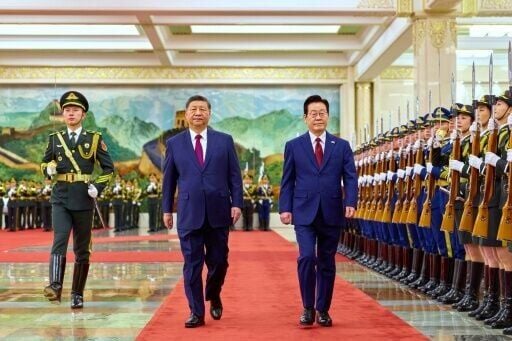
Lee's visit to China this week was the first by a South Korean leader in six years, with Seoul seeking a broad reset in relations with its largest trading partner as well as help with the recalcitrant North.
He met with Xi in Beijing on Monday -- a day after the nuclear-armed North fired two ballistic missiles into the Sea of Japan.
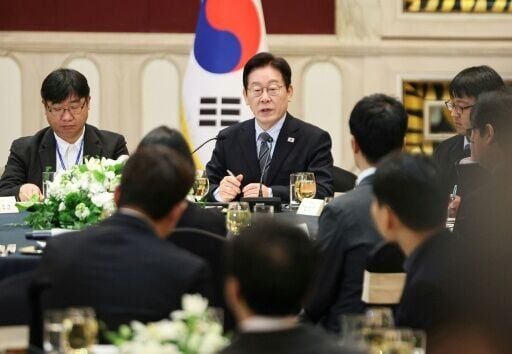
Speaking to journalists in Shanghai as he wrapped up the visit, he said he had urged Beijing's help in bringing Pyongyang back to the negotiating table.
He said he told Xi he would "like China to play a mediating role on issues related to the Korean Peninsula, including North Korea's nuclear programme".
"All our channels are completely blocked," he said.
"We hope China can serve as a mediator -- a mediator for peace," he added.
The Chinese leader in response urged Seoul to show "patience" with Pyongyang given how frayed ties between the two Koreas have become, Lee added.
"And they're right. For quite a long period, we carried out military actions that North Korea would have perceived as threatening," Lee said.
China's foreign ministry did not respond specifically to Lee's Shanghai comments when asked on Wednesday.
"Maintaining peace and stability on the (Korean) Peninsula is in the common interests of all parties. China will continue to play a constructive role towards this in its own way," spokeswoman Mao Ning told a regular press briefing.
- 'Must not give up' -
Lee on Wednesday also laid out a plan whereby Pyongyang would freeze its nuclear programme in exchange for "compensation".
"Just stopping at the current level -- no additional production of nuclear weapons, no transfer of nuclear materials abroad, and no further development of ICBMs (Intercontinental Ballistic Missiles) -- would already be a gain," he said.
"In the long term, we must not give up the goal of a nuclear‑free Korean Peninsula," he added.
North Korea has repeatedly declared itself an "irreversible" nuclear state and relations between the two Koreas have fallen to their worst levels in years.
Lee's predecessor, ousted last year for a failed bid to suspend civilian rule, stands accused of having tried to provoke Pyongyang as a pretext for declaring military rule.
On Monday, Pyongyang said its nuclear forces were ready for war and that it was keeping a close eye on "the recent geopolitical crisis" in an apparent nod to this weekend's US attack on Venezuela.
That operation represents a nightmare scenario for North Korea's leadership, which has long feared a so-called "decapitation strike" of that kind and accused Washington of seeking to remove it from power.
Pyongyang has for decades justified its nuclear and missile programmes as a deterrent against alleged regime change efforts by Washington.
And it has stepped up missile testing significantly in recent years.
Analysts say this drive is aimed at improving precision strike capabilities, challenging the United States as well as South Korea, and testing weapons before potentially exporting them to Russia.
Lee said Monday that he wanted to open a "new phase" in relations with China, "based on the trust" between himself and Xi.
Seoul has for decades trodden a fine line between China, its top trading partner, and the United States, its chief defence guarantor.
It has also stayed out of a diplomatic spat between Beijing and Tokyo triggered when Prime Minister Sanae Takaichi suggested that Japan could intervene militarily if China were to attack Taiwan.
On Wednesday, Lee told reporters "relations with Japan are just as important as relations with China".



Commented