
Photo by Atlantic Ambience via Pexels
By Stephen Beech
Strawberries keep fresher when dipped in a coating made from seaweed, according to a new study.

(Clare Kiernan/UBC via SWNS)

(Clare Kiernan/UBC via SWNS)
Sunny to partly cloudy. Areas of smoke and haze are possible, reducing visibility at times. High around 85F. Winds WNW at 10 to 15 mph..
Mainly clear skies. Areas of smoke and haze are possible, reducing visibility at times. Low 59F. Winds W at 5 to 10 mph.
Updated: August 11, 2026 @ 9:46 am

Photo by Atlantic Ambience via Pexels
By Stephen Beech
Strawberries keep fresher when dipped in a coating made from seaweed, according to a new study.
The edible coating can keep the popular summer fruit fresh for at least four days at room temperature, outperforming uncoated berries stored in a fridge.
The revolutionary dip was developed by researchers at the University of British Columbia (UBC) in Vancouver, Canada.
They say the agar-based coating could help cut spoilage, large-scale food waste and reliance on refrigeration.
The researchers said nearly half of all food produced in Canada is lost or wasted, costing the economy billions each year.
Fresh fruit and vegetables are particularly vulnerable to spoilage, losing moisture and becoming susceptible to mold and bacteria during storage and transport.
But the new coating, described in the Journal of Agricultural and Food Chemistry, offers a simple approach for extending produce shelf life and reducing reliance on refrigeration across the supply chain.
Study senior author Tianxi Yang said: "We wanted to find a simple alternative to cold storage.
"Once we added the coating, the fruit became far less sensitive to changes in temperature and moisture and stayed fresh longer."
(Clare Kiernan/UBC via SWNS)
By TalkerShe said the coating is made from agar, a substance derived from red seaweed that is widely used as a vegan alternative to gelatin and as a thickener in foods like puddings and jellies.
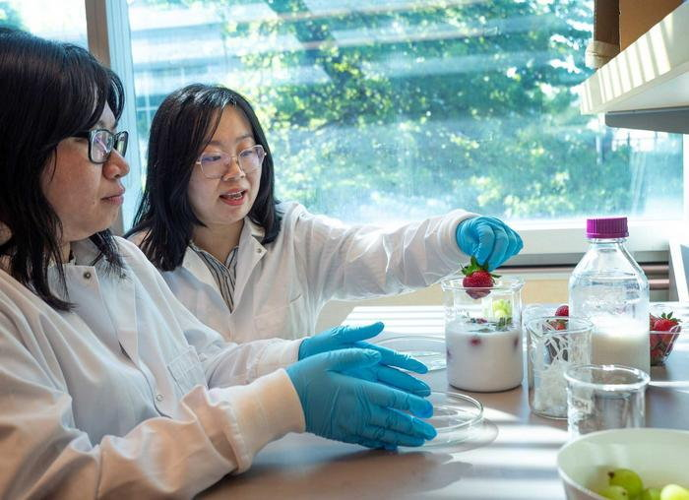
On its own, agar forms a thick gel, but when the research team combined it with zinc, an essential nutrient, and tannic acid, a naturally occurring plant compound found in grapes and tea, the material transformed - self-assembling into tiny microparticles that create a thin protective layer around the fruit.
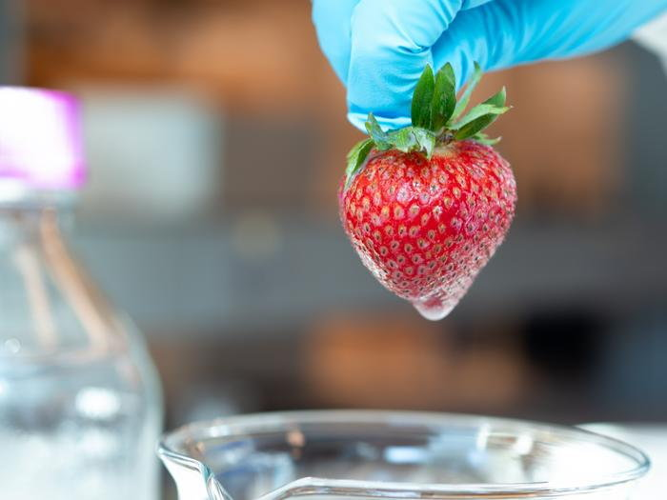
When dipped in the solution, strawberries, grapes and apple slices emerged with a thin, edible coating that dried completely clear.
Study lead author Ivy Chiu, a doctoral student at UBC, said: "It was exciting to watch the particles self-assemble in real time, from a cloudy, milky liquid into this incredibly uniform, protective layer.
"To our knowledge, no one had made an agar-based microparticle coating like this before."
Over four days at room temperature, she said coated strawberries lost less than half as much water as uncoated fruit and remained noticeably firmer, with more vitamin C and antioxidants preserved.
Grapes and apple slices showed similar benefits, with improvements lasting 14 days and 24 hours, respectively.
By comparison, untreated strawberries stored at room temperature began developing mold within two days, while refrigeration only extended their shelf life slightly - most untreated berries began to deteriorate by the fourth day.
Coated strawberries stored without refrigeration remained mold-free for at least four days, while those stored in the fridge stayed fresh for at least six days.
(Clare Kiernan/UBC via SWNS)
By TalkerThe coating also showed antibacterial properties and no signs of toxicity in tests using human intestinal cells.
The researchers said that people who prefer to remove the coating before eating can wash most of it away with tap water within two minutes.
A life-cycle assessment found that the coating has a 14% lower carbon footprint than conventional refrigeration and reduces freshwater ecotoxicity by about 85%, largely by reducing reliance on the electricity and refrigerants required for cold storage.
To assess its potential for real-world use, the team replaced lab-grade agar with commercially available food-grade agar.
The results remained consistent, with coated strawberries showing reduced moisture loss and spoilage while maintaining quality.
Yang added: "Our hope is to help keep produce fresh for longer throughout the food system.
"If we can reduce spoilage during storage and transportation, we can reduce food waste while using less energy to preserve food."
The researchers are now testing the coating on additional fruits and vegetables and investigating how it could be scaled, tested and integrated into commercial food systems.
Originally published on talker.news, part of the BLOX Digital Content Exchange.
Information from the News and our advertisers (Want to add your business to this to this feed?)
Success! An email has been sent to with a link to confirm list signup.
Error! There was an error processing your request.
Sign up to receive notifications when a new Columbia Gorge News e-Edition is published.
Would you like to receive our news updates? Signup today!
Receive weekly updates on obituaries and death notices.
Oregon Capital Press presented by Columbia Gorge News
Receive updates on upcoming promotions and special sections.
Receive weekly updates on local sports news.


Sorry, an error occurred.
Already Subscribed!
Cancel anytime
Thank you .
Your account has been registered, and you are now logged in.
Check your email for details.
Submitting this form below will send a message to your email with a link to change your password.
An email message containing instructions on how to reset your password has been sent to the email address listed on your account.
No promotional rates found.
Secure & Encrypted
Thank you.
Your gift purchase was successful! Your purchase was successful, and you are now logged in.
| Rate: | |
| Begins: | |
| Transaction ID: |
A receipt was sent to your email.
Commented