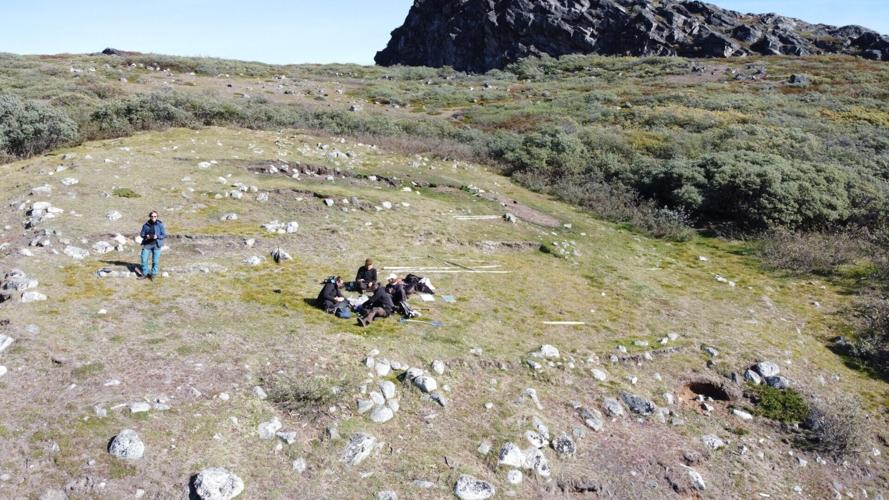
The authors during their fieldwork on Greenland. (Louise Hindborg Mortensen via SWNS)
By Talker
By Stephen Beech
Microbes frozen for thousands of years in ancient rubbish heaps have helped reconstruct early Greenlanders' farms, seal hunts and toilets.
The thawing waste dumps — known as middens — are revealing their secrets as the Arctic warms up to four times faster than the global average, say scientists.
Human settlements on the world's largest island, 80% of which is covered by a massive ice sheet, date back around 4,500 years with the first being several Paleo-Inuit cultures.
Descendants of Vikings inhabited Greenland between the 10th and 15th centuries, while Danes have lived there since 1721.
All left their traces on the landscape, for instance in the form of ancient domestic rubbish heaps.
Composed of waste — including animal bones, excrement, mollusc shells, and human artifacts — the dumps have proved a precious resource for modern archaeologists.
"Rather, we found that these middens in the cold Arctic acted like long-term natural experiments.
"Human- and animal-associated bacterial signals, including opportunistic bacteria and bacteria carrying antibiotic resistance genes, have remained detectable in them many centuries later as the legacy of human activity: for example, livestock farming by the ancient Norse."
In 2020 and 2021 in West and South Greenland, Aarestrup and his colleagues collected samples from several middens frozen in time by permafrost and covering 4,500 years of human life on Greenland.
At ancient Norse sites, including at Kapisilit and Narsarsuaq, they also collected soil samples from historic winter enclosures and summer grazing grounds for livestock.
The research team used DNA sequencing to reconstruct entire bacterial communities.
They compared their findings to those in 143 soil samples from areas of permafrost distant from any historical settlements.
The sequencing revealed between nine and 202 bacterial species per midden, for a total of 1,207 species.
Many of the species were previously undescribed and could only be assigned to broad taxonomic categories.
Middens had "significantly richer" bacterial communities than surrounding pristine soils, confirming that they preserved the biological legacy of human activity.
Middens from the Paleo-Inuit had the most soil-like bacterial communities, indicating that the microbial imprint from humans and animals diminishes over time.
Groups of bacteria known to live on or within animal and human hosts predominated in most middens, according to the findings published in the journal Frontiers in Microbiology.
(Photo by Lara Jameson via Pexels)
These included harmless bacteria from human feces such as Clostridium massilliamazoniense, Clostridium baratii which can cause botulism, and Paeniclostridium sordellii, which can cause life-threatening human diseases including toxic shock syndrome, sepsis, and gas gangrene.
The researchers said bacterial communities depended strongly on the type of waste material in each midden.
For instance, those from the early colonial era contained decomposing seal skins and were rich in the bacterium Clostridium perfringens, a major cause of food poisoning.
Romboutsia species and Paraclostridium sordellii — which live in the gut of many animals — were abundant in middens filled with animal carcasses, while early Norse middens with decomposing bones were rich in unknown species of Proteobacteria and Clostridiaceae.
The research team also found a huge diversity of genes associated with antimicrobial resistance in bacterial genomes from middens.
The presence of the same genes in ancient and contemporary soil layers signaled that microbes resistant to antimicrobials can linger in permafrost for centuries.
But the researchers concluded from the spatial distribution of the pathogens that they don't spread far from thawing middens, so they appear to pose little risk to public health — at least for now.
Study co-author Saria Otani, an associate professor at the National Food Institute, said: "The microbiome in thawing permafrost appeared to be rapidly replaced by local contemporary environmental microbes once released into run-offs."
But Anders Priemé, a professor at the University of Copenhagen, added: "It is not known whether the risk of release of pathogens will increase with increasing temperatures, or whether this might be greater in other Arctic regions.
"For this reason, it would be prudent to include microbiome characterization as a routine monitoring aspect during archaeological visits."



Commented
Sorry, there are no recent results for popular commented articles.