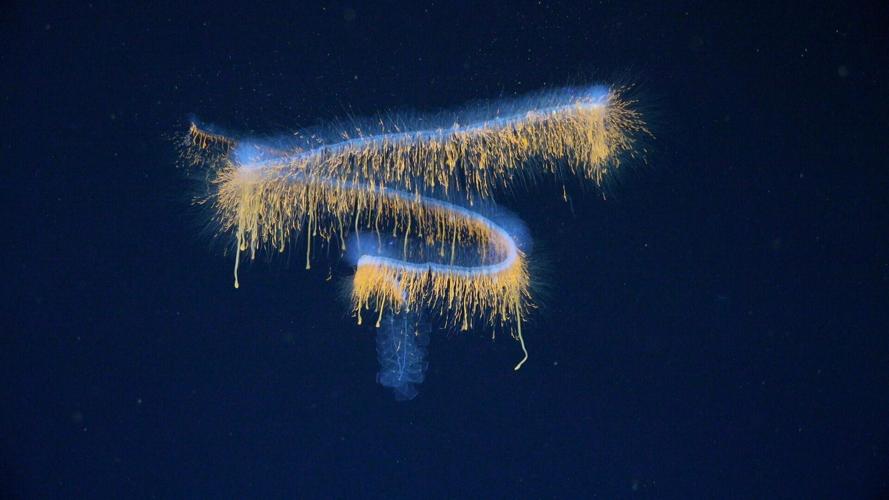
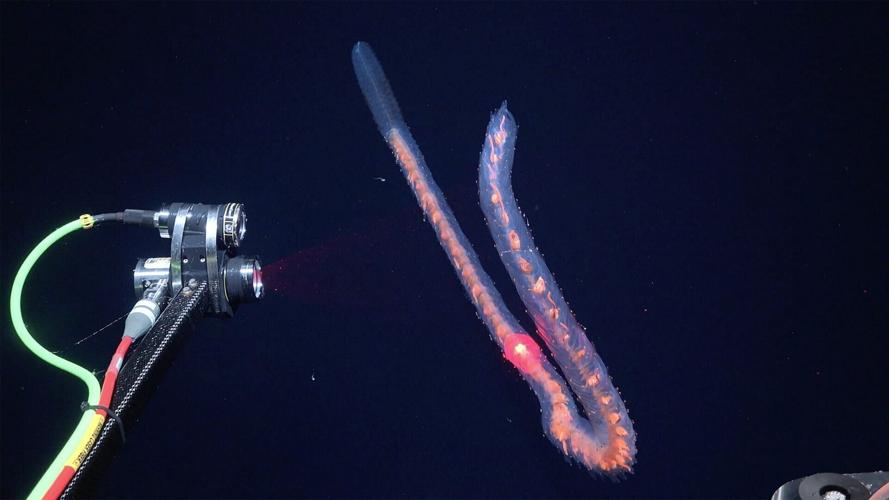
A siphonophore — a colonial marine invertebrate related to jellyfish — is scanned using Deep Particle Image Velocimetry (DeepPIV) at a depth of 930 meters. (ROV SuBastian/Schmidt Ocean Inst via SWNS)
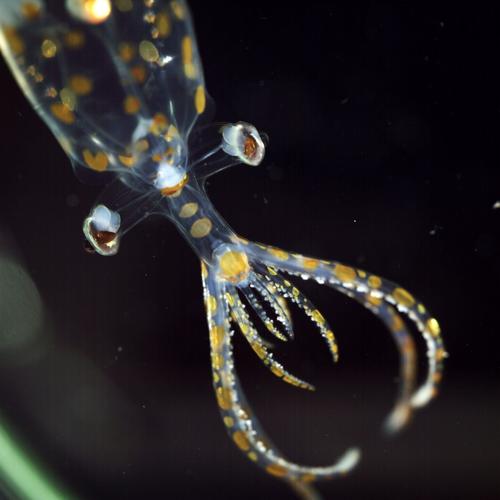
A juvenile glass squid. (Emily Clark/MBARI/Schmidt Ocean via SWNS)
By Talker
The scientists used advanced technologies to explore the ocean’s midwater — the water between the sunlit layer and the seafloor — which is Earth’s largest and least explored habitable ecosystem.
Schmidt Ocean Institute said it can take scientists decades to identify and describe new species, but the combination of technology and expertise enabled the team to confirm these species as new within a matter of days.
The list consists of an amphipod, a type of crustacean related to crabs and lobsters; a gossamer worm that moves faster than scientists expect based on its body shape; and nine new jellyfish.
A siphonophore — a colonial marine invertebrate related to jellyfish — is scanned using Deep Particle Image Velocimetry (DeepPIV) at a depth of 930 meters. (ROV SuBastian/Schmidt Ocean Inst via SWNS)
By Talker
There are also seven siphonophores, colonial organisms related to jellyfish and corals; seven comb jellies, or ctenophores, famous for the glittering cilia they use to swim; four larvaceans, tadpole-like creatures that live in mucus houses and are more closely related to humans than invertebrates; and two giant rhizarians, single-celled organisms visible to the naked eye.
Dr. Karen Osborn, of the Smithsonian National Museum of Natural History and the expedition’s chief scientist, said: "The largest habitat on Earth, the midwater, is filled with incredible animals we are only just starting to understand.
"I continue to be fascinated by the fantastic variety of solutions they have evolved to survive in this formidable environment, and that drives me to keep asking questions about our ocean."
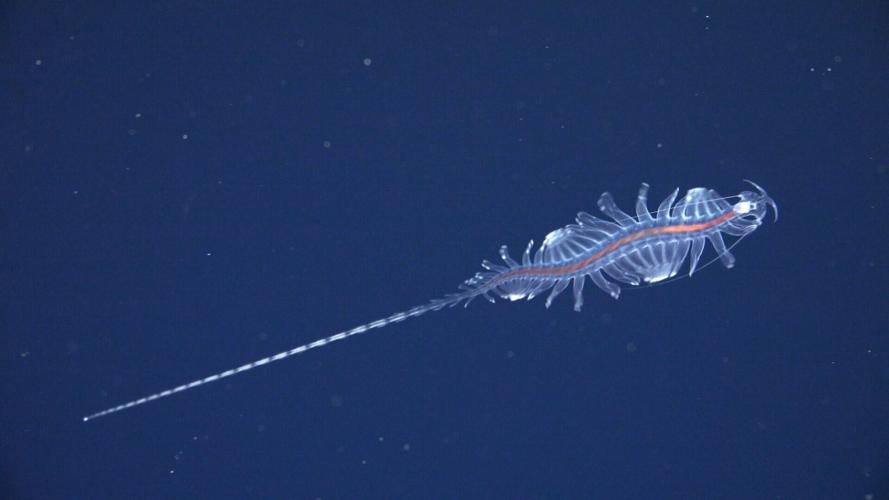
This is a new species from the genus Tomopteris, commonly known as gossamer worms. (ROV SuBastian/Schmidt Ocean Inst via SWNS)
By Talker
The team witnessed far more diversity and abundance of midwater organisms than they expected, said Osborn, including glass squid and a pelagic octopus feeding on a bright red jellyfish.
Jyotika Virmani, Schmidt Ocean Institute’s executive director, said: "The novel suite of technologies on this cruise is a glimpse into the future of marine biological science.
"Schmidt Ocean Institute’s mission is to push technological advancement, and this was our third cruise in collaboration with this team of scientists and engineers to test and further develop this innovative midwater equipment.
"We look forward to a future in which scientists study marine life as elegantly as this team did – and in virtual reality."
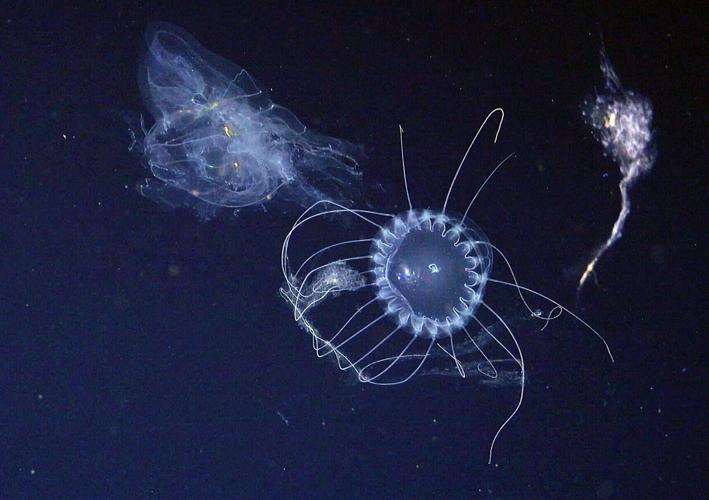
A Solmissus, or dinner plate jellyfish, preys upon a ctenophore, commonly known as a comb jelly. (ROV SuBastian/Schmidt Ocean Inst via SWNS)



Commented
Sorry, there are no recent results for popular commented articles.