
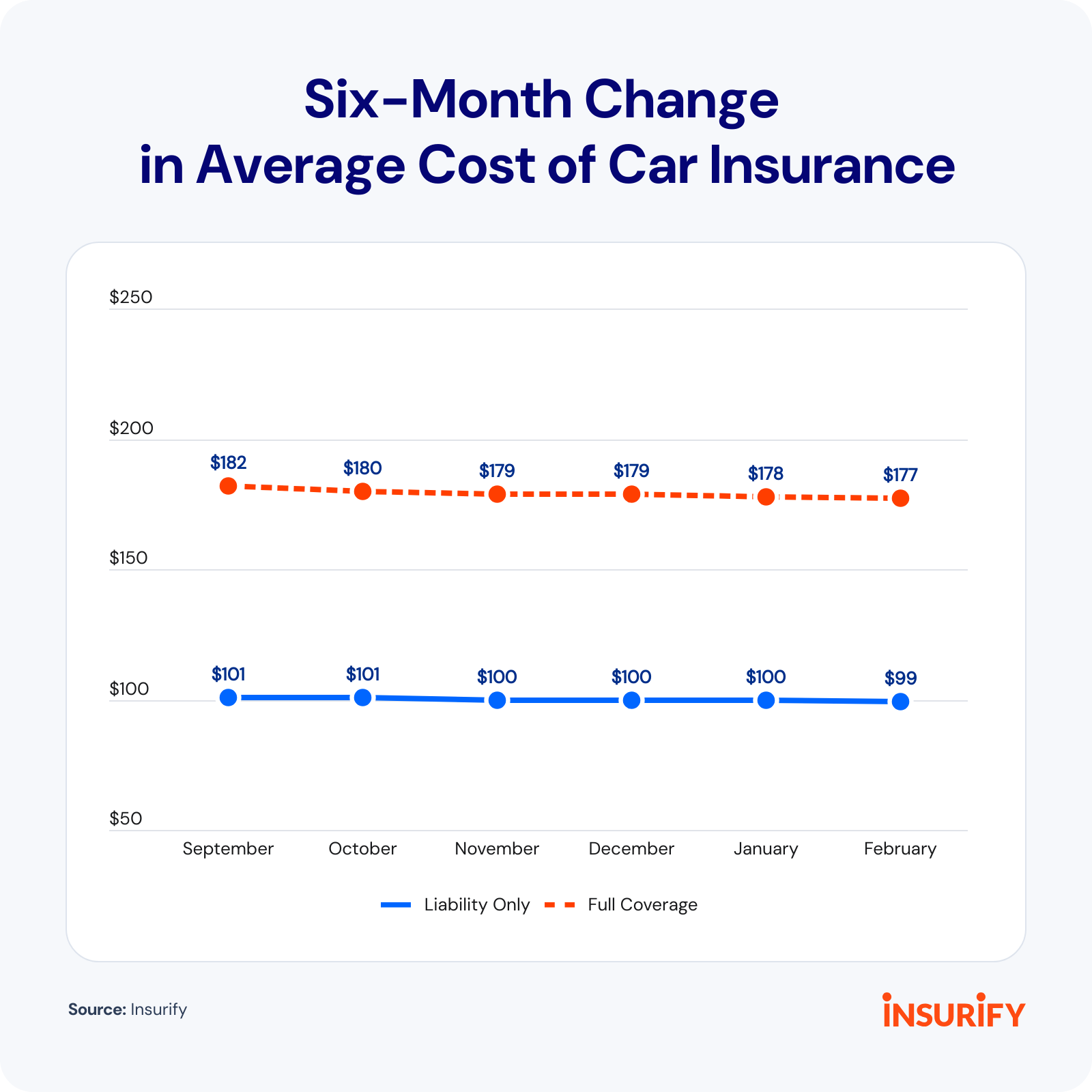
Car insurance rates have continued declining throughout 2026. In February, the national average rate for full-coverage car insurance fell from $178 per month to $177, according to Insurify data. The national average liability rate fell from $100 to $99.
Average cost of car insurance by state as of March 2026
Insurance rates can vary greatly based on location, which influences factors like exposure to extreme weather, repair costs, traffic congestion, and vehicle crime rates.
Here are the monthly averages for full and liability coverage across the country.
5 states with the highest car insurance rates as of March 2026
Washington, D.C., remains the most expensive location for car insurance in the nation.
Maryland, Rhode Island, and New Jersey also show that rates remain high in the Northeast. South Carolina returns to the top five, replacing New York.
5 states with the lowest car insurance rates as of March 2026
New Hampshire retains the top spot for the most affordable car insurance, with rates well below the national averages of $99 per month for liability and $177 per month for full coverage. North Dakota appears on the list for the first time, replacing North Carolina.
Factors that affect car insurance rates
Car insurance rates can vary significantly among drivers based on many factors that insurers use to estimate risk. Some common rating factors include:
Driving history: Insurers consider whether a driver has a clean record or infractions such as speeding, driving under the influence (DUI), or causing an accident.
Age: Driving experience and accident risks closely correlate with age, actuarial data shows.
Gender: Statistically, women are less likely than men to cause accidents and engage in risky behaviors like aggressive driving.
Location: Where a policyholder lives and drives affects their exposure to risk factors such as extreme weather, vehicle crime rates, and accident rates.
Credit history: Data indicates that drivers with better credit are less likely to file car insurance claims than those with poor credit.
Vehicle make and model: Vehicles that are less expensive or have multiple safety features cost less to insure.
Vehicle usage: Driving fewer miles per year reduces a vehicle’s exposure to the day-to-day risks of driving.
Vehicle equipment: Safety features like lane-keeping assist and blind-spot warning can help decrease the risk of accidents.
Coverage type: Generally, liability-only coverage costs less than full-coverage car insurance.
Coverage limits: The amount of coverage you buy affects annual premiums. Minimum coverage is typically the cheapest but doesn’t offer enough financial protection for most drivers.
Deductible: A higher collision and comprehensive coverage deductible (liability coverage has no deductible) reduces rates, as the insurer assumes less risk for the cost of repairs.
How to save on car insurance
Every state except New Hampshire requires drivers to carry a minimum amount of liability coverage. Insurance professionals recommend buying more coverage for greater financial protection in the event of an at-fault accident. And if a driver leases or finances a vehicle, the leasing company or lender will require them to buy full-coverage car insurance.
Drivers can take the following steps to reduce the cost of car insurance:
Drive safely. Avoid speeding, hard braking, distracted driving, and other risky driving behaviors that could cause a claim.
Look for discounts. Most insurers offer discounts, such as good student or multi-car discounts, that can help reduce premiums.
Increase the deductible. A higher collision and comprehensive deductible typically leads to lower rates.
Adjust coverages. Liability-only coverage is the cheapest insurance available, and minimum coverage is the cheapest liability option. But drivers should be careful and buy enough coverage to adequately protect themselves financially.
Comparison shop. Drivers should compare rates from multiple companies every time their policy comes up for renewal.
Related articles
Methodology
Insurify data scientists analyzed more than 97 million rates from car insurance applications in Insurify’s proprietary database to calculate the premium averages displayed on this page. These premiums are real quotes that come directly from Insurify’s 50+ partner insurance companies in all 50 states and Washington, D.C. All premium averages reflect the cost of car insurance for drivers between the ages of 20 and 70 with a clean driving record and average or better credit.
For most states, full-coverage premium prices represent two-year rolling medians in order to manage extreme market volatility seen over the past few years as insurance companies have sought substantial rate increase approvals and deprioritized writing new policies in the face of rapidly rising costs.
Liability-only premium prices — as well as full-coverage prices in Maine, Massachusetts, Michigan, Montana, North Dakota, Nebraska, New Hampshire, New Jersey, and Vermont — represent one-year rolling medians.
Liability-only premium averages correspond to policies with the following coverage limits:
Bodily injury limits between state-minimum rates and $50,000 per person, $100,000 per accident
Property damage limits between $10,000 and $50,000
No additional coverage
Full-coverage premium averages correspond to the same bodily injury and property damage limits in addition to:
Comprehensive coverage with a $1,000 deductible
Collision coverage with a $1,000 deductible
For full-coverage historical data, please visit Insurify’s Auto Insurance Data Center. Data housed in the Data Center dates back to 2021 and represents the average yearly cost of full coverage for drivers between the ages of 20 and 70 with a clean driving record and average or better credit.
Monthly prices are based on two-year rolling averages in order to manage extreme market volatility seen over the past few years. Insurance companies have sought substantial rate increase approvals and deprioritized writing new policies in the face of rapidly rising costs.


Commented