
MOVER grant will bring infrastructure to district
HOOD RIVER — Hood River County School District had three reasons to celebrate at the Aug. 30 board meeting.
“Over the past couple of weeks, we have received some really good news with a couple of grant applications that were submitted in the spring of 2023,” said Superintendent Bill Newton.
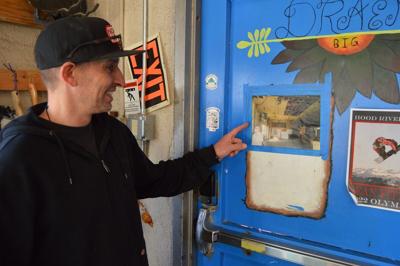
The first, a Youth Reengagement Grant for $250,000 was awarded to Hood River Valley High School’s Community Works program housed in the old Hood River Fire Department firehouse on Wilson Street. There, students work on projects ranging from building skateboards and a tiny home to making mosaics and jewelry, catch up on homework and get help with college applications.
While anyone is welcome to sign up for the program, Community Works “supports students who are disengaged and/or at risk of not completing high school,” Newton said. The grant “will be used to support an instructional assistant and a parapro position, as well as supplies, materials and transportation.”
Community Works teacher Pete Lawson, CTE (Career and Technical Education) Coordinator Ashley Fogle and former HRVHS Assistant Principal Nate Parson worked with grant writers Claire Rawson and Paul Lindberg to apply and “were instrumental in writing and receiving this grant,” Newton said.
The second, a 21st Century Grant for $425,000 over the next five years, means the district will be able to continue offering EXCEL after-school care programs at Parkdale, Mid Valley and Cascade Locks elementary schools and Wy’east Middle School. Adrienne Acosta, Cascade Locks principal, also worked with Rawson and Lindberg to write the application.
“Claire and Paul are supported by the United Way and Providence,” Newton said. “We are so fortunate to have collaborative partners within our community.”
District officials recently learned HRCSD has been awarded a $1,000,000 MOVER grant from the Department of Energy and an additional $200,000 from Pacific Power. Director of School Safety and Security Kyle Rosselle, with Joseph Wachunas and Kevin Carbonnier of New Buildings Institute (NBI), said the three-year MOVER project is one of the first in the nation to combine electric school buses with a microgrid, which will be located at Wy’east.
NBI is a national nonprofit based in Portland and will manage the project. Wachunas said they met with grant officers in July and were encouraged apply for another large grant to pay for portions of the proposed microgrid and to help increase the size of the solar array from the Oregon Community Renewable Energy Grant Program. The board unanimously voted to go forward with the process.
“We’ve been working with partners in Hood River for a while, kind of dreaming up this project, having conversations with Kyle over a couple years on the idea of helping Hood River begin to electrify its fleet as well as potentially bringing in some innovative project elements like solar panels and EV charging, and potentially a microgrid,” Wachunas said.
Wy’east will be the focal point, with expanded solar powering a microgrid — “a piece of the building that can island itself when there’s a power shutoff and have electrical power to serve as a ready resilience hub” — as well as produce electricity. Wy’east will additionally have an EV charging station, as would the Coe building and the district’s bus barn.
“From the transportation aspect, we really need to have our infrastructure set [to support electric buses],” Rosselle said. “Getting the power and the conduits and the charging stations and everything in place, to me, is the most critical and probably one of the most difficult pieces … Once we’re set, then the procurement of electric buses will happen naturally as we look to upgrade.”
“Transportation is moving towards electrification and this is definitely true with electric school buses,” Wachunas said. “There’s a lot of momentum towards electric school buses; the federal government has put forth $5 billion of funding to help fleets electrify, and this grant is a way to help Hood River County School District begin the process of electrifying it’s school buses — it won’t cover everything, but it helps with the charging infrastructure that you’ll need and the first couple of electric vehicles.”
The first year will include stakeholder meetings to design the project, as well as exploring options such as leasing larger buses instead of buying them outright.
“We’re very open to ideas. Nothing is concrete, nothing is set on this project and that’s by design, so that we can make sure that it’s the best that it can be for everyone involved,” Wachunas said.
“To be able to get the support through a grant where we’re not having to pay out of pocket for it is wonderful,” said Board Member Corinda Hankins Elliott (position 3).
“If the federal government is willing to invest $5 billion in this, that says a lot. That speaks volumes as to where we’re headed,” said Board Member Barb Hosford (position 2).
MOVER partners are: Lead, New Buildings Institute, Hood River County School District, Columbia Willamette Clean Cities Coalition and PAE Engineers; technology, Forth, Oregon Clean Power Coop, Bonneville Environmental Foundation and Electric School Bus Newsletter; local, Mid-Columbia Economic Development District, Hood River County and Hood River Energy Council; and utility, Hood River Electric Coop and Pacific Power.


Commented
Sorry, there are no recent results for popular commented articles.