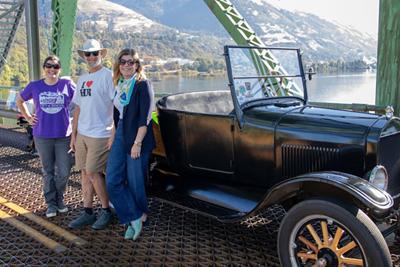
From left to right, Bingen Mayor Catherine Kiewit, Hood River Mayor Paul Blackburn and White Salmon Mayor Marla Keethler stand in front of Arthur Babtiz’s Model-T car during the bridge’s 100th anniversary celebration (two months early) on Oct. 6, 2024.
From left to right, Bingen Mayor Catherine Kiewit, Hood River Mayor Paul Blackburn and White Salmon Mayor Marla Keethler stand in front of Arthur Babtiz’s Model-T car during the bridge’s 100th anniversary celebration (two months early) on Oct. 6, 2024.
THE GORGE — The years-long effort to replace the Hood River Bridge reached an historic milestone July 18 as Hood River-White Salmon Bridge Authority commissioners approved a memorandum of agreement (MOA) ensuring the project’s compliance with the National Historic Preservation Act.
Section 106 of that law requires federal agencies to consider, and in some cases mitigate, the effects of projects on historic properties. Constructed in 1924 when Ford Model Ts ruled the road, the Hood River Bridge is an historic structure.
“This has been a long time coming,” said Klickitat County resident Jacob Anderson, who co-chairs the bridge authority with Hood River resident and former Hood River Port commissioner Mike Fox. “Staff has done an amazing job getting this across the finish line. Congratulations, everyone.” Approval of the MOA came on motion by former Hood River mayor Arthur Babitz, seconded by Klickitat County resident Eric Wilson.
The MOA encompasses multiple federal, state and local entities, including the Federal Highway Administration, Oregon and Washington historic preservation agencies, Oregon Department of Transportation, the Cities of Hood River and White Salmon, Klickitat and Hood River counties and the bridge authority itself. The MOA identifies specific mitigation strategies for bridge replacement. Compliance keeps the door open for federal funding, with a $532 million request pending before the federal Department of Transportation.
Wilson described the MOA as “the first of several agency sign-offs that approve the conceptual bridge replacement approach.”
“All of this will culminate in the National Environmental Policy Act Record of Decision, critical to informing the detailed design process and planning the construction methodology,” Wilson added.
Friday’s approval by the bridge authority leaves one final signature pending, from Oregon Department of Transportation’s Region 1. ODOT is reviewing the MOA now, said Michael Shannon, the bridge authority’s project director.
Mitigation requirements include formation of an advisory committee on mitigation strategies; creation of a museum exhibit on the existing bridge; development of an illustrated publication “on the history of Columbia River crossings between Oregon and Washington from approximately the Bonneville Dam east to where the Columbia extends solely into Washington at the Wallula Gap,” to include ferry crossings and prehistoric (“precontact”) crossing points; and permanent outdoor interpretive displays depicting the current bridge’s history and significance of the area’s river crossings.
The bridge authority will need to conduct a feasibility study “to find an alternative use of the bridge including separating and relocating individual spans if relocation of the bridge in its entirely is not feasible.” The MOA cites as examples use of the current bridge’s structural elements in the new bridge, or use in museum displays.
Tribal outreach is required for bridge design elements, and a “no work zone” is established to protect archaeologically sensitive areas.
Due dates for those elements have various timelines. For instance, the museum display is due within three years of construction “notice to proceed,” and the interpretive panels must be completed within three years of the “record of decision” for federal environmental review, which is anticipated in the fall of 2028.
All of this is contingent on project funding. Good news on that front arrived July 8, when the Oregon Legislature agreed to match a $125 million commitment by the Washington Legislature for bridge construction. That’s not quite a quarter of the total budget, now estimated at $1.12 billion.
“This project strengthens our entire region’s foundation for growth and prosperity,” said Oregon Rep. Jeff Helfrich (R-Hood River), in a joint news release on the legislative funding. “This isn’t just about new steel and concrete — we’re literally rebuilding the backbone of our communities.”
“The combined funding between our two states puts us in a stronger position when we approach the federal government for additional dollars to help pay for the bridge project,” said Washington state Sen. Curtis King (R-Yakima).
Final bridge design is anticipated to start this September, with completion expected in 2030.



Commented
Sorry, there are no recent results for popular commented articles.