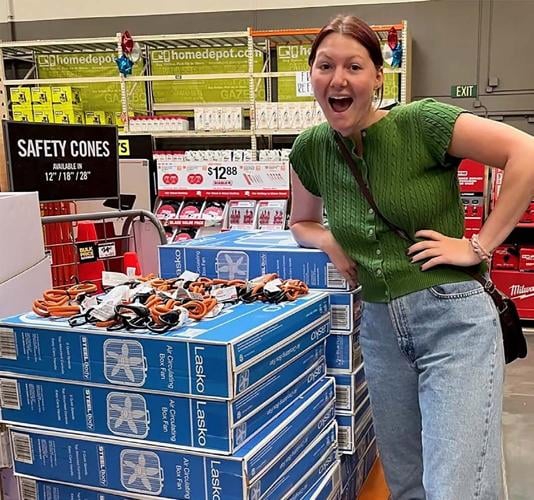
Above, a 2023 AmeriCorps volunteer gathers DIY fan supplies for Smoke Ready Oregon’s “Join the Fan Club” initiative. Learn how to join the initiative and make your own air purifier out of a box fan and furnace filter at SmokeReadyGorge.org.
Above, a 2023 AmeriCorps volunteer gathers DIY fan supplies for Smoke Ready Oregon’s “Join the Fan Club” initiative. Learn how to join the initiative and make your own air purifier out of a box fan and furnace filter at SmokeReadyGorge.org.
THE DALLES —Skies may be blue today, but imagine a thick amber haze curtaining the outdoors like a sepia photo; that heavy, cloying tang of carbon in the air.
Gorge residents are familiar with smoky days during wildfire season, but in recent years the air quality has reached extremely hazardous levels previously unknown to the region. Scientists are only just beginning to understand how dangerous this exposure can be to human health.
Lauren Kraemer
Oregon State University
In March, the Environmental Protection Agency issued a rule revising National Ambient Air Quality Standards and changing the Air Quality Index (AQI) to reflect higher amounts of smoke particle risk.
Previously, air was considered “good” quality with 0 to 12.1 micrograms of particulate per cubic meter, but with these changes the quality becomes “moderate” once it hits 9.1 micrograms per cubic meter. Similarly, the “unhealthy,” “very unhealthy” and “hazardous” categories were lowered by 25 micrograms per cubic meter, showing more danger from these levels of smoke than previously understood.
“We need to do more to protect human health,” said Lauren Kraemer, MPH, associate professor of practice at Oregon State University, who delivered a smoke safety presentation to the Wasco County Commissioners on June 5.
Kraemer offered both a detailed look at how air quality impacts Gorge residents, and what each person can do to mitigate their risk this year before the smoke rolls in.
Reflecting on the catastrophic fires of 2020, Kraemer noted, “Air quality in Oregon was some of the worst we’d ever seen across the globe.”
During the fires, Kraemer recalled farm workers out harvesting pears and tribal fishers, both working when the air quality was in the 500 to 800 AQI range. Anything more than 300 AQI is considered “hazardous,” which AirNow.Gov calls “emergency conditions” and strongly recommends all groups avoid outdoor activity in.
Kraemer said she commonly encounters the belief that smoke can’t be harmful when the burning material comes from nature, but this is incorrect.
“What we’re finding through longitudinal studies and following communities that have been impacted by smoke events, it really is damaging to our health,” she said.
The Gorge region isn’t just susceptible to wildfire smoke. Agricultural burning, household debris burning, smudge pots in fruit orchards to protect delicate spring blooms and general wood burning can also impact air quality, particularly during winter inversions, Kraemer noted.
Kraemer emphasized the severe health implications of exposure to fine particulate matter less than 2.5 micrometers in diameter (PM 2.5), a mixture of fine gases and particles produced when wood and other materials burn.
To explain the size of this particulate matter, she told listeners to examine one of their hairs and visualize 40 of these microscopic particles wrapped around one hair.
“That’s what we’re the most concerned about during wildfire smoke events, those teeny tiny particles can go deep into the lungs,” Kraemer said. Inflammation, irritation and exacerbated existing conditions like heart and lung disease can result from this exposure.
She also noted this particulate can bond with other chemicals, explaining that burning orchard wood contains particles that bond with legacy chemicals sprayed onto the trees. When those particles enter human lungs, chemicals from the pesticide and herbicide sprays or fertilizers can cross into the bloodstream.
“We can even start to see impacts on our DNA and organs with chronic and long-term exposure,” Kraemer said.
The local population has significant numbers of vulnerable individuals, including those with pre-existing conditions, older adults, children, and outdoor workers. Approximately 60-70% of the population in Wasco and Hood River counties falls into these sensitive groups.
Children’s health, in particular, can be more impacted by smoke exposure because their lungs are not fully developed.
“The respiratory system is still under development until age 21,” Kraemer said.
Recent longitudinal studies of smoke impacts show that both a high level of acute exposure and long-term moderate exposure can harm communities, but it’s still unclear how those different types of impacts manifest long term.
“When we follow smoke-impacted communities, they show poor lung function for a full year following that event,” Kraemer said.
Kraemer mentioned research conducted by Canadian researcher Dr. Stephanie Cleland, assistant professor, Legacy for Airway Health chair in promotion of lung health at Simon Fraser University, who studies the long- and short-term impacts of smoke events on cognitive function. In an Oregon Smoke Ready Community Call Kraemer attended, Clelend recommended that schools delay standardized testing in the event of smoke to mitigate poor air quality’s impact on behavior, attention and cognition.
Kraemer also detailed the expansion of air quality monitoring in the Gorge, supported by various grants totaling more than $50,000.
More than 50 new monitors have been installed at schools, orchard sites, and other locations. These monitors provide real-time data, accessible through platforms like SmokeReadyGorge.org, the Purple Air website and EPA’s AirNow.gov.
“Having accurate, timely data is crucial for informing the public and helping them take protective measures,” Kraemer said.
Efforts to improve communication during smoke events have also been bolstered through the “Smoke Ready Gorge” program. Developed with extensive community input, this program includes a Gorge-wide survey, focus groups, community listening sessions, information distribution and resources.
Kraemer highlighted the importance of timely information, particularly for marginalized and hard-to-reach populations, noting that during the 2020 fires many of these groups were missed.
When it comes to the Gorge’s smoke response, Kraemer listed many local government and community leaders on board with upgrading air purifiers and using air quality monitors.
“We know a lot of the buildings are quite old around the county, so many of them may need to do some improvements to improve indoor air quality,” she said.
Another significant development is the use of air curtain incinerators, which produce much less smoke than traditional burning methods. These incinerators are now more accessible due to the removal of costly permitting requirements by the EPA.
For those interested, Kraemer encouraged participating in the “Join the Fan Club” initiative, which provides instructions on creating affordable DIY air purifiers using box fans and furnace filters. These can be just as effective as more expensive commercial air purifiers and are a practical solution for many households.
How to protect yourself and your family during a smoke event
1. Wear N95 masks outdoors:
Use N95 respirators if you need to be outside during a smoke event.
Ensure the mask is fit-tested and worn snugly to prevent inhalation of tiny PM 2.5 particles.
Avoid loose surgical masks; they are not effective against smoke particles.
2. Seal and eliminate particles from entering:
Ensure doors and windows are well sealed to prevent smoke from entering.
Don’t vacuum, burn candles or smoke inside.
3. Purify indoor air:
Use indoor air purifiers, either DIY box fans with furnace filters or commercial air purifiers.
Schools, hospitals and workplaces should consider installing air scrubbers or purifiers in common areas and classrooms.
If you have an HVAC system, upgrade to MERV 13 filters or higher. Ideally, use the highest MERV filter your system can handle.
4. Make your own air purifier:
Create your own air purifier using a box fan and a furnace filter. This affordable solution can significantly improve indoor air quality, reducing the AQI by 100 points in about an hour.
Watch the Youtube video “How to make your own clean air fan” by the Washington Department of Ecology for a tutorial on how to make your own air purifier.
Visit SmokeReadyGorge.org to find out where you can get a “Join the Fan Club” DIY air purifier kit.




Commented