THE GORGE — Whether it’s snowing, raining or windy, the most likely place you’ll find Joe Dellaporta is on the side of a snow-covered volcano, seeking out potential avalanche hazards in the snowpack.
Dellaporta is an Avalanche Specialist for the Northwest Avalanche Center (NWAC), a nonprofit organization that partners with the U.S. Forest Service to equip backcountry travelers with avalanche information and awareness.
Avalanches can present a significant danger to travelers in the mountains. Equivalent to a river of unstoppable snow, a triggered avalanche can cascade down a slope with the potential to knock down trees, rocks and humans in its path.
“Unfortunately, there are avalanche fatalities every single year across the U.S. and Canada,” Dellaporta said. “Giving the public useful information to avoid this hazard is something I find incredibly important so people can have a more fun, safe day out.”
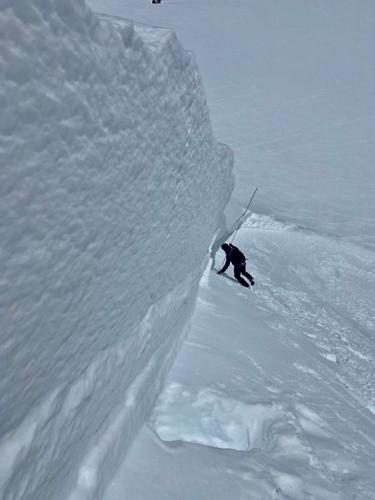
Crown of an D3 avalanche triggered on Mount Hood.
Ben Ticklerbal photo
From the start of December to the end of April, Dellaporta posts a Backcountry Avalanche Forecast every day at 6 p.m. at nwac.us and through the new “Avy App,” launched last November by NWAC.
“There’s a wide variety of users in the mountains and it’s our job to make sure we can get that information to everyone in a way that’s clear, concise and approachable,” Dellaporta said.
The forecast includes a summary of the avalanche danger on a color-coded scale labeled from low to extreme. There’s also an estimation of the type of problems that could be seen, including the aspect, elevation, likelihood and size.
“The danger changes every day,” Dellaporta said. “Reading beyond the danger scale is important for making safe travel decisions. In the descriptions, we dive a little deeper into the information and overall the forecast discussion, including what’s driving that danger.”
Throughout the winter, Dellaporta tracks the weather and storm cycles closely. Wind, precipitation and temperature are all important factors to consider for avalanche forecasting because of how they impact the snowpack.
When possible, Dellaporta uses his backcountry splitboard, a snowboard set-up that splits into a walk-mode, to travel in the mountains to get in-field observations. On the north side of Mount Hood, Mount St. Helen’s and Mount Adams, snowmobiles are required for the terrain.
“These volcanoes are very isolated in the winter and often hard to get to,” Dellaporta said, “A snowmobile is such a powerful tool. It helps us produce better forecasts because we can see more areas and get more observations from different aspects and elevations quicker.”
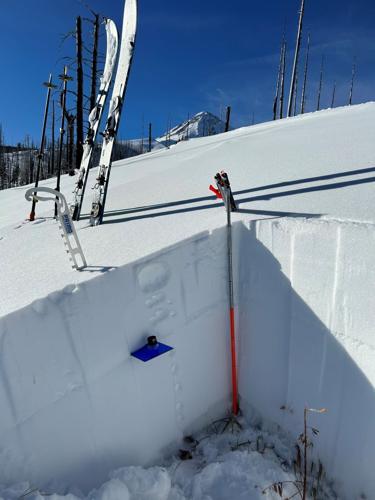
Early in the season, the snowpit reaches the ground for snowpack observations.
Dellaporta photo
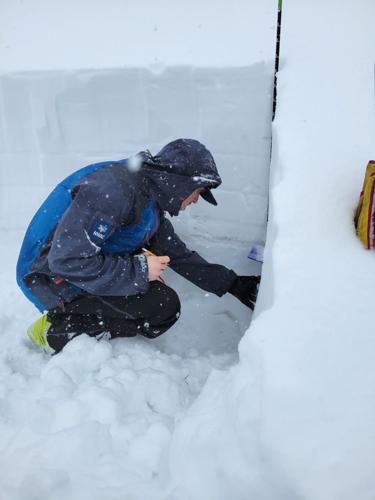
In the field, he digs rectangular snow pits along the slope to better understand how the layers of snow bond together and how they might react to travelers on the top layer. This includes testing the hardness, stability and reactivity of the layers on an isolated snow column.
“The snowpack is an ongoing story,” Dellaporta said. “Often, I’ll dig a snow pit for observations because I don’t want to miss a beat. It’d be similar to missing a chapter in the book.”
Each chapter can be considered a different layer of cohesive, bonded snow. If the layers of snow don’t bond together, it increases the likelihood of a weak layer, which might cause an avalanche.
One example Dellaporta pointed to was a layer of buried surface hoar, a weak layer of ice crystals, in mid-December 2022. The layer didn’t bond to others and as the weight of snow from other storms increased, so it created a persistent slab problem in the forecast.
“It was producing avalanches for a week. This weak layer wasn’t present everywhere and the distribution was my uncertainty,” Dellaporta said. “I dug around a lot of places to figure out the distribution. It wasn’t living above the tree line, it wasn’t everywhere below the tree line, but it was in a lot of mid-elevation areas with open canopy, so with minimal trees.”
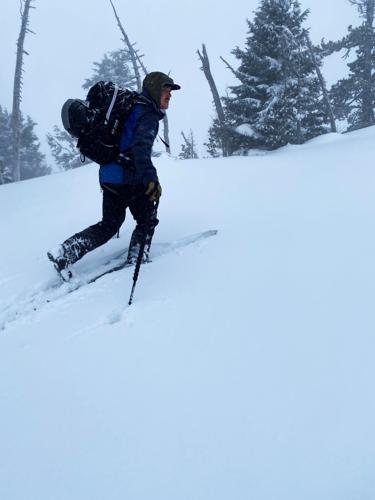
Dellaporta tours through the snow storm to get in-field observations.
Ryan Matz photo
This winter, he noted that the snowpack has a distinct wet, saturated layer to the ground from the warming and rain events that have occurred at lower elevations. Going forward, he plans to keep a close eye on how that layer bonds with new snow.
Dellaporta is the only NWAC forecaster on Mount Hood and encourages anyone who travels in the mountains this winter to submit a public observation online at nwac.us if they witness snow collapsing, cracking or an avalanche.
“At the end of the day, this makes a better and more accurate avalanche forecast,” he said. “Avalanche forecasting is very much a community project and I rely on public observation to help fill in the gaps of uncertainty for me.”



Commented
Sorry, there are no recent results for popular commented articles.