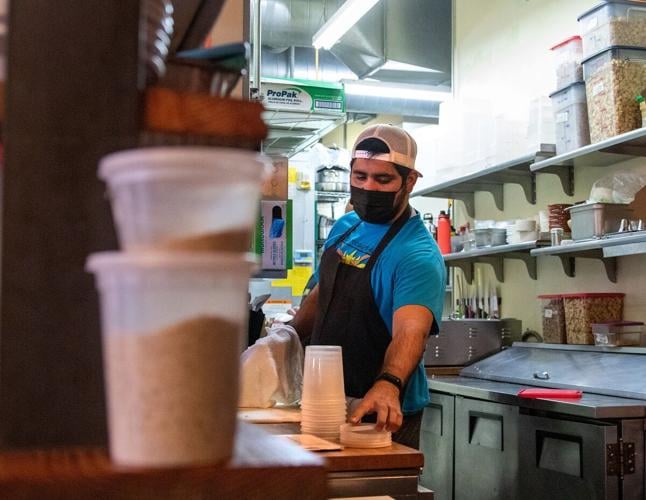
The coronavirus pandemic is instigating the greatest staffing shortage the Columbia River Gorge region has seen in years, according to local economists.
With the tourist industry making up a large portion of the local economy, regional economist Scott Bailey with the Washington State Employment Security Department said restaurants and the hospitality industry took the brunt of the impact stemming from ongoing restrictions.
As COVID-19 hit stateside in March 2020, the first regulations were put in place for Oregonians. Gov. Kate Brown made the decision to shut down the state with the notion of public health at the forefront. Throughout the month of March, Brown instituted mask mandates and policy changes for restaurants, schools, health care facilities and public spaces.
In Washington state, Gov. Jay Inslee instituted a “Stay Home, Stay Healthy” initiative asking citizens to stay home for two weeks, but in early April he extended the state’s proclamation for another month. When positive cases began to spike in June, Inslee mandated face coverings statewide. A federal response included supplemental unemployment benefits.
Schools initially sent students home for two weeks, but soon after made the difficult transition to online education. Restaurants were forced to shut down indoor dining and adapted by either offering takeout orders only closing down and applying for grants or loans, on the basis that they keep workers on their payroll, as opposed to terminating their positions.
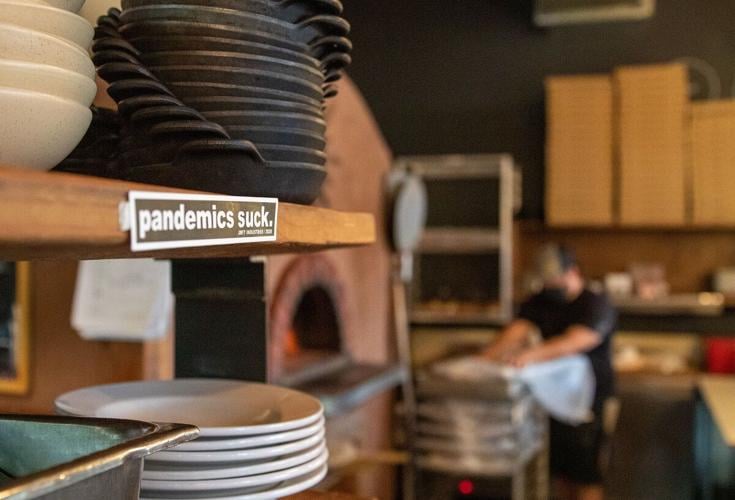
A sticker reading “pandemics suck” can be seen behind the bar at Solstice Wood Fire Cafe & Bar in Hood River.
Noah Noteboom photo
Solstice Pizza in Hood River chose to close completely. Sending their employees home, Co-owner Aaron Baumhackl and General Manager Natalie Price decided it was best to take a step back and assess the situation.
COVID had impacted not only businesses, but workers as well. When White Salmon local April Baker got laid off for the first time from her kitchen job during the shutdowns that ensued following the declaration of a global pandemic, she was shocked.
“It’s really hard to process,” Baker said. “You’re ‘go go go go go,’ and then all of a sudden you’re not in that position, but the world is falling down around you. I mean, it was very, very difficult.”
Baker said she worked in kitchen jobs most of her working life, going from working on the line to being a prep cook in recent years. She had been working as a prep cook for months at her newest place of employment when the shutdowns took away her ability to work in that environment.
After years of working in the kitchen, Baker said, she had been locked into familiar patterns and routines, but when her place of work shut down, and after the shock wore off, it was like her brain had opened up new pathways and lines of thought. And she said her colleagues in the food service industry felt similarly.
“We’re asking new questions, and we’re seeing the sky is a different color. We’re noticing the sky, because some of us haven’t seen it in so long,” Baker said.
Later in the pandemic, Baker said new opportunities opened up for her. A friend had recently undergone surgery and needed help cleaning her house, so they reached out to Baker and asked to pay her for her labor. She was happy to take up her offer, and suddenly, a new window opened up. She began her own cleaning service in White Salmon, offering to clean people’s houses. She likes the feeling of helping people, she said, leading to her business model of allowing a sliding fee scale on the basis of need.
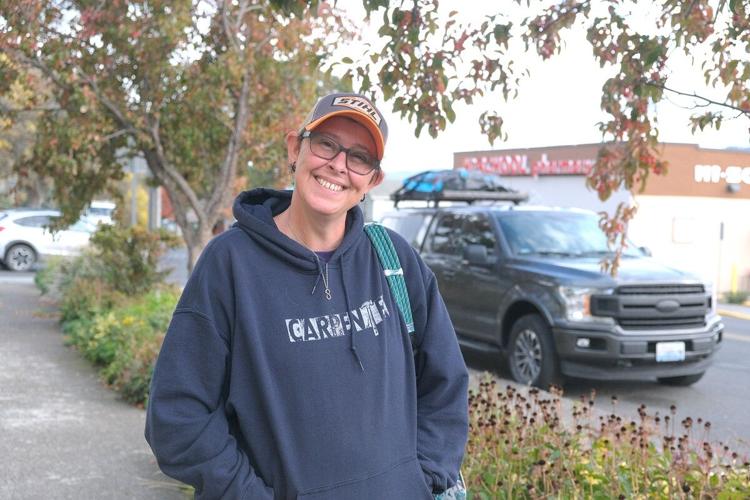
April Baker is the owner of L’ill Miss Does It All, a cleaning service based in White Salmon.
Jacob Bertram photo
“If you’re a single parent, of course I’m going to give you a discount, it’s the holidays,” Baker said. “I truly believe that no one should be priced out of getting the help they need.”
Most of her clients are on a fixed income, she said, “and the ones that aren’t that pay me more an hour make it possible for me to help those people who can’t afford more than that. And I like to tell those people that because, you know, you’re paying me more, (at) the very least, they get to feel good about it.”
Suddenly, with her growing business, Baker said she had more time to work in her garden and do handiwork around the house. She can schedule her own hours, she earns more money for less hours on the job, and that gave her the flexibility to explore opportunities to advance her education. Currently she is taking online courses, studying criminal justice, which will give her the training to become a counselor and a life coach, she said. It’s an overall improvement to her situation. Baker said she felt burnout from working in restaurants. She was happy and eager to learn more skills in the industry and advance her career, taking jobs as kitchen manager and other higher level positions. But even still she said kitchens have a lot of problems under the surface.
People like to focus on the money, she said, but there were other indicators of a toxic work environment. The substance abuse issues, the misogynist work environment where she says she has seen her male colleagues paid more than her for the same work, the long hours and the constant disregard for her and other workers’ wellbeing — it was taking its toll. She had to get out of there. But when you’ve been working in the same industry for so long, she said it’s difficult to reset.
“I’m so thankful I never have to step foot in the kitchen again every single day,” Baker said. She admits there are some positive aspects to a kitchen job: She grew tough and learned to multitask. She liked training the greener workers and was proud to see the kitchen work effectively.
Baker said others like her have realized much of the same thing and began to reset their own lives. Senior members of the industry are leaving the field, and leaving much of the work to junior staff members who may not have the training or the lived experience to handle the workload. With perpetually understaffed kitchens, she says the problem could soon be exacerbated.
For Baker, the tipping point was the COVID-19 pandemic which prompted shut downs in multiple industries and sent scores of workers home to collect unemployment and other benefits.
Until September, many workers collecting unemployment benefits were eligible for an additional $600 per week in federal benefits, and Bailey, the economist with Washington’s employment agency, said it is still too soon to see the impact of the expiration of those benefits. Many attribute the staffing shortage issue to those benefits — that they had paid out greater amounts than a working wage. Bailey suspects that the federal benefits will be a factor in a minority of cases.
Citing a U.S. Chamber of Commerce survey published in June 2021, which found that three out of 10 unemployed people did not expect a return to the workplace this year, Bailey said individuals may have multiple reasons for their lack of desire to return to their jobs. He cited examples, such as a fear of catching COVID-19, a feeling of burnout in their industry, and a desire to change careers, as evidence that makes this current staffing shortage unique.
“It’s a really complex story that I don’t know that anybody could put a number on,” Bailey said, making sure to qualify this issue that there were shortages in workforces before the pandemic, especially in the healthcare and child care industries. He also noted the decline in rising wages through the years, which started in the 1970’s. Due to the wage stagnation and the imbalance of federal unemployment benefits, Bailey said employers are faced with leveraging higher wages to bring people onto staff.
With businesses opening their doors once again, employment rates have begun a slow crawl back to pre-pandemic numbers. In a September news release provided by the State of Oregon Employment Department, Hood River County’s seasonally-adjusted unemployment rate reached 4.7% after a 0.2% fall from July to August.
Sherman, Wasco and Wheeler counties rates also sustained 0.2% falls, reaching 4.1%, 5.4% and 3% unemployment rates respectively. Gilliam County reached 5.0% unemployment rate after a 0.1% fall, and, according to the Federal Reserve Economic Data Database (FRED), Klickitat County’s August unemployment rate sits at 5.2%, after a minor 0.1% increase from July’s rate.
According to FRED, Oregon’s pandemic-related unemployment rate peaked in April 2020, at 13.2%, and Washington’s own April 2020 peak reached 16.3%.
Bailey said unemployment claims in Skamania County, for example, were filed by workers who earned an average of around $2 below the median wage, and that claimants had been disproportionately female and earning lower-income when compared to the workforce at large.
Despite a tentative return to pre-pandemic normalcy, local businesses all around the Columbia River Gorge are continuing to struggle to gain back employees, resulting in a staffing shortage and negatively impacting local economies.
In an April 2021 economics needs assessment performed by the Mid-Columbia Economic Development District (MCEDD), community and small business leaders from around the Mid-Columbia region were interviewed in order to identify key economic needs that have developed due to the COVID-19 pandemic, as well as identifying opportunities to address these issues.
One key concern recognized that the Mid-Columbia region has been defined a “childcare desert,” with a 2018 study performed by the Center for American Progress defining the term as “a ZIP code with at least 30 children under the age of 5 and either no childcare centers or so few centers that there are more than three times as many children under age 5 as there are spaces in centers.”
Nancey Patten, director of Child Care Partners, an Oregon childcare resource provided through Columbia Gorge Community College, described — among several issues — a disconnect between the continued growing need for child care in the area and the ongoing struggle childcare providers face trying to provide services. “Parents are struggling to afford to pay for childcare, child care providers are struggling to stay in business, because they’re not making enough money,” said Patten, “Just like everything else in our lives, the cost of childcare has gone up during the pandemic. I know that concerns parents, but it also concerns providers.”
Minimum wage for Hood River and Wasco counties sits at $12.79 per hour, with Washington at $13.69. While significantly higher than the $7.25 federal minimum wage, a by-state cost of living data series produced by Missouri Economic Research and Information Center lists the cost of living for Oregon at 131.9%, and Washington at 112.7%, the sixth and 14th highest states in the country, respectively. Contributing factors to these percentages consist of groceries, transportation, healthcare, and housing.
Attainable housing in the Mid-Columbia region continues to be a growing issue. According to the September 2021 RMLS Market Action Report provided by Copper West and Windermere real estate agencies, the average sale price for houses in Wasco County sat at $340,100, with a total market time (the number of days a property is on the market to when an offer is accepted on that property) at 32 days, an average cost of $541,600 and a total market time of 76 days for Klickitat County, and an average of $695,500 with total market time of 10 days for Hood River County. The MCEDD economic needs assessment notes an ongoing challenge of living and working in the Mid-Columbia Gorge, recognizing that the “cost for homes and rentals have risen faster than wages, increasing the affordability gap for residents … impacting local business’ ability to attract and maintain the necessary workforce to operate today.”



Commented
Sorry, there are no recent results for popular commented articles.