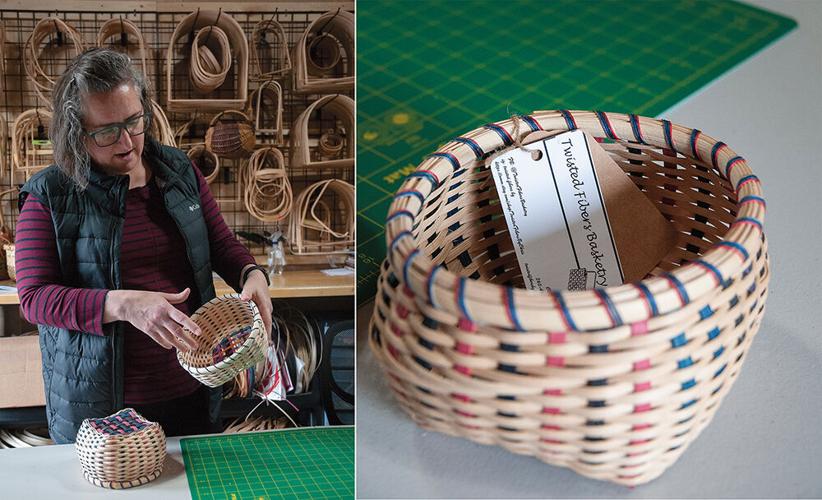
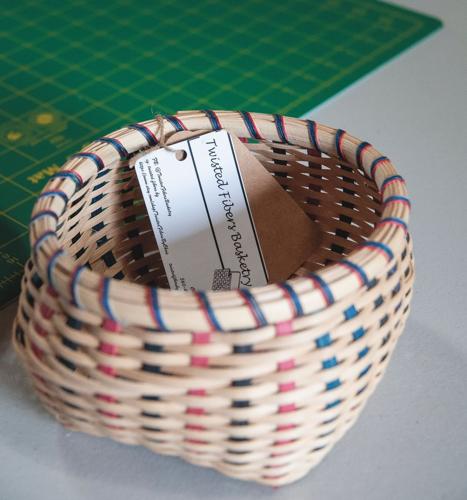
Local basket maker Chris Bush describes the process for making a cat-ear basket (close-up at top right), a favorite pattern that's stable on flat surfaces. For information on all artists participating in the Gorge Open Studios Tour and a map, visit gorgeartists.org.
Local basket maker Chris Bush describes the process for making a cat-ear basket, a favorite pattern that's stable on flat surfaces. For information on all artists participating in the Gorge Open Studios Tour and a map, visit gorgeartists.org.
Local basket maker Chris Bush describes the process for making a cat-ear basket (close-up at top right), a favorite pattern that's stable on flat surfaces. For information on all artists participating in the Gorge Open Studios Tour and a map, visit gorgeartists.org.
THE DALLES — Chris Bush, the only basket maker to be featured in the upcoming Gorge Artist Open Studios Tour, found her passion for the art that fills her recently-completed studio almost by chance.
An encounter with another basket maker at a craft fair sparked Bush’s interest. “She was selling baskets, and I wanted to learn how to make one,” Bush recalled. Her acquaintance taught classes, and the two happened to live near each other. Bush made her first basket in fall 2012.
She estimates she’s completed more than 200 baskets since that first encounter. Basketry isn’t her full-time profession, but someday, she hopes it could be.
That first piece, a market basket in an over-under weave, holds pride of place on her studio shelves. Nearby hang egg baskets, double-lobed baskets with ribbed indentations meant to carry fragile eggs without letting them roll around, a bean pot basket with a long handle, an old shape designed for transporting hot pots of food; and a few elegant, purely decorative baskets.
In basketry, Bush found a relaxing art, in the form of small projects that can be finished in as little as an hour and a half. “I was trying to find something to just get away from work and school, and all the regular things in life,” she recalls. What began as stress relief became a commitment to the craft.
Bush now shares her passion with students through year-round, near-weekly classes, mostly at The Dalles Art Center (TDAC) and Columbia Gorge Community College, but also takes requests for classes at various locations — and various basket patterns. She also sells her baskets at TDAC's holiday show.
Most of her art is quite functional. “You name it, you can use a basket for it,” Bush claimed. Hers are for storage, totes, backpacks, or places all the bits and pieces that accumulate on the coffee table. Her favorites combine functionality with colorful elegance.
Her materials fill another wall: Strips and hoops of calamus rotang — a woody vine from Asia, commercially harvested, which she orders from the Eastern U.S. — dyed all colors of the rainbow, with different widths and profiles to suit her 50 different basket patterns, many of them her own inventions.
“These woody vines grow so quickly. ... I’m not cutting down a multiple trees to teach basket weaving, I’m using a source that is continually regrowing itself,” Bush said. Traditionally, some of the baskets she makes could require cutting a tree and processing parts of the wood.
Local basket maker Chris Bush describes the process for making a cat-ear basket, a favorite pattern that's stable on flat surfaces. For information on all artists participating in the Gorge Open Studios Tour and a map, visit gorgeartists.org.
Flora Gibson photo
Other basketry traditions that inspire her rely on specific local materials, like cedar bark. Bush said she felt local styles vary more by material than by shape, as each material imparts its own characteristics and needs different weaving patterns.
She sometimes researches traditional basket shapes, reproducing what she sees online or in old photographs, searching out the baskets her ancestors in Ireland, Scotland and England might have made. But to avoid infringing on the cultural traditions of other basket makers, she’s committed to using just this one, non-local material. “I don’t want to take away from, there so many people here that are Native American that can teach their own craft,” she explained.
She begins each new basket by making the base. Some require a square of woven strips, others a wooden base with slits for gluing vertical strips for the sides, yet others the formation of a “God’s eye” circle into which strips for the sides are anchored.
Once the basket's base is made, the hardest part is done. “When I teach my classes, I always remind them, once you get past a certain point, it’s a lot easier and it’s calming,” Bush said. “And to me it’s pretty relaxing.” In her newly-finished studio, she’s already planning out new baskets for her next classes. She prefers to offer her students artistic freedom, she said, helping them design baskets based on their own vision, or alter designs to add their own desired color and pattern.
“It’s a dying art,” she added. “It’s ... so much easier just to go out and buy it. No basket is machine made. They’re all handmade somewhere by somebody.”



Commented
Sorry, there are no recent results for popular commented articles.