
The roll-out of a parks plan will be followed by a rolling up of sleeves.
On Wednesday, the Hood River Valley Parks and Recreation District Board of Directors (HRVPRD) got its first look at the freshly-issued draft master plan for parks in Hood River County.
HRVPRD, Hood River County and City officials will hold a public meeting on Feb. 28 to discuss the plan, formally known as the Multi-Jurisdictional Parks, Recreation and Open Space Plan for Hood River County.
The plan looks beyond the Hood River Aquatic Center and other facilities HRVPRD owns and operates, toward priorities and possibilities for expanding programs and facilities as well as coordinating with other agencies.
Subtitled “A Parks Plan For All,” the 275-page document is the result of two years’ of work by HRVPRD and its consultant, Conservation Technix. It is a working document that is months away from adoption, but in presenting the draft to the board and about 20 people from the community Wednesday, HRVPRD Executive Director Mark Hickok said, “This is not finished. We can make major changes, including philosophical changes.”
The document sets a vision and framework for the district, as well as the four other local agencies within the HRVPRD that maintain and provide parks and recreation services and facilities: Hood River County, the City of Hood River, Hood River County School District and the Port of Hood River. (Privately-owned facilities, such as Horizon Christian School, are also accounted for in the facilities inventory.)
Audience members sent two messages to the HRVPRD board Wednesday, one of them being that the plan should not be philosophical, or “aspirational,” as several called it, but carry purpose and authority, as well as specific plans for funding expansions and improvements.
“I hope, with other agencies, we do identify what they’re going to do — not what they might do,” said HRVPRD Director Mike McCarthy.
Second, most in the audience called for HRVPRD to protect Morrison Park as open space. The park, which is owned by the city, is mentioned in the plan but speakers, including Josh Sceva, called on HRVPRD to do what they can to protect the park in its current state. (The city has approved rezoning of the park to allow for construction of affordable housing, though that action has not been formally taken.)
Sceva questioned the wisdom of new park land acquisition when an existing park might be taken away. “The last thing I want to see is lose the park that is so valued for the community,” Sceva said. “Maintaining open space is one of the cheapest things you can do.”
Outside of its listing in the inventory of parks facilities, the only mention of Morrison Park in the plan is in stakeholder comments: “The development of Morrison Park property for low-income housing with recreational amenities.”
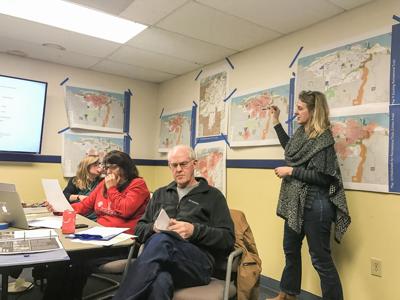
Acquiring west side park land and updating or replacing the aquatic center, and trails — expanding and improving connectivity — stood out as priorities for the four district directors present. Assistant District Director Marci Wiley wrote the priorities on a whiteboard during the meeting, with Glenna Mahurin, Mike McCarthy, Anna Cavaleri and Nan Noteboom weighing in. (Board Chair Art Carroll was not present.) Other priorities included establishing long-term funding for projects, coordinating with other agencies to improve efficiencies, and new ballfields.
The plan’s preface states that “current community interests surfaced through a series of public outreach efforts that include an open house meeting, focus group discussions, stakeholder interviews, community surveys (on paper and online), website content and the project’s Technical Advisory Team meetings …”
It states that to guide implementation of the goals of the plan, a Capital Improvement Plan (CIP) for each major partner agency was developed, along with a set of strategies and potential implementation options.
“Once adopted, the plan can become a component of the city and county’s Comprehensive Plan and integrated approach to park system service delivery for the next 10 years.”
The document contemplates a list of facility upgrades, service expansion and other moves, and assigns them to the five partner agencies as Leader, Partner and Advocate.
The stakeholder interview summary section of the report states that “stakeholders recognized the limited financial capacity of the partners and were often quick to offer suggestions for potential partnerships or other means to accomplish specific projects. Suggested projects ranged from coordinating the development of trail connections, identifying opportunities to expand sport field capacity, and improving existing facilities.”
Stakeholders interviewed were: John Rust, former Community Education director; Kevin Liburdy, city senior planner; Mike Doke, Columbia Gorge Fruit Growers; Judy Zimmerman and Marianne Durkan, Gorge Ecumenical Ministries; Victoria Hubler, Citizens for Responsible Growth, and son Oliver, 10; Renee Tkach, Frineds of the Gorge/Towns to Trails; Erika Taylor, Parkdale resident; and Erick Haynie, then Hood River Rotary president (elected to city council in November 2018 and now serving).


Commented
Sorry, there are no recent results for popular commented articles.