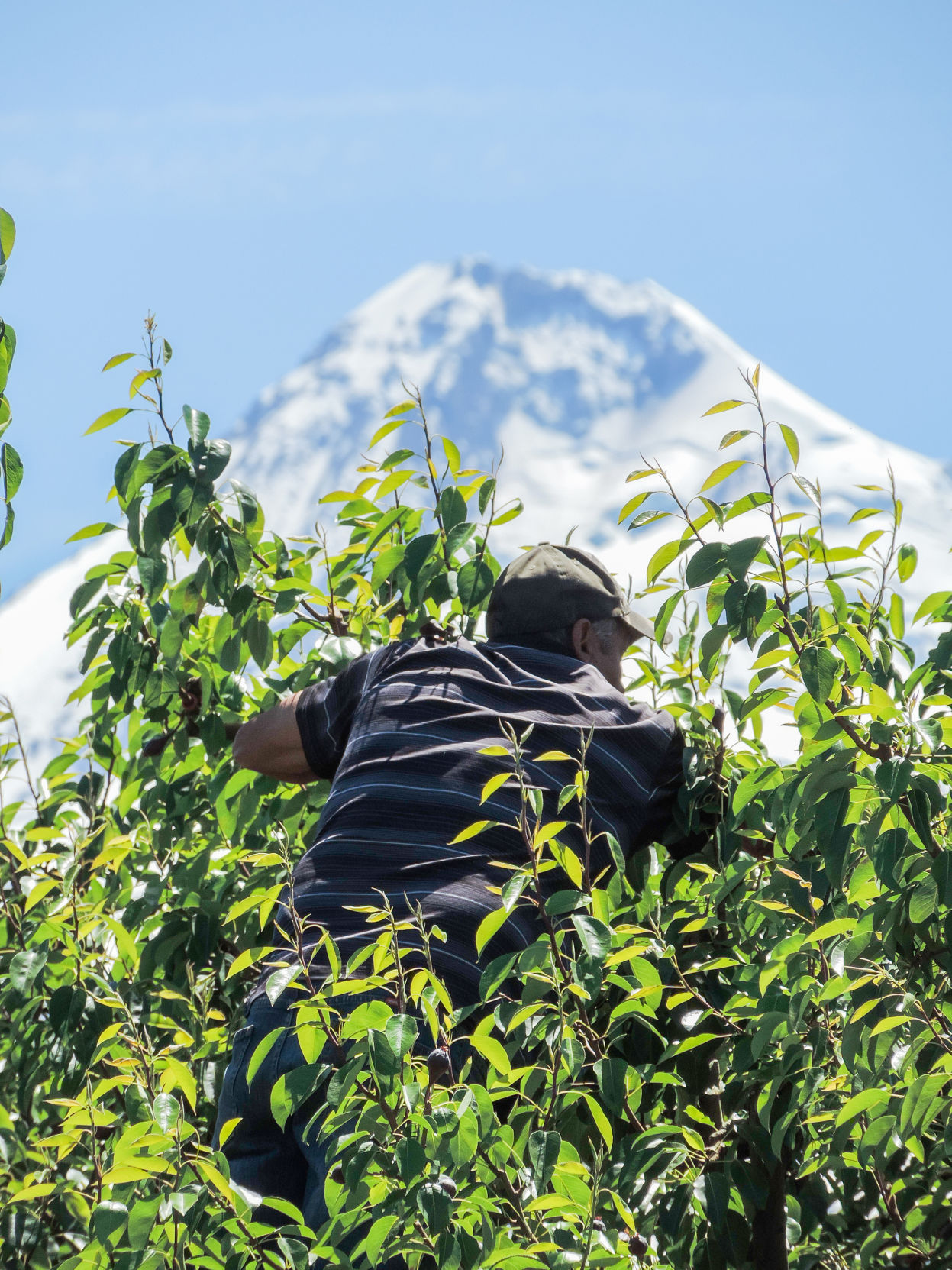
Luis Perez climbs among the highest branches in this Parkdale pear orchard as he prunes and thins branches Tuesday, in 70s temperatures near the cooling flanks of Mount Hood.
Luis Perez climbs among the highest branches in this Parkdale pear orchard as he prunes and thins branches Tuesday, in 70s temperatures near the cooling flanks of Mount Hood.
As summer harvest begins and the temperature climbs, the Oregon Farm Bureau Health & Safety Committee wants to alert farmers and ranchers who are employers about a requirement from the Oregon Occupational Safety & Health Administration (OSHA) that’s designed to protect workers from heat-related illness on the job.
When Oregon OSHA inspectors visit workplaces between June 15 and Oct. 1, they will likely ask employers about what Heat Illness Prevention Program is in place, said a Farm Bureau press release.
According to a study conducted by the U.S. Bureau of Labor Statistics, in 2015, exposure to environmental heat led to 37 work-related deaths nationwide and 2,830 nonfatal occupational injuries and illnesses involving days away from work.
To help keep workers safe, Oregon OSHA requires employers who have employees exposed to excessive and continuous heat to have a Heat Illness Prevention Program, said the press release. This also applies if workers wear protective clothing or equipment that impacts their ability to naturally shed heat.
The goal is to prevent heat-related illnesses and deaths by raising awareness among workers and employers about the health risks associated with working in hot environments; the primary focus is to educate and inform employers with indoor hot processes and/or outdoor workers, particularly in agriculture, construction and forestry, said the press release.
Heat-related illnesses generally occur when body heat generated by physical work is aggravated by environmental heat and humidity. Indoor worksites where heat-related illnesses may occur include those with hot processes, such as seed and grain elevators, food processors, and canneries, to name just a few.
Outdoor operations typically affected by hot weather include most crop-production agriculture, landscaping, firefighting, forest activities, construction and demolition.
Another consideration is when the use of personal protective equipment (PPE) is required, said the press release. The use of non-porous (non-breathable) full-body suits, such as for pesticide applications, can cause heat-related illnesses among the workers during even relatively mild work activities without any additional sources of heat.
If a farm or ranch is visited by Oregon OSHA enforcement staff over the next few months, the inspector will likely ask for documentation of a Heat Illness Prevention Program, said the press release. Companies have been cited as high as $7,000 for the lack of a work rest regimen, not ensuring employees’ access to fluids, and/or not providing heat stress training to employees — all elements of an effective program.
The OFB Health & Safety Committee urges ag employers to implement a heat safety program. The plan template at www.OregonFB.org/safety can help. Other valuable resources for farmers and ranchers at www.OregonFB.org/safety include information about safety when driving farm equipment on public roads, the Worker Protection Standard (WPS), agritourism safety, and the comprehensive “Sowing the Seeds to a Safe Agricultural Workplace” guide.
Oregon Farm Bureau (OFB) is a grassroots, nonpartisan, nonprofit, general farm organization representing the interests of farming and ranching families in the public and policymaking arenas. First established in Oregon at the county level in 1919 and the state level in 1932, Farm Bureau is organized in all 36 counties.



Commented