
THE GORGE — “It hasn’t been a boom year, but it’s been a decent year for many of the stocks,” said Michael Milstein, public affairs officer for the National Oceanic and Atmospheric Administration (NOAA) West Coast Regional Office.
“Some of the big runs have been near their 10-year average. Some have been a little lower, some a little higher,” he noted, as measured against the last decade.
NOAA works mainly with threatened marine species. Anadromous fish, such as salmon, fall under that classification.
As of Oct. 19, about 109,966 adult spring chinook were counted passing Bonneville Dam, a little below the 10-year average of 112,433, according to Fish Passage Center data. Importantly, these numbers mostly represent hatchery fish — which represent 80% of Columbia's anadromous fish. Non-hatchery fish are counted, and their endangered runs evaluated, separately and their numbers are much lower, often by thousands.
Summer chinook were also just below the 10-year average, with about 79,259 adults passing Bonneville Dam by Oct. 19.
Fall chinook runs, which peak in September, are close to being over now.
“There’s about 543 fall chinook that came through yesterday, down from about 1,511 earlier in the week,” Milstein noted. “So the run’s coming to a close.”
Adult fall chinook passing Bonneville so far number 11,592 adult fish over their 10-year average of 518,035.
Coho also seem to be numerous, with counts at Bonneville numbering 28,565 adults over the 10-year average of 100,130.
Shad are about a thousand below their 10-year average so far, and lamprey are more than 26,000 above their 10-year average of about 37,000, according to counts from Bonneville Dam.
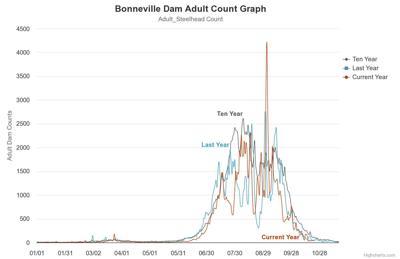
Although most runs are doing well this year, “there are some exceptions, for example Snake River steelhead in particular have been low,” Milstein noted. Snake River steelhead are an endangered stock.
Current steelhead totals are fairly representative of the year-end total, Milstein said. About 115,000 steelhead have passed Bonneville, compared to a 161,000 10-year average.
About 41,000 “wild” steelhead have come through Bonneville so far, compared to a 59,000 10-year average.
Snake River steelhead numbers can be counted at Granite Dam; this year, adults are down about 10,000 individuals from their 10-year average of 75,000. Wild-spawned Snake River steelhead on the other hand number 2,000 fish below their 10-year average of 20,000.
Conservation of the individual stocks is important, Milstein emphasized, as many are adapted to specific rivers, making the overall population more resilient to disaster and change.
Some steelhead stocks are doing better, Milstein said. “Mid-Columbia steelhead have been a bit of a bright spot, because there’s been a lot of work by some agricultural interests ... making sure the streams have enough water,” he said, among other initiatives. “People have pulled together and really made a difference.”
It’s not always easy to tell why such runs vary from year to year, Milstein said.
For one thing, various anadromous fish, such as coho and steelhead, inhabit different parts of the ocean, encountering varying ocean conditions. One year, the coho’s coastal habitat may have better conditions, while steelhead encounter a paucity of food far out to sea.
Different stocks of the same species are also differently vulnerable to threats, encountering different spawning conditions in different tributaries.
Those which utilize small tributaries and creeks are more vulnerable to habitat change, damage to the ecosystem of their home stream, and warming waters due to climate change, Milstein noted.
The numerous fall chinook, for instance, head down to the ocean soon after squirming out of the egg. “There really isn’t a lot of habitat for them to hang out as juveniles before they head downstream,” Milstein said. But spring chinook and steelhead spend their first year eating and growing in tributaries and streams, depending on cool water and good habitat to grow to a competitive size.
Another example is sockeye.
“There’s only really two stocks in the Columbia,” Milstein said. One is the endangered Snake River sockeye, which makes the furthest journey of any anadromous fish in the Lower 48, traveling 900 miles into Idaho. Some years, only one or two individuals return.
Another sockeye stock spawns in the upper Columbia. “They’re doing super well, probably one of the most productive,” Milstein said. “Sometimes thousands of hundreds of ... sockeye swim upstream.” This year, 327,600 adult sockeye passed Bonneville as of Oct. 19 — about 12,000 fish over the 10-year average.
“The only problem for sockeye is, adults tend to swim up the river when it’s hottest,” Milstein said, making this stock potentially vulnerable to climate change.
But Milstein hopes they can adapt to some extent. “They wouldn’t still be around if they weren’t pretty tough,” he said. Compared to the last decade, this year’s hatchery sockeye have done well.


Commented
Sorry, there are no recent results for popular commented articles.