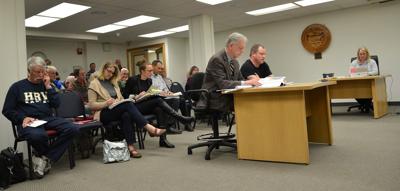
A DEETOUR HEARING held by the Hood River County Board of Commissioners included testimony from proponents Michael Robinson and Bob Benton, and opponents with Hood River Valley Residents Committee Meriel Darzen and Heather Staten.
A DEETOUR HEARING held by the Hood River County Board of Commissioners included testimony from proponents Michael Robinson and Bob Benton, and opponents with Hood River Valley Residents Committee Meriel Darzen and Heather Staten.
Disputes have resurfaced over a proposed upper Hood River Valley hotel. This time the debate entails a developer’s plans for a shrunken down 27-room building to supplement a concert venue.
The Hood River County Board of Commissioners heard testimony Monday on DeeTour Hotel from proponents Apollo Land Holdings LLC, and opponents Hood River Valley Residents Committee. Instead of making a decision that night, the panel tabled the follow-up hearing to April 2.
At issue was an Oregon Land Use Board of Appeals decision upholding the Residents Committee’s appeal that blocked permitting for the hotel. LUBA found three errors in the county’s approval of the project at the old Dee mill site, at the Lost Lake Road and Dee Highway juncture.
The state land use board sent the issue back to the county via remand to resolve.
Backers of the project then came forward with a scaled down 27-room hotel and sought county approval. (Originally in late 2015, Apollo representatives asked for permits to site a 50-room hotel. It would supplement a riverside amphitheater the county already okayed for development.)
County planners recommended the board approve the project with a set of conditions that meet legal requirements, such as following land use goals, and specific instructions for installing a septic system.
Michael Robinson, attorney for Apollo, praised the hotel as an economic boost and a smaller developmental impact than the original mill.
“I think it’s more likely that the future of the economy is represented by people staying at a hotel after enjoying a concert venue,” Robinson said.
He briefly signaled that another proposal for the DeeTour music venue itself could be close at hand, telling commissioners, “You’re going to hear another application,” in the next couple of months about the amphitheater.
Residents Committee representatives argued the hotel is an incompatible urban use in a rural area, and that the project should be considered for its cumulative impacts resulting from a “magnet”-like destination drawing visitors from Portland and beyond.
Attorney Meriel Darzen said the number of hotel rooms doesn’t define if something’s urban or rural. “You could shrink something down to a certain point and it still could be an urban use,” she said.
Heather Staten, HRVRC executive director, said, “You have to analyze the cumulative impacts of the hotel concert venue complex as a single synergistic entity — that’s how the applicant considers it.”
Staten contended that the hotel applicants have brought forward various piecemeal portions of the total project in an attempt to circumvent land use rules.
Four other county residents weighed in against the project, including people involved in agriculture.
Steve Hunt, an orchardist in Dee Flat, disagreed with Robinson’s statements about tourism representing the future for the area. He said there have been orchards nearby for a century, and “with any luck we will have another 100 years of orchards there.”
Some testimony favored the project.
Pasquale Barone, who formerly owned the Dee mill property for about 15 years before Apollo bought it, spoke in favor of the project. He said the former mill has been derelict for decades and the hotel would give it a new use.
“Rather than simplifying the process (LUBA’s decision) neutered the county’s ability to make decisions. I object to that because if we’re going to do anything for the county, then the decision ought to be made locally,” Barone said.
Commissioner Bob Benton recused himself as a commissioner from the matter at the beginning of the hearing due to his ties with Apollo. He testified on behalf on the project.
He said a traffic study had convinced him the Dee development’s impact on farmers wouldn’t be significant. The location doesn’t abut on farms, he said; “I’ve never seen a fruit tree from the site.”
Benton said it would be cost-prohibitive to “go into astronomical detail as far as everything people would like to see” about each aspect of the project as it progresses.
Commissioners said they weren’t ready to make a decision that night, given how much information parties had just turned in.
Commissioner Les Perkins said he’s still struggling on a goal exception involved in project zoning, and “it’s difficult to get a large amount of information right before you sit down for a meeting like this.”
Chair Ron Rivers closed the public record and continued the hearing to April 2 at 6 p.m.



Commented