THE DALLES — Ask Lupita Castillo why she works in harm reduction in The Dalles, helping substance users to stay safe and alive, and she has a heart-wrenching answer.
She’s lost seven friends to drug overdoses, including her best friend. “It gives me chills,” she said. “It’s very real. It’s very real.”
“I really want to help people keep their families together. I don’t want to see children left behind anymore,” she said. “I don’t want families to be torn apart. I don’t want people to be houseless and feel hopeless and feel they are incapable of anything just because they are stigmatized or because they are substance users.”
Castillo, a 2010 graduate of The Dalles-Wahtonka High School, works for Eastern Oregon Center for Independent Living (EOCIL). She herself struggled with drug addiction off and on for 10 years and was homeless for two of those years.
She not only had no access to help, she said, but didn’t even know what help looked like.
Now, five years sober, she is that help, and has been for awhile.
It was crucial to her in her recovery that she help others like her, precisely because she didn’t know where to turn when she was captivated by her addiction.
“We go into people’s lives, whether they are homeless or not, and we’re advocates for them,” she said.
She also goes out in the community, finding her clients in encampments, “because they aren’t coming to me.” She’s not scared when she goes out to them, “but I’m cautious.”
She talks to them about their “wants and needs and goals and their aspirations. And we really focus on not causing any more harm. To minimize harm is our biggest goal.”
The reason she does this work today is because of fentanyl, the powerful synthetic opioid that came roaring into Oregon in about 2019 and took so many of her friends.
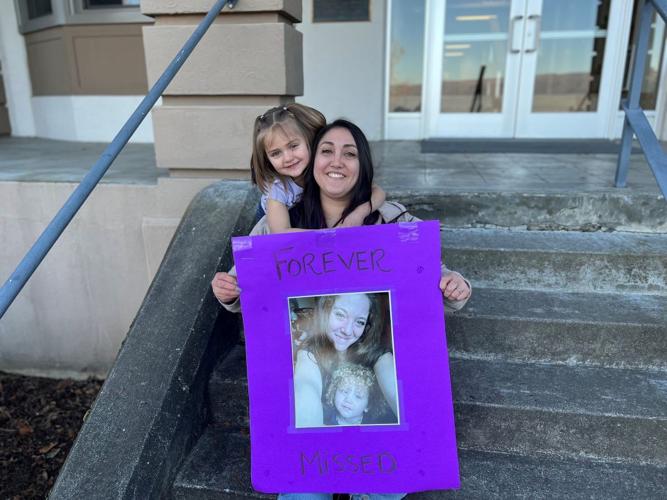
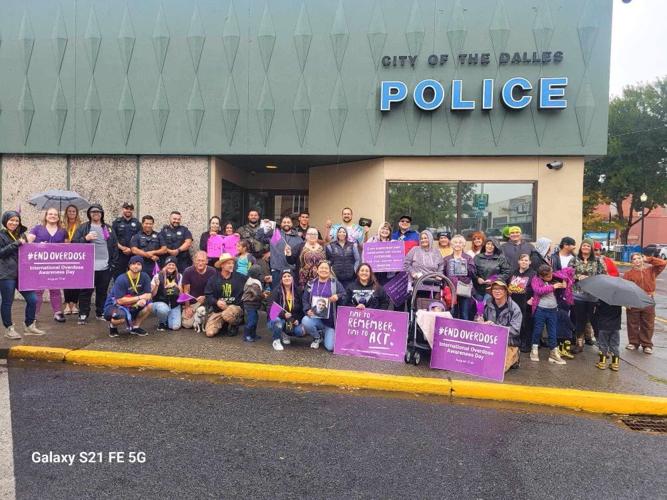
She didn’t see it really impact The Dalles until around 2021. She organized a drug overdose walk that year, making flyers herself and distributing them. “I was adamant about it.”
She talked to organizations, and her work was recognized by Debby Jones of YouthThink, the Wasco County drug and alcohol prevention program.
Then the Wings Program, which runs a sober house for women in The Dalles, introduced Castillo to EOCIL. She began working for EOCIL in March 2023.
The program covers 13 counties, and Castillo works in Wasco and Sherman counties and other areas.
Before joining EOCIL, she was a recovery mentor, working with clients of various local agencies.
Lupita Castillo organized an overdose awareness walk in 2021 after seeing the impacts of fentanyl in The Dalles.
Contributed photo
Castillo runs a needle exchange program. If someone has Hepatitis C or HIV and they are sharing needles, she said, they can infect whoever else uses the needles.
She also offers wound care kits, HIV test kits, fentanyl strips, safe sex kits and COVID tests.
She does countless referrals, hoping to get people into detox and drug treatment. That’s “very hard” to do, though, she said, because of the severe shortage of those resources.
The Oregon Health Authority recently estimated the state needed another 3,000 treatment beds to meet demand.
Once a month, she works with other groups including Mid-Columbia Center for Living, Wings House and Bridges to Change, a recovery program, doing community outreach.
“We go out into the community and give out food, socks, gloves, blankets, tents," she said.
She has seen the homeless community change its attitude toward naloxone (brand name Narcan), an opioid reversal medicine. At first, they didn’t want it.
They said, “'No, we’re fine, everything is fine.' Until they realized everything wasn’t fine and they were dying," she said.
Now, she said, “It’s ‘Please give us Narcan because by the end of the night we’re going to need it.’”
She said Narcan gets used by the homeless population “if not every day, every other day. It’s pretty serious out there. But I have seen less deaths since Narcan has been in The Dalles.”
She’s only had to administer naloxone once. The man, once revived, refused to go to the hospital, so she sat with him for hours. “He was still nodding out.”
Her goal, along with the wider prevention community, is to have naloxone become a standard part of every home first aid kit.
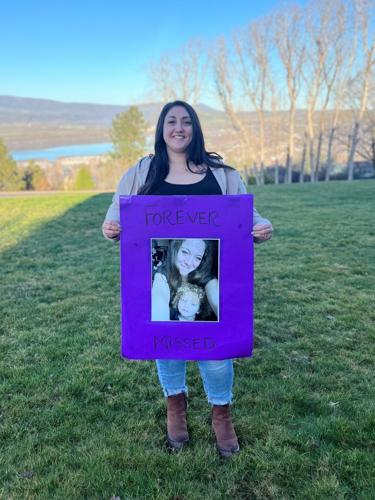
Lupita Castillo, a 2010 graduate of The Dalles-Wahtonka High School, works for Eastern Oregon Center for Independent Living (EOCIL).
Chelsea Marr photo
People tell her, “They love fentanyl, they even give it a cute little name like fetty and I hate it. And sometimes people try to get as high as they can to the point where they do overdose.
“It’s such a euphoric feeling, they enjoy that. That’s what I’ve heard countless times from people.
“Narcan can be enabling, but it’s also lifesaving and changing. There’d be a lot more dead folks without it,” she said. “It’s better to save someone’s life. You don’t know how many people that person’s death is going to impact.”
She said a lot of people consider houselessness a choice. “They don’t grasp the complexity of how these people became homeless.”
Something impactful in their lives made them homeless, she said.
Castillo should know. Born to a German mom and a Mexican dad, she had an abusive childhood. She ventured on her own as a youth to attend a faith-based after-school program at the old Salvation Army building.
She credits her faith with helping her attain sobriety. “It was like my cornerstone; it was like something that helped me pick myself up," she said.
She also credits being caught up in the criminal justice system with forcing her to finally get clean. “I was on probation, and I had requirements to fulfill like outpatient and mental health treatment services. Relapsing on probation wasn’t an option. It would more than likely result in a dirty UA and a failed urinalysis would result in a two-week sanction.
“There wasn’t any wiggle room to screw up, but it did more good than I realized at the time. It allowed me to make better decisions and start focusing on what really matters the most to me. It gave me enough space to change my life for the best.”
She is “pro-police, I do believe in police work. We need them.” But their hands are tied by Measure 110, which decriminalized drug possession in Oregon. While Measure 110 has been detrimental in that regard, she said, she feels it has also done a lot of good by funding more services for substance users.
So far, Castillo has not seen anyone escape addiction. “What can I do if they’re not ready? It’s their life, it’s their decision, it’s their choice to make. I can only do so much. I try and I try, and I don’t give up. I continuously help people.”



Commented