
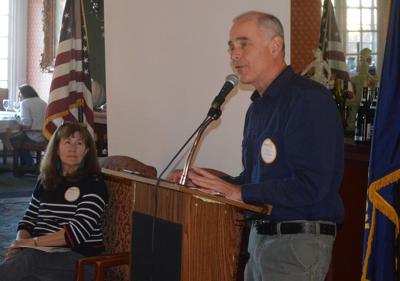
One chief petitioner and one opponent of a forthcoming charter amendment ballot measure spoke to both sides of the issue Thursday at a Hood River Rotary luncheon at the Columbia Gorge Hotel. Below are highlights of their responses.
Measure 14-67 would amend the City of Hood River Charter, asking, “Shall the city require a public authorizing vote before the city may dispose of city Parks?”
Tracey Tomashpol, speaking in favor, said the proposal provides a way for the community to actively take part in decisions about our parks and for everyone to have a voice. She is co-petitioner with Brian Carlstrom.
“It’s because I believe parks are valuable places for us, valuable places for our children to play and people of all backgrounds and experiences to come together.”
Arthur Babitz, speaking in opposition to 14-67, said, “We have a system where we have elected representatives to balance competing interests. That’s very fair. This takes one area — sell the parks — and says we should treat it differently. The question of whether or not to sell parks is a new category that is wholly unjustified.”
Ballots are due Nov. 5 at 8 p.m. (postmarks don’t count, so voters are advised to hand-deliver their ballots instead of mailing them, after Oct. 29.)
Measure 14-67 is for in-city voters only.
Measure 14-67 is for in-city voters only.
The full 14-67 ballot summary reads this way: “Adds a new chapter to the City Charter. Requires a public authorizing vote before the City may dispose of City parks for any purpose other than promoting or enhancing recreational enjoyment by the general public. Defines ‘City Parks’ as the city’s collection of public parks so designated by the city as of Jan. 1, 2019, and new parks so designated after that date. Defines ‘dispose of’ as sale or transfer of any property rights of all or part of the collection of City parks by lease or other means for any purpose other than promoting or enhancing recreational enjoyment by the general public ...”
Tomashpol and Babitz dined with Rotarians at the same table, with supporters Susan Crowley, in favor of the measure, and City Council Member Megan Saunders, opposing it. Rotary past president Staci McCarthy acted as moderator.
Tomashpol said, “I’ve been coming to the Hood River area since 1991, and at least a decade before I started to come here decided to contribute to community organizations,” starting with Waterfront Park. “My heart’s been touched by this area a long time. We sometimes are asked why we chose a charter amendment: It’s just a way that has a high bar before it can be changed. City ordinances can easily be changed and resolutions sort of come and go over time but a charter amendment reflects what all of us in a community believe and value. It’s part of our Oregon democratic background and we get the chance to decide on state and local initiatives. If you look at charter initiatives across the state, there’s a variation in what they support and it felt for us this was a good strong way for a community that clearly appreciates the outdoors and loves its community parks to give people a voice in those parks,” Tomashpol said.
Babitz introduced himself as an engineer with 40 years’ experience, elected to City Council in 2016, who served three terms as mayor. “I worked hard to straighten out the city’s fiscal mess and am still focused on problem-solving. It’s what I do.” He served as City Landmarks Committee chair, and on the budget committees for Columbia Gorge Community College and Hood River County. Babitz is also chair of the State Trail Advisory Committee and volunteers as photo curator at The History Museum of Hood River County, publishing a daily online photo blog for the past five years.
“ I know how we get from one place to another and how our politics has a role in history,” he said.
“ I know how we get from one place to another and how our politics has a role in history,” he said.
“When I was with the city, we built two new parks and restored a third. This is not a question of liking parks or not liking parks,” Babitz said. “I’m drawn to big problems and I don’t believe this is one of them.”
He asked for a show of hands, and got none, to two questions: “How many people here hate parks?” and “Who thinks government moves too fast?”
“We have ample recourse to challenge government,” he said. “Government is slow and ponderous, and doesn’t need our help to slow it down. What I see here is a proposal that appears to be borne of frustration and anger, and I completely understand that frustration and anger, but history says it’s a bad place to start with writing policy on complicated issues.”
Citing the example of what he described as confusing complexities of tax limitation initiative measures, Babitz said, “What I learned is, when in doubt on a charter amendment or constitutional amendment, vote no. There are unintended consequences and the way to avoid them is by not making any changes. It is much easier to stop government from doing anything than creating or accomplishing anything.
“This focus on an additional tool to stop government presumes that an election isn’t enough, that recall isn’t enough, and legal recourse is not enough. I think it is. I want to focus on creating parks, I want to focus on creating housing through code changes. I feel this will hurt those efforts,” Babitz said.
Babitz and Tomashpol answered McCarthy’s question based on the Rotary Four-Way Test tradition including: “Is this the truth?” and “Is it fair to all concerned?”
McCarthy asked both to “explain if (the) proposal has been vetted in a truthful manner:”
Tomashpol said, “Some of the language used by opponents in writing have been attacks on people and their intentions, which haven’t been helpful. Some of the opposition letters are mistaken, and may be because many of us who have spent months looking at the language around charter initiatives and amendments and what they do perhaps understand them a little better and perhaps some of the letters are misinformed.
“A council member wrote that changes are forever, and in city council, stated, ‘You don’t amend on a single issue,’ but Oregon rules on charter initiatives require they be on a single issue, and sometimes they get changed because of unintended consequences and sometimes voters change their minds and they get voted out. Local values change over time and local issues need changing over time,” Tomashpol said.
“A council member also said it ‘undermines the integrity of democracy,’ but Oregon gives us the right to do this as part of citizen democracy. Citizen initiatives and citizen votes support democracy.”
Tomashpol debunked the claim by some opponents that a charter amendment would be “expensive.”
“But this measure will only require a vote when the council decides to sell a park,” Tomashpol said. “At other times, let’s say the councilors feel they have a good argument to present to the city for sale of a park, and many times it may come when there is something else on the ballot, and at that point the extra decision on the ballot is a marginal cost, not free but it’s not the extra expense the opponents have suggested. It’s also in my opinion that the loss of a park forever could cost the community.”
Babitz said, “I don’t question Tracey’s intentions or Susan’s (Crowley) intentions. They are active, they regularly attend council and planning commission meetings. They are not the problem and their intentions are not the problem. But I will say I am confident, if this passes, we will have less park land in 20 years than if it doesn’t.
“I talked about unintended consequences and saw a latter claim of ‘unintended consequences is alarmist nonsense.’ I am not prone to alarm nor to saying things flippantly. I read what was described as simple code and after the simple statement that sale of park has to go through public vote; there are 40 words describing what is a park and 39 describing what is a sale. I spent my time constructing scenarios, how would I expect someone to use this to stop a project they don’t like. I have seen that done time and time again in government. One has already happened, the dog park; the dog park and (Morrison Park) disk golf were intended to be temporary uses,” Babitz said.
“The city has looked at dog park, decided it is not worth taking the risk, because reverting from a dog park to use by the treatment plant, which is likely necessary at some point in the future, will be more difficult that it would be without this. I’ve looked at mechanisms to develop linear parks and there are mechanisms the city has in development code, where you acquire (land) through some statutory mechanism and you sell part of it or all of it, retaining easement for trail rights, and then use those funds to purchase a next step for development. I can easily construct a challenge to that transaction under this language. But it really doesn’t matter what the intentions are, because the courts don’t care about the intention of the drafter or petitioner. Before you can even get to court, the fear of legal challenge will kill government interest.
“I don’t want to be here in 20 years bemoaning the lack of parks. Let’s not pretend City Council is going after Jackson Park and Wilson Park,” for rezoning, Babitz said.
Tomashpol defended the fairness of the proposal by saying, “It’s true that everyone here loves and appreciates their parks, but I will go a little further and say that parks are one of the fairest things we have. They are open spaces everyone can enjoy. There are no tests to get in. They are open to all.
“We meet our neighbors there and celebrate community there. We believe the people of the city are the ones who own the parks, the parks are held in trust for us by the city so the measure is fair to all concerned because those city voters, the citizen owners, make decisions when city council makes the recommendations that the parks are to be sold or otherwise disposed of. Local leaders make their case for tax and bond measures, and just as they make those cases to us and people decide on them, I believe this measure, the change in the charter, will let the city councilors make those arguments to us, and I do trust the people to make good decisions about those parks.
“The city voters will cast their vote. It’s democratic; not everyone will like every outcome, but every voter will have an equal voice,” Tomashpol said. “A voice is a vote but it is fair. It won’t be the loudest voice in the room, it will be the voice of people who aren’t able to come to council and planning commission meetings. It won’t be the voice of the group that musters the biggest support to come and speak at those meetings. In the privacy of their home they will be looking at the ballot, reading about the measure, letters to the editor, talking to folks at their church or community groups, and that makes the measure and that idea fair for all.”
“We meet our neighbors there and celebrate community there. We believe the people of the city are the ones who own the parks, the parks are held in trust for us by the city so the measure is fair to all concerned because those city voters, the citizen owners, make decisions when city council makes the recommendations that the parks are to be sold or otherwise disposed of. Local leaders make their case for tax and bond measures, and just as they make those cases to us and people decide on them, I believe this measure, the change in the charter, will let the city councilors make those arguments to us, and I do trust the people to make good decisions about those parks.
“The city voters will cast their vote. It’s democratic; not everyone will like every outcome, but every voter will have an equal voice,” Tomashpol said. “A voice is a vote but it is fair. It won’t be the loudest voice in the room, it will be the voice of people who aren’t able to come to council and planning commission meetings. It won’t be the voice of the group that musters the biggest support to come and speak at those meetings. In the privacy of their home they will be looking at the ballot, reading about the measure, letters to the editor, talking to folks at their church or community groups, and that makes the measure and that idea fair for all.”


Commented
Sorry, there are no recent results for popular commented articles.