
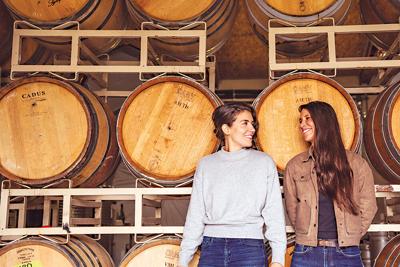
CASCADE LOCKS — Port commissioners heard a 30-minute report from Landmass Wines at their Sept. 18 meeting.
Landmass Wines is a current tenant in the port-owned Flex 2 building, were they have a “wonderful business” and always pay their rent on time, noted port Executive Director Jeremiah Blue. Now outgrowing that space, proprietors Melaney Schmidt and Malia Myers hope to build a larger, more elegant winery in the port area, with space for events and room to sublet and mentor other beginning winemakers.
Myers and Schmidt, partners in life and business, started Landmass about six years ago and now enter their seventh grape harvest. “Landmass, for us, is something that we built from the ground up, and it has really started to flourish ... we started off kind of small and then it just sort of skyrocketed,” Schmidt said.
They’ve received accolades and recognition; now, they’re looking at how they can draw more visitors to Cascade Locks — and encourage them to spend all day, supporting local businesses, rather than move on to Hood River or White Salmon.
“We’re trying to drive people to these other businesses, right? Like, ‘Come see us but also check out all these other really cool things,’” Schmidt said.
Instead of shuttering their old space, the Landmass proprietors hope to transform it into “an incubation space for other small up-and-coming wine makers,” staying close enough to mentor the new inhabitants.
Their own business has begun manufacturing about 5,000 cases a year, an amount the two proprietors are comfortable with.
“What people have really latched on to with us, is that since we’ve bootstrapped this business and we are our own owners, we have no investors. We kind of have been able to do whatever we want, as long as it satisfies the two of us,” Myers noted.
They started in the Willamette Valley, but three years ago packed up their operation and moved to Cascade Locks. “People thought we were nuts,” Schmidt said.
For the last two years, they’ve placed either second or third on one listing Oregon’s “best” winemakers. For perspective, there’s about 1,100 different wineries in Oregon, Myers said.
A lot of their fruit comes from Washington side of the Columbia, also from The Dalles and Mosier. But also a few fruit contracts come from the Willamette Valley.
“I think people have never seen the likes of us in wine, making wine fun and making wine also delicious,” Schmidt said, adding, “The preservation of the land is extremely important to us ... The beauty of wine is, where does human intervention meet the natural?”
They are interested in moving to larger property near their current location — and also near the recreational trails: “We want to build something really beautiful for our winery, but we also want to have something that’s some extra visiting experiences or activations,” she said.
The conversation moved to commissioner’s new Strategic Business Plan and their desire for a “cohesive vision” for businesses on port land, to preserve the beauty of these tracts and avoid conflict between tourist spaces and industrial buildings.
Commissioner Carrie Klute noted there has been general reluctance to sell port land or assets, partly because the commission aspires to become financially independent of Bridge of the Gods someday. However, they are open to long-term leases.
“We want to spend our entire career here,” said Schmidt.
The port expressed enthusiasm for the partnership and invited them to keep working on these plans.
“It’s delicious wine, you all should try it and it’s really nice that they’re establishing here in town,” commissioner Albert Nance said later in the meeting.
Bridge of the gods
In other news, the commission voted to appoint commissioners Brad Lorang and Carrie Klute to help staff score contractor’s proposals for upcoming Bridge of the Gods safety and preservation studies.
These studies, funded by a $6 million government grant, aim to determine how Bridge of the Gods can be updated to preserve it, make it safer from seismic events like earthquakes, and potentially accommodate people on foot.
A Request for Project Proposals (RFP) has been sent out, and by Sept. 17, the port received one proposal. At 4 p.m. the next day, submissions closed and port staff began scoring all proposals. Staff hope to approve a contract by Oct. 15.
In other news
Also, Ixtapa’s new restaurant location near the Marine Park is on track to open this winter season, with one more piece of equipment left to update and install — an essential hood extension that will get the dishwasher’s moist exhaust outside the building.
The port also unanimously approved their new grant program for 2024-2025.
In the consent agenda, commissioners approved ratification of bills in the amount of $269,505.08, approval of August payroll in the amount of $45,269.56, and September payroll in the amount of $45,071.56; and minutes for their last three meetings.
Flex One is emptying, with two tenants gone by the end of September. Blue noted the port hopes to provide a single business with a simpler lease for an entire 2,500 to 10,000 square foot space.
The Oregon Office of Emergency Management declined both the port’s resiliency hub grant requests. “That’s disappointing. We still want to move forward with the generator project at the school ... but we are going to need to find some additional funding,” Deputy Director Genevieve Scholl noted. “Hopefully, we’ll have some recommendations before the snow flies.”
A generator could provide a power during any winter blackouts or fire-related emergencies.
Summer on the updated recreational trails, including bills and reports from contractors, is also nearing completion. The port’s next meetings were scheduled for Oct. 8 (after press deadline) and Oct. 21.


Commented
Sorry, there are no recent results for popular commented articles.