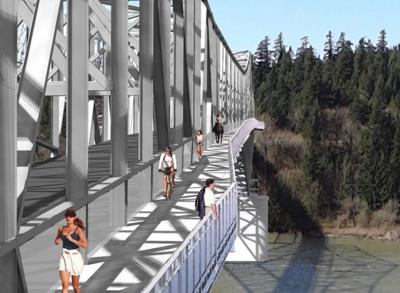
A RENDERING shows what an option for a bike-pedestrian crossing on the Bridge of the Gods might look like. The Port of Cascade Locks is lobbying in Washington, D.C., for federal help in carrying out a study into the project. (Page A1 bridge image was taken on a community bridge day event in 2015.)
A RENDERING shows what an option for a bike-pedestrian crossing on the Bridge of the Gods might look like. The Port of Cascade Locks is lobbying in Washington, D.C., for federal help in carrying out a study into the project. (Page A1 bridge image was taken on a community bridge day event in 2015.)
Cyclists and pedestrians share a narrow path at the Bridge of the Gods, but that would change if a dedicated crossing for those travelers becomes a reality.
The emerging plan rolled closer to fruition in March. The Port of Cascade Locks last week submitted to the Oregon and Washington Federal Lands Access Program (FLAP) branches a proposal outlining challenges and next steps in the project — and seeking federal grant aid.
Officials with the port are eyeing the federal program for help carrying out a study into what’s required leading up to building the Columbia River bike-pedestrian crossing.
“The port has received a great amount of positive support for this project, and we feel we submitted a strong proposal,” Bridge Manager Ryan Vollans said.
This week, several port staff and commission members are in Washington, D.C., lobbying for this project and other port priorities, Vollans noted.
The port’s proposal describes project needs, conceptual solutions, cost at a planning level, and a rough schedule. The whole plan is broken into two parts.
Phase 1, pitched as a planning level study, will support evaluating and selecting a preferred project type, as well as other improvements like improving the surrounding trail system.
Phase 2, which is not part of the port’s initial request for funding, would push the resulting alternative to final design and construction.
Over the past few years, the port has researched the issue of crossings at Bridge of the Gods. In 2012, a feasibility study looked into the topic. In December 2015, the port teamed up with the Pacific Crest Trail Association and partners to do a study titled “Improving Pedestrian Safety and Trail Experience at the Bridge of the Gods,” which outlined issues and paths ahead.
Safety and usability are at the crux of the discussion.
Tourism is boosting the number of cyclist and pedestrian crossings each year, according to the port. Bridge of the Gods, a toll crossing owned and ran by the port, is considered part of the 2,650-mile Pacific Crest Trail.
In 2017, the port counted nearly 7,800 pedestrian users, including PCT through-hikers. That’s a congestion challenge, given that BOTG is the only true pedestrian crossing over the Columbia River for 43 miles east or west.
“As tourism and recreation in the area continue to increase, we are seeing more potential for conflicts between vehicles and our pedestrian and bicycles users,” Vollans told the port commission in a February staff report.
He noted that a pedestrian structure built and attached to one side of the bridge would “greatly improve the safety and access issues which currently exist with the bridge users.”
The port’s concept description sent to federal officials includes an option for how a crossing would function:
Retrofit the bridge with an overhanging structure. This concept involves a structural steel extension of the bridge’s floor beam to make way for a pedestrian facility, “outboard of the main cantilever truss spans.”
It would cost $15-25 million.
The port notes this option benefits from simplified construction, less traffic disruption, and an improved user experience due to its separated path. Key issues remain in structural feasibility from retrofitting the bridge for the weight.
To pay for a study into the project, the port prepared a grant request to FLAP. (The project is included in the port’s 15-year plan for the bridge’s maintenance and preservation.)
This April and May, the Western Federal Lands will be reviewing all submitted projects. In June and July, they will conduct field reviews and in August a selection committee will make final selections for the projects.



Commented
Sorry, there are no recent results for popular commented articles.