
By Flora Gibson
Columbia Gorge News
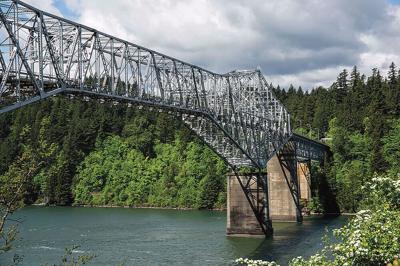
CASCADE LOCKS — Studies funded by a $6 million state grant, will determine how the port-owned Bridge of the Gods can be made safer from earthquakes — a danger its 1926 builders didn’t consider when they perched the structure’s ends on earthworks and pinned it together with parts that might not withstand the seismic forces of a big quake, Port of Cascade Locks announced last week.
Cascade Locks released a request for proposals (RFP) on Aug. 21, asking contractors to put in their bids for the work before Sept. 18. If all goes as planned, the studies would continue through June 2027.
Constructed in 1926, the almost 100-year-old bridge connects Cascade Locks in Oregon with North Bonneville and Stevenson in Washington. The port of Cascade Locks purchased the structure in 1961 and has owned, operated and maintained it as a toll bridge ever since, according to the RFP.
Emergency response vehicles depend on the bridge to reach Cascade Locks, North Bonneville, Stevenson, Carson and Corbett. It’s also crucial for commerce and travel, and the Pacific Crest Trail — a major conduit of tourism and recreation activity — crosses the Columbia River here.
A big earthquake in the next few decades is not unlikely, according to studies from The United States Geological Survey (USGS). Odds are better than one in three for a partial rupture of the Cascadia Subduction Zone — the 600-mile-long fault that follows the coast from British Columbia to California — in the next 50 years. And smaller, local faults in earth’s crust can also cause earthquakes.
If “the big one” ever happens, Bridge of the Gods would be a vital link for recovering communities, but likely wouldn't remain operational.
It’s three segments are each a different type of structure, with different vulnerabilities, according to that study. Some components may not have the strength to resist or transfer the forces an earthquake could exert on the structure and could break; others are unstable and could tip over, resulting in extended closure to fix.
While the bridge footings may or may not be on bedrock, the ends of the span rest on soil. An earthquake could “liquefy” that soil, turning the bridge’s sturdy support into a landslide.
In 2024, the Oregon legislature approved $6 million from the state’s General Fund to pay for studies on how to retrofit the bridge, making it safer from earthquakes, and adding a pedestrian walkway for Pacific Crest Trail hikers — the current bridge doesn’t even have a sidewalk.
The $6 million will cover planning, permitting, environmental assessments and construction bid documents. To actually construct these changes, the port will need to get more funding. With this RFP, the port is seeking a contractor to organize the studies, select other contractors for the smaller jobs, update the bridge’s preservation and maintenance plans, and come up with those detailed designs, materials requirements, documents and assessments — everything needed to get the retrofits ready for construction.
By 2027, detailed designs are due. The port’s considering pursuing another $6 million from Washington to fund the next stage — actual construction.


Commented