
By Aziza Cooper-Hovland
Columbia Gorge News
At the beginning of fall, I got to visit Chicago, another “windy city” (so named for its politics not its meteorology) on a river that is thinking about a lot of the same issues we are. On an architectural boat tour, the guide explained that adaptive reuse is one of the most important ideas shaping the city today. Downtown Chicago is very densely built, and while the suburbs are sprawling, the city itself has been shaped by years of changing industrial landscape.
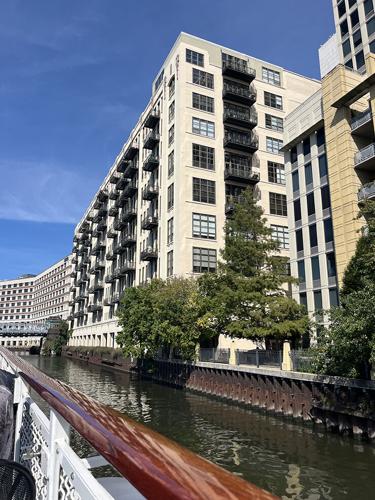
With industry comes the need for housing. Many of the large warehouse buildings along the river that were once home to industries like mail-order giants Montgomery Ward and Sears, are now workforce housing. The guide, Cynthia, from the Chicago Architecture Center said that the hanging balconies are one of the main features that let you know a building has been adapted from a previous use into housing because a balcony is an attractive feature that can be added to the exterior of the building.
Chicago also has a wave of new tech headquarters taking up residence, which have also found a way to reuse the buildings that were once part of Chicago’s old life. The massive Old Post Office building now houses corporate offices for Uber, Walgreens, and PepsiCo after an architectural addition in 2016.
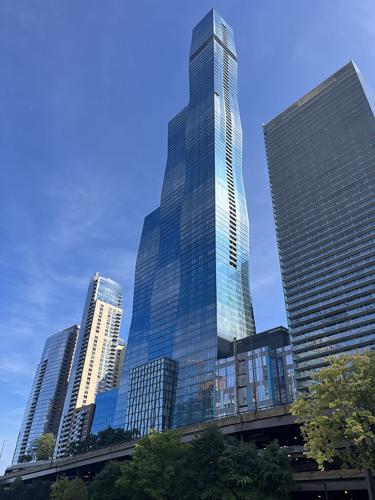
One of the factors that must be considered when building the skyscrapers that dominate the Chicago city skyline is wind load. Not only must these buildings be able to hold themselves up on their foundations, but they have to keep themselves from toppling over against the sideways force created by the wind blowing into the building. The St. Regis, designed by architect Jeanne Gang, a McArthur Fellow, accounts for this in part by creating an open “blow-through” level which reduces the force the tallest of it’s three towers has to account for.
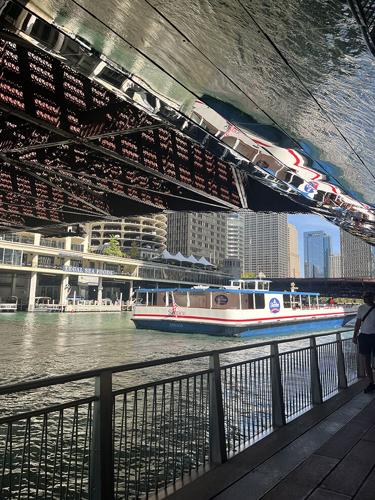
The Chicago River hasn’t always been the scenic ribbon through the city it is now. There was a time when it was so polluted due to waste from manufacturing and sewage from the Union Stock Yard and the meat packing industry that it caught fire multiple times and was known as “Bubbly Creek.” However great efforts have been made to clean and rehabilitate the river in the 1990s, and now buildings that were once built without river-side windows to minimize the smell, are now prime real estate. One step taken in 1900 to preserve the drinking water for the city sourced from Lake Michigan was reversing the river’s flow, the only time a river has been purposefully and permanently reversed by human intervention. Contentiously this did end up sending all of Chicago’s waste through the Chicago Sanitary and Ship Canal downstream to St. Louis who tried to file a lawsuit, but by then it was too late — Chicago rushing to complete it before the lawsuits could stop them — and the water was already flowing backwards. One way that the riverside has been revitalized is with the Riverwalk, a pedestrian path along the length of the river downtown that keeps that property protected for public use. This public park space guideline has also created some interesting design solutions on new riverfront development, like at 150 North Riverside, nicknamed “the tuning fork,” a two-acre parcel described by our guide as a “postage stamp” that supports a 54-story building with a footprint on only 25% of the parcel, and a riverwalk, amphitheater and park included. One of the architectural marvels included to make this structurally sound is called “tuned liquid sloshing dampers” — basically very large bathtubs that counteract the lateral movement of the building through the law of inertia (these are also part of the St. Regis’ design).
The work of cleaning the river is not yet done; there are still fish advisories about mercury and PCBs in carp, catfish, bass and other fish found in the river (something we around the Columbia River are also familiar with), but in late September it was clean enough to host its first open-river swim in almost a century with 250 swimmers participating.
These architectural beauties are just some of the stunning design throughout the city which also boasts public art (I enjoyed saying hello to Cloud Gate, more commonly known as “the bean”), a lovely transit system that took me to restaurants, colleges and museums (my personal favorite was the Chicago Art Institute though meeting Sue, the most complete T-rex fossil, at her home in the Field Museum was also a highlight) and many more wonders I’ll have to save for my next trip.


Commented