Playing a special video game improves emergency doctors' decision-making in high-pressure situations.
ER medics who participated in the trauma triage game outperformed their peers who only received standard education when it came to properly caring for severely injured older adults.
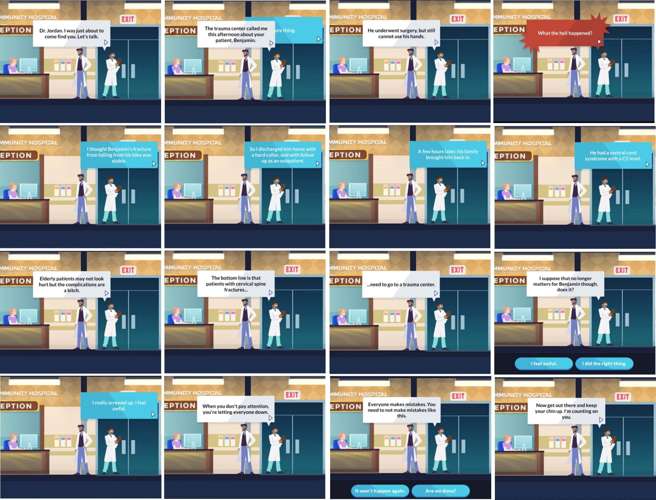
Experts say the game — called Night Shift — could be an "effective" alternative to costly and time-consuming recertification courses, while also improving adherence to life-saving triage guidelines.
Study lead author Dr. Deepika Mohan said: “An increasing proportion of seriously injured patients are older than 65 and, unfortunately, when they come into the emergency department, they are under-triaged because their injuries are more insidious.
“People may not think a rib fracture is a big deal. But if an older person falls and suffers four rib fractures, their risk of dying is the same as a young person shot in the liver.”
She said triaging seriously injured patients can involve split-second decisions, where doctors quickly consider everything they know about a patient and their injuries, and then use their knowledge of medicine to decide the right level of care.
That could mean putting the patient on a medical helicopter for transfer to a hospital with more trauma expertise and resources, or discharging them to recover in the comfort of their home.
(Night Shift 2024 via SWNS)
By Talker
Older adults are under-triaged as much as 70% of the time, according to the study published in the journal JAMA.
Mohan, from the University of Pittsburgh's School of Medicine, became interested in improving appropriate triage practices after a frustrating night at work consulting on patients who didn’t need to be there.
She then saw a patient who was under-triaged and had a long delay in transferring to her trauma center for appropriate care.
Mohan says she was witnessing the outcome of ingrained decision-making behaviors — sometimes called "mental shortcuts" or heuristics — which are notoriously hard to change.
After talking with decision scientist Baruch Fischhoff, of Carnegie Mellon University, she hit on the idea of building a video game that could let emergency physicians subconsciously learn from their decisions without impacting real patients.
In 2016 she created the first version of the game Night Shift with Schell Games, a Pittsburgh-based educational and entertainment game development company.
The game features a young emergency doctor triaging trauma patients in a high-stakes, emotional setting.
Players' decisions garner reinforcing praise or admonishment.
The game also features puzzles that the player must solve in under 90 seconds with limited clinical information.
Mohan and her colleagues followed 800 doctors who staffed the emergency departments of nontrauma centers in the U.S. for a year.
Dr. Deepika Mohan. (University of Pittsburgh via SWNS)
By Talker
Half were chosen to play the game for two hours and then quarterly for 20 minutes, and the other half simply attended regularly scheduled continuing education, which doctors are required to receive to maintain certification.
Doctors who played the game had lower rates of under-triaging severely injured older patients, at 49%, compared to a 57% under-triage rate in those who did not play the game.
Conversely, playing the game was not associated with over-triaging; both groups over-triaged at the same rate.
Mohan said it provides some reassurance that playing the game didn’t just increase doctors' willingness to transfer injured patients — rather, it may have improved diagnostic abilities.
She says it indicates that the way the game leverages storytelling to tap into emotions or uses puzzles to shape decision rules may be rewiring heuristics and effectively changing behavior.
Mohan noted that physicians assigned to the game had the best adherence to the trauma triage guidelines within 30 days of playing it, with the effect fading until they played the game again.
She said: “Quarterly exposure for 20 minutes may not be the best ‘dose.’
“Perhaps playing the game more frequently and for less time would be better — maybe even a ‘microdose’ of 90 seconds each week.”
Mohan says the next steps involve testing that hypothesis, along with an ambitious project to tackle decision making across the spectrum of trauma care.
She added: “It would be a multicomponent behavioral intervention at multiple levels.





Commented
Sorry, there are no recent results for popular commented articles.