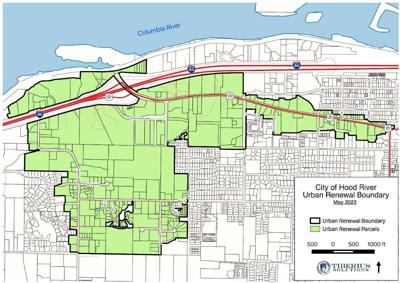
During the Aug. 28 Hood River City Council meeting, councilors approved Ordinance No. 2077, which establishes the Westside Urban Renewal District effective Jan. 1. The plan sets goals and objectives for projects related to affordable housing, transportation, Parks and Recreation, administration and equity framework.
During the Aug. 28 Hood River City Council meeting, councilors approved Ordinance No. 2077, which establishes the Westside Urban Renewal District effective Jan. 1. The plan sets goals and objectives for projects related to affordable housing, transportation, Parks and Recreation, administration and equity framework.
HOOD RIVER — During the Aug. 28 Hood River City Council meeting, councilors approved Ordinance No. 2077, which establishes the Westside Urban Renewal District effective Jan. 1, and heard the first reading of Ordinance No. 2078 that regulates vehicle storage in the public-right-of-way.
Roughly 18 months in the making, the Westside Urban Renewal District is officially set to take effect on Jan. 1, 2024. The 406 acres of land was agreed to by the Hood River County and other taxing districts within the boundary were consulted by City Manager Abigail Elder. Elder said that the elected officials of the districts are glad the city is addressing issues like traffic and affordable housing.
“My very first week at work was where this concept was introduced,” Elder said. “I’ve been here about 18 months and that has been a focus. So it’s really satisfying to see that come to a conclusion.”
The maximum amount of indebtedness that may be issued is set at $146,700,000. Maximum indebtedness is defined in the plan as “the amount of indebtedness secured by a pledge of tax increment revenue that can be spent on projects, programs and administration throughout the life of the Plan.”
The plan sets goals and objectives for projects related to affordable housing, transportation, Parks and Recreation, administration and equity framework. The Urban Renewal Agency (URA) will file annual reports that shall include financial analysis of the plan, including updated projections and updates to project lists. The URA will consult and confer with affected taxing districts regarding the results of this financial and project update and will consider revenue sharing or shortening the time frame.
Columbia Area Transit and the Hood River Library District voiced how the new urban renewal would affect them and made their concerns known. In a letter to addressed to the city, the Library District explained that over the next 25 years the plan would remove more than $6 million from the library’s budget. Elder pointed out that some of the $6 million would not be available without the creation of the district. Elder said that the new district will spur development which raises the property values, and in turn increases revenue.
The letter states, “While the goals of this plan are laudable and will finance some needed public improvements, we object to the fact that the Hood River County Library District will become one of the major funders of the project due to our tax rate of $.39 per thousand.”
Currently the library operates on an annual budget of $2 million.
“Generally, I would say, taxing districts recognize the need,” Elder said. “Even the library district who is concerned about their financing, recognize the need for something to happen.”
New parking enforcements
In April and in response to concerns from multiple residents, city councilors asked staff to review parking code and enforcement strategies to limit long term parking that do not meet the requirements for abandoned or unlicensed vehicles in the public right-of-way. In June, the council reviewed potential language which would amend sections of the Municipal Code to limit the length of time a vehicle could be parked and/or stored in the public right-of-way.
Council asked staff to conduct research and provide additional information at a future meeting. The city attorney worked with Police Chief Neal Holste and Code Enforcement Officer Marty Morgan to formulate language on specific time allowed and distance required to move from parking spot to parking spot. In July, Holste presented options for council to prohibit parking ranging from 72 hours to 30 days. A majority of council members preferred a plan that would “prohibit parking on the public right-of-way or on public property for a period not more than seven days without moving; and that vehicles, RVs, trailers and boats must be moved at least two blocks from where the motor vehicles was originally parked,” according to the ordinance.
These rules apply to — but are not limited to — vehicle owners if the vehicle’s license plates are missing, expired or its registration sticker has lapsed. The ordinance also specifies that any vehicle that is rusted or wrecked, dilapidated, partially dismantled or inoperative condition may not remain parked in one location for more than 168 hours — or seven days.
Violation of the regulations may result in a misdemeanor and civil infraction “if a motor vehicle, recreational vehicle, trailer, or boat has one or more missing or flat tires, doors or windows that are broken, missing or open for more than one week (168 hours).”
The council approved the first reading 5-2. Councilors Tim Counihan and Gladys Rivera voted nay.



Commented
Sorry, there are no recent results for popular commented articles.