
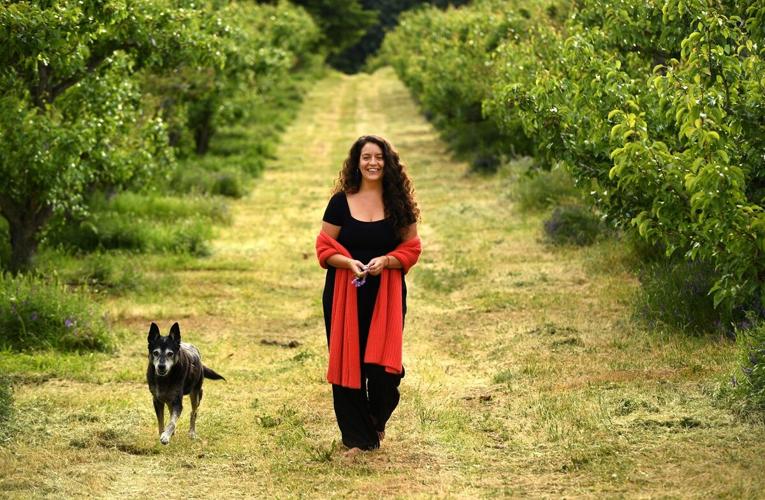
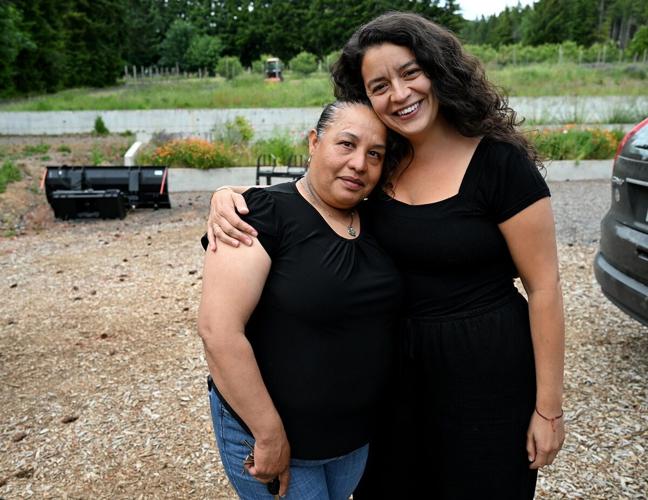
Morella Mora understands community as something far deeper than proximity. To her, community is the belief that no one should disappear simply because a system was designed not to see them. It is a philosophy rooted in mutual aid; the quiet, deeply human understanding that survival has always depended on people caring for one another when institutions fail to do so.
In the Columbia River Gorge, Latino families make up a significant part of the workforce sustaining agriculture, hospitality, construction, and tourism. Because of this, Morella has spent years asking a difficult question: What does it mean for a community to depend on people while still leaving them unseen?
“Mutual aid is not charity,” Morella says. “Mutual aid is the process.”
Long before Morella became the first Latina immigrant and only renter to serve on White Salmon’s city council, she understood what shaped her life. A family history that carried across borders and generations. She did not learn the philosophy from books or politics alone, but from witnessing generations of women forced to rebuild their lives through one another. “There is incredible labor and beauty in these communities,” she says. “People deserve to feel reflected where decisions are being made.”
Nearly 40 percent of the Gorge’s population is Latino, yet many families remain underrepresented in civic leadership, wellness spaces, housing access, and public decision-making.
Morella’s story begins thousands of miles away, where her mother, Marta, was a university student in Chile when the government was overthrown under Augusto Pinochet’s dictatorship. People around her disappeared. Others were killed. She was blacklisted from the university and eventually exiled after being identified and named. Her dreams of becoming a teacher and building a life in her homeland were abruptly taken from her.
“She was in her twenties,” Morella says. “Her life was completely upended.”
Her mother fled to Paris, where a large Chilean exile community had formed. Eventually, she traveled to Venezuela, where she met Morella’s father, Gerardo, a driver working for the influential Otero family. Her mother worked as a nanny for the same influential family. And this is when Morella was born. Her mother was caring for the children in a wealthy household while raising her own daughter alongside them. In many ways, Morella grew up inside that world; in its rooms, its rhythms, its language of comfort and abundance. She played alongside the children she was raised with. She moved through the same hallways, another child in the house. But in just as many ways, she was not. Closeness is not the same as belonging.
Her earliest sense of home was a lived contradiction: being part of a family's daily life while quietly understanding that her permanence there was not guaranteed in the same way. Although she would not have language for it then, this was where she first learned that care and exclusion can exist in the same room. She was included in the fabric of the household, but not fully held by it.
Later, Morella’s tío (uncle) Ricardo, a gifted Chilean musician who had left before the dictatorship, fell in love with an American woman in Paris and moved to Connecticut. Morella’s parents divorced when she was five, and her mother made another impossible choice: she followed her brother to the United States as a single mother, unable to speak English.
“She had no idea what awaited her,” Morella says.
America was grueling work in fruit-packing warehouses and cleaning jobs. But her mother didn’t stop. She went to night classes to learn English. Then she went to college to earn her bachelor’s degree, then a master’s degree. Eventually, after years of sacrifice, Morella’s mother became a clinical social worker helping immigrant families navigate trauma and the very terrain she herself had survived.
During this time, Morella and her mother’s survival depended on the women in their community. Morella remembers bedrooms rented out to make ends meet. She remembers never having much, but never feeling without. She remembers her mother creating warmth out of scarcity.
“I never remember being hungry,” she says. “She made a home.”
Around them, a circle of Latina women formed: Puerto Rican, Dominican, Peruvian, and Chilean immigrant mothers building a life together in Connecticut while carrying vastly different stories of displacement and struggle. They became one another’s childcare, emotional support, emergency contacts, interpreters, and family.
“They became my tías (aunt),” Morella says. “They were incredible women providing each other support to make it happen.”
This, Morella believes, is what the public often fails to understand about immigration.
“People are presented as a monolith in the media,” she says. “We talk about what is happening to immigrants, but not who they are.”
Her own life reflects these complexities hidden beneath political language. She was born in Venezuela but raised culturally Chilean. As a child in Connecticut, she was placed in special education because she did not speak English, only to be later moved into gifted programs. Her mother, undocumented for a period of time, paid taxes while receiving no public assistance because she did not qualify. Meanwhile, immigration fees continued to mount in a system that was intentionally difficult to navigate.
“The goalpost is constantly moving,” she says about immigration.
What sustained them was mutual aid.
“Your society can only be as strong as the weakest link,” Morella says. She believes when people are disempowered, everyone feels the consequences.
Years later, Morella studied anthropology and English literature and worked as a researcher with first-time Latina mothers experiencing depression. She eventually moved to Atlanta with her college sweetheart. Atlanta became transformative for her. The city felt alive with culture, movement, and political history.
She started working in restaurant operations in Atlanta. After suffering pregnancy loss, the breakdown of her marriage, and the emotional strain of trying to build a life while carrying grief, the pandemic hit. Restaurants closed, and entire staff networks disappeared overnight. She found herself responsible for laying off more than one hundred employees. Many of these employees were undocumented Latino workers who had no access to federal relief programs that were available to others.
At the same time, her own legal precarity surfaced. She was working, paying taxes, participating in systems that suddenly excluded her from the very aid being distributed.
“My green card had expired while I was in the process of citizenship,” she says. “I was working, paying taxes, and I couldn’t access aid either.”
What emerged in Atlanta during that period changed her permanently. “The DNA of Atlanta is mutual aid,” Morella says with a smile.
She immediately got to work. She contacted restaurant owners and explained to them what would happen to their employees during the layoffs. Through grassroots organizing, Morella formed a plan with the owners. Restaurants became informal relief centers. Meals that once moved through the restaurant shifted into food for employees to take home to their families. She helped community members redirect resources, write rent checks, check on families, and tried to hold together what institutions had failed to protect. This was not charity, it was a structure emerging where a structure had collapsed.
“If people without paperwork are not supported,” she says, “where would the community be without them when everything reopened?”
To Morella, mutual aid is resistance to dehumanization itself. “It is an act of violence to not allow people to provide for their families,” she says.
At the same time, her own life was collapsing. She packed her books, art, dog, and whatever else could fit in her car, left behind a 2,500-square-foot home, and moved back in with her mother.
A good friend told her, “Your whole world will open if you leave and start over,” she recalls. Her mom said, “You don’t have to start over. You just have to be brave and keep going.” So she did.
She spent years rebuilding herself through therapy, movement, yoga, and writing. She traveled to Chile and New York. She poured into her body and mind. She found a deep connection to yoga, a practice she had studied for nearly two decades, and it became something more than exercise to her.
“It’s how you find your way back to yourself,” she says.
Eventually, her cousin, Taro, invited her to Idaho. She planned to write about her cousin, who was a wildland firefighter and smoke jumper. He spent many days parachuting into fires, working in some of the most dangerous conditions. But instead, she became fascinated by the women supporting the smoke jumpers. She watched her cousin’s wife, Carly, and the other smoke jumper wives manage homes, care for children, support families in their communities, and create stability while their loved ones were away. “It was through Carly that I first glimpsed what it looked like for these women to hold it down,” Morella says. “Again, it was women doing mutual aid,” she says.
Soon after, a trip through the Columbia River Gorge changed everything. “I looked at the Gorge and just knew I was home,” she says.
The Pacific Northwest reminded her of Patagonia. At the invitation of her close friends, Jason and Laura Mann, she spent several harvest seasons working in their orchard and vineyard in Underwood. The farmworkers welcomed her like family from the very beginning. Long days in the fields turned into shared meals, stories, laughter, and friendships.
“I saw how much of this community depended on immigrant labor while simultaneously excluding those same people from opportunity,” she says.
Housing instability forced her to move six times in two years. The experience became one of the catalysts for her eventual appointment to the White Salmon City Council. When she interviewed for the position, she looked around the room and realized no one there reflected her experience.
“There is no one in these meetings who looks like me,” she told the council.
When Morella arrived in the Columbia River Gorge, she worked in a place sustained by labor that remained invisible to the systems built around it. Much of her life has been spent on farms, in orchards, in restaurants, and in tourism, all of which depend on Latino workers. Their presence shaping the region’s economy, yet their representation in decision-making spaces remained limited. Morella herself had endured the scarce housing in the Gorge. It was often seasonal and unstable, forcing constant transitions that prevented any sense of permanence.
Morella carried an important message: What does it mean to live in a place you help sustain, but cannot reliably stay in?
White Salmon voted unanimously to appoint her.
Within months, she drafted and introduced a proclamation supporting immigrant protections in White Salmon. She worked closely with attorneys and local leaders and held firm throughout the process.
During the public testimony, her mother flew in and sat in the front row. “I dedicated it to her,” Morella says.
The room was filled with immigrant families sharing their own stories. The resolution eventually passed, inspiring similar conversations in neighboring communities. Still, Morella is careful not to frame representation as a finished achievement.
“Does having me there create equity? No,” she says. “That’s a long-term commitment communities have to make at every level.”
Instead, Morella sees herself as one piece of a much larger inheritance built by countless people before her. The farmworkers, immigrant mothers, organizers, and women who carried one another through impossible circumstances. She is careful not to frame representation as a transformation in itself, because many systems still hold invisible boundaries. Immigrant communities sustain entire regions while remaining underrepresented in the spaces where decisions are made. The presence of one Latina immigrant on White Salmon’s City Council is meaningful, but not sufficient. It is a beginning, not a resolution.
Morella’s work in representation has not stopped at the city level. She was recently appointed to Washington State’s Affordable Housing Advisory Board, where she now represents her region in conversations about housing policy and access. Morella is looking forward to this new opportunity because she feels housing instability is not an abstract issue in the Gorge. She is particularly focused on increasing access to affordable housing and advocating for safe, dignified housing for members of our agricultural community. She hopes to bring lived experiences into spaces where decisions are made. Morella believes the voices of immigrant communities must be part of the conversations shaping the future of housing. They cannot be discussed from a distance; they must be represented at the table.
As one of only a few Latinas serving in this space, Morella sees this new appointment as a much larger responsibility. She believes equity does not arrive through visibility. It is people repeatedly choosing to show up for one another until care becomes infrastructure rather than exception.
In response to the imbalance, Morella began translating her philosophy of care into something physical, accessible, and shared: free Spanish-language yoga classes for Latina women in the Gorge.
Her idea did not come from wellness culture; it came from absence.
With donated mats, clothing, and support from local organizations, Morella created a space specifically for Latina women, many of whom had never entered a yoga studio before.
“These spaces are primarily white and wealthy,” she says. “So I asked the women where they would actually feel comfortable. The women are so brave, joy-filled, warm, and excited about being taken care of for once,” she says. “For generations, they’ve been master caregivers for everyone else.”
When donations arrive, the women immediately begin setting items aside for future participants in other towns, rather than taking the much-needed items for themselves.
“They are the embodiment of mutual aid,” Morella says. “It comes naturally to them.”
Watching them care for one another often reminds her of her own childhood. All the immigrant women who once helped raise her while her mother worked endless hours to survive.
“I look at them, and I see my mothers,” she says quietly. “I feel like I am healing generations.”
The classes are offered free of charge. They are held in community spaces like Machi Yoga and Yoga Samadhi, where women can arrive without barriers or expectations, and without needing to translate themselves into someone else’s world. For many participants, it was the first time they had entered a space explicitly designed for their comfort.
At a time when immigrants are often discussed in terms of statistics, fear, or political rhetoric, Morella continues to ask people for something simpler and far more difficult. Curiosity.
“Ask why people are leaving their homes,” she says. “People do not want to leave their homes.” Then she pauses. “Recognize your family in their eyes.”
For her, mutual aid is not something she adopted. It is something she came from and is still trying to make visible.
To learn more about White Salmon City Council meetings, visit www.WhiteSalmonWA.gov, or to connect with Morella Mora directly, email morellam@whitesalmonwa.gov
Morella Mora will be teaching a class in the autumn of 2026 on the History of Mutual Aid and its Modern Application at Industrial Street Studios.


Commented