Welcome to December, our last month of the year, and the start of winter. The winter solstice will occur on Dec. 21. On that day, we’ll have about 8 hours and 35 minutes of sunlight. Sunrise will be at about 7:45 a.m., with sunset following at 4:23 p.m.
Even though it is the shortest day of the year, the solstice does not have the earliest sunset — that came on Dec. 10. And it also does not have the latest sunrise — that will come on Jan. 2. Why? Since the Earth’s orbit is slightly elliptical, our day length varies a bit throughout the year. We standardize our time, but the Sun’s position varies from that a bit.
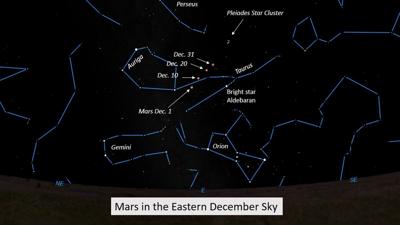
December is the best month for Mars. The red planet will be closest to us on Dec. 8, and will be bright and prominent throughout the month. Look in the eastern sky, and it will be unmistakable, due to its red color. Brave a few minutes on cold December nights and take a look at Mars in our eastern evening sky. If you look close, you may notice that it moves compared to the background stars. Compare with the picture included with this article. As the planets orbit the Sun, they move in relation to the stars. Early people saw the planets as the stars that wandered across the sky. The Greek root of the word planet is plantes, meaning “wanderer.”
Jupiter and Saturn remain in our evening sky in December, although Saturn is getting pretty low in the west. By the end of the month, Saturn will set at about 8 p.m. Look for Saturn low in the west-southwest. Don’t confuse it with Altair, an almost equally bright star to the right of Saturn, or Fomalhaut, to Saturn’s left in the south-southwest. Jupiter, still the brightest object in the night sky (except for the moon of course), shines high in the southwestern evening sky.
Our December Moon is full on Dec. 7, and new on the 23rd. At the start of the month, the first-quarter Moon will be just to the left of Jupiter, which should make for a really nice view. On the 8th, the almost full Moon will lie just to the left of Mars. Early morning viewers can find the waning crescent Moon just above the bright star Spica on the 18th, in the southeastern morning sky.
If you have a good view of the southwestern horizon, the thin crescent Moon will join Venus and Mercury, hugging the horizon just after sunset on Christmas Eve. And on the 26th, the crescent Moon should make for a very pretty view, when located just to the left of Saturn.
The bright winter constellations Orion, Taurus, Gemini, and Auriga are all above the eastern horizon on December evenings. Mars is right in the mix, located in Taurus. In those constellations you can find Capella, the sixth brightest star in the sky, in Auriga; Rigel (seventh) and Betelgeuse (10th) are both in Orion; Aldebaran (14th) is the bull’s red “eye” in Taurus, and the twins Pollux (17th) and Castor (24th) are in Gemini. By 10 p.m., or 8 p.m. late in the month, they are joined by Sirius (first) and Procyon (eighth) as they clear the horizon.
A bit of history in December: 50 years ago, on Dec. 7, 1972, the last Apollo mission Apollo 17 blasted off for the Moon. Astronauts Gene Cernan and Harrison Schmitt landed on the Moon on Dec. 11. At the time, I doubt many would have thought it would be more than 50 years before humans returned to the Moon. The November launch of the Artemis 1, the unmanned first test for the new spacecraft planned for a Moon landing in a few years, should end that long drought. As I write this, Artemis 1 is approaching the Moon. Watch online for video and pictures of the mission.
Step outside for a few moments on a clear night and enjoy the December skies!



Commented
Sorry, there are no recent results for popular commented articles.