
Passport — check.
Visa —check.
Letter to accept donated supplies — check.
New, crisp $$ to exchange for local currency — check.
Herbs to stay healthy and to treat illnesses — check.
Plane tickets — check.
Relax. Enjoy the 33 hour travel to Mandalay, Myanmar. Remember to thank Charlie once again for taking good care of our patients. Reflect on my time as a solo traveler, and as a Chinese Medical Practitioner who will be treating people of Myanmar and mentoring young Traditional Myanmar Doctors.
Rest. Feel the excitement surge upon landing. Look for your three other teammates from the U.K. (Charlotte, Naomi and Keith), whom you’ve never met and will be working and living alongside for the next four weeks! Smile.
My adventure begins Jan. 12, 2015, in Mandalay, Myanmar, as a volunteer of the Myanmar Acupuncture Project. This project was started 15 years ago by the Metta Dana Project, Vipassana Hawaii, in association with Sayadaw U Lakhana from Kyaswa Monastery, Sagaing, Upper Myanmar. It was started by two acupuncturists, Michael Zucker and Daniel Bruce from the United States in 2000, and has seen international Acupuncturists yearly since the beginning. This project is funded by Metta Dana, Wachet Sagaing Hills Hospital, personal donations and volunteer service donations (local as well as international).
In 2013, a designated clinic was built to serve patients twice a week for free treatments in Acupuncture and Traditional Medicine (cost of needles only). This program operates throughout the year, run by U Win Ko and volunteer doctors.
Health Care in Myanmar is grossly underfunded and tends to be centered in larger cities, although the majority of the population resides in rural areas. The average household income is about $800 a year, with the major expenditure being food at 70 percent of income. This is a significant indicator of poverty levels, as there is little to no money for anything else, especially healthcare. Also, clean water and basic sanitation is severely lacking in rural areas, which leads to higher levels of associated diseases and higher death rates, which could be prevented.
Susan Froehlich is a Licensed Acupuncturist and Practitioner of Traditional Chinese Medicine. She owns and operates Columbia River Acupuncture with her son, Charles Cannon, with clinics in Hood River and Mosier.
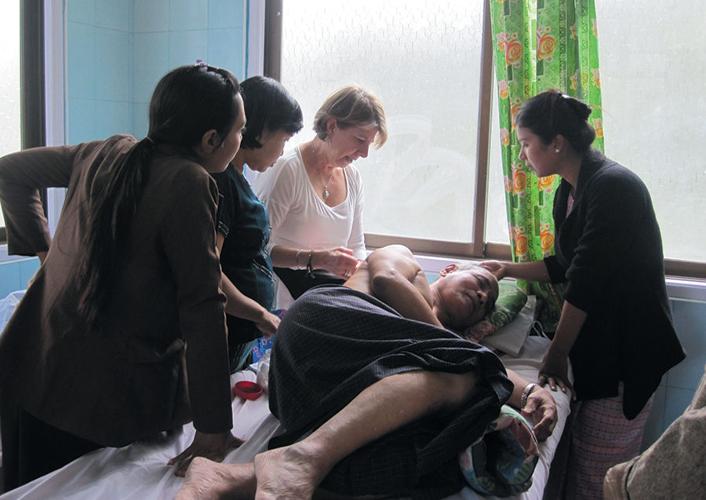
During our time there, our small team worked alongside eight to 12 traditional Myanmar doctors, where we were able to treat about 1,200 patients in 15 days. Our team provided direct mentoring to these young doctors in Traditional Chinese Medicine, specifically acupuncture and theories of Chinese Medicine, from our experience.
Our patients were monks and nuns from the surrounding monasteries, and residents of Myanmar. Some of the patients traveled by bus for 12 hours to receive one treatment, traveled back home and repeated the travel the next day! Our team was fortunate to have interpretation provided by the doctors, and we soon learned common words like “Mingalaba” for hello and “NaLa” for pain.
Patients favorably responded to their treatments, usually showing 20-40 percent improvement after their first treatment, with no adverse side effects. Common conditions treated were musculoskeletal pain (chronic and acute), insomnia, digestive disorders, paralysis following stroke and motorbike accidents, menstrual irregularities, headaches and migraines — conditions very similar to what we see in our clinics in the USA. (The stroke and hypertension rate is much higher in Myanmar however, while cancer rates are quite low.)
As Acupuncture is a relatively new treatment modality in Traditional Myanmar Medicine, the response to this form of medicine is quite amazing. People were willing to travel long distances, wait hours for treatment and experience rough travel to get to us. They were always gracious, kind, generous with their smiles and gratitude for relieving them of their suffering and helping them to become healthier. We, in turn, were energized, and overwhelmed by their kindnesses.
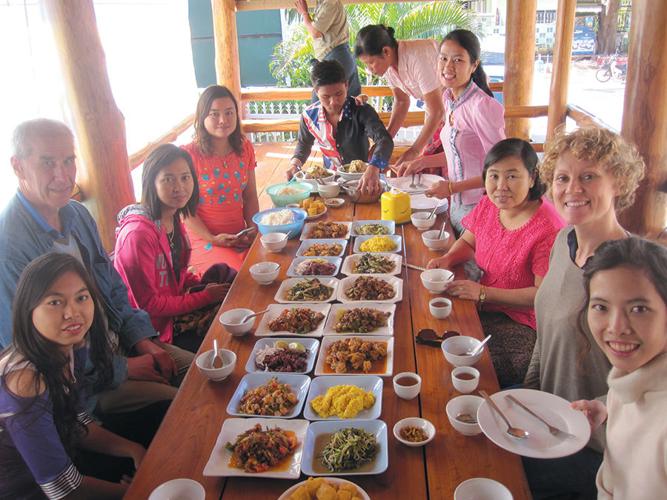
Wachet Hospital hosted us during our stay with a simple dormitory style room on the top floor of the hospital, hot showers and slow, intermittent but usable Internet. They fed us very well with traditional Myanmar meals, consisting of soup, rice, a variety of vegetable and fish/meat dishes and fresh fruit. The spice combination between all of the dishes were delightful — savory and some spicy — garlic, cumin, turmeric, tomato, peppers and salt. Unfortunately, loads of salt and no weight loss!
All of the food was locally grown, caught and prepared, originating from the delta area on the Irrawaddy River. I will try my hand at some of their dishes as they were yummy and healthy (minus the salt), and as my suitcase was loaded with a variety of their spices on my return.
After the clinic day, we often taught an hour class on different techniques and /or theories in Traditional Chinese Medicine. These classes and the mentoring became valuable learning opportunities for the doctors, as it is cost prohibitive to travel for continuing education. Following the clinic/classes, these doctors would travel back to their own clinics and work for four-plus more hours.
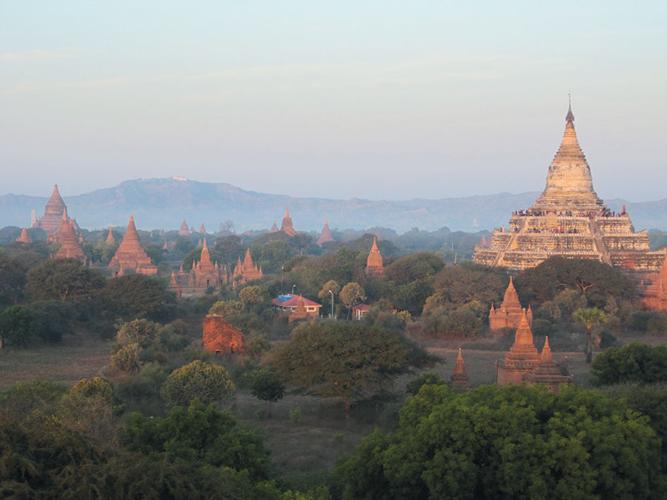
And we would hike … anywhere and everywhere. Usually, this involved going straight up — about 1,000 foot stairways, well-worn covered paths, footbridges, open rustic steps and trails of sorts. We would try to get to the ridge line so that we could awe at the commanding views of the hillsides, the Irrawaddy River, and the numerous pagodas and temples that dotted the scenery.
There are 500-plus pagodas, temples, monasteries and nunneries in this sacred area of Sagaing Hills. While hiking, we would walk into one that connects with another, which crosses through to the next one. All of them beautiful, different from each other, and open to having people visit them. (We respected the privacy of the monasteries and didn’t enter or cross through without permission, as some of them are not open to foreigners.)
In each temple/pagoda, we were required to dress appropriately, remove shoes and speak quietly. These were sacred spaces and they welcomed everyone, and required respect in return.
Actually, in all of Myanmar, dress codes and modesty are customs that should be respected. Women wear long skirts (longyi) or pants, modest blouse with shoulders covered, while men also wear long pants (or longyi) and shirt that covers shoulders.
The longyis are very comfortable and are fashioned like a sarong, except that the ends are sewn together, so that you step into this circle of fabric and tightly wrap the top around your waist (women to the side, men in the middle). This custom is changing in the large cities and is beginning to change in smaller areas as well. I received many compliments from locals when I wore my longyi in the tourist areas like Inle Lake and Bagan.
Back to the temples in Sagaing Hills: Some were simple, but most stupas were adorned in gold paint (or real gold leaf). Soon U Ponya Shin is the most prominent of these temples, with a grande, gold Buddha greeting you, along with amazing territorial views. The Umin Thounzeh, my favorite, is a stunning cave temple, with 45 sitting, gilded Buddhas arranged in a semi-circle pattern, adorned with mirrored glasswork mosaics behind them. This temple is also situated on top of the ridge, so that the views are spellbinding!
Each morning, we attended morning meditation at the Metta Dana Monastery, a short walk (yes, up!) from the hospital. This was a great way to start our day, connected as a group, with quiet peaceful meditation. The traditional form of meditation is called Vipassana, translated into “seeing through the veil of ignorance,” to promote insight and concentration. A Pali word, “papanca,” was learned and used often — it is a word to free one’s mind from craving, false views and conceit and those challenging thoughts that enter your mind while meditating.
Sundays we had off, and our doctors hosted us to shopping and sightseeing in their beautiful country. The first Sunday was spent eating and shopping at Zegyo Market, a large, multi-floored market with literally everything from local produce to longyis to traditional spices and medicinal herbs to the latest fashions, sunglasses, children’s toys.
Next stop was Mandalay Hill and Kuthodaw Pagoda, a complex built in 1857, housing the complete text of the Tipitaka Buddhist scripture on stone tablets, 729 of them. This is the “World’s Largest Book,” listed in the Guiness Book of World Records. Next, the beautiful Sataungpyei Temple at the top. According to Theravada Lore, the Buddha visited Mandalay Hill and prophesied that a great city would be founded at its foot. As a result, many people pilgrim up this auspicious assent to pay respect.
In Myanmar, about 90 percent of residents are Buddhist, and this faith seems to permeate every aspect of their life. They believe that Buddhism is an integral part of each of them and that right thought and action will accrue merit for this life and lives to come. This may be why I did not see any altercations between anyone in the whole month that I was there, except for one time — a motor vehicle accident. People were kind, spoke softly and were pleasant even in the case of challenging situations. Buddhism in Myanmar is of the Theravada sect, which is the oldest surviving sect of Buddhism. Nats, or spiritual guardians — specific to Myanmar Buddhism —are also a part of this tradition and these 37 statues can often be seen at famous temples.
The following Sunday offered us a trip to Poo E Lwein, a mountainous area, famous for its cool air and flowers. We rode in an open-air vehicle for two hours to the top and to Pho Win Taung Caves, a cave temple of sandstone which holds more than 520 rock-cut chambers, carved between the 14-18th centuries depicting various teachings of Buddha with figurines and Buddha statues.
Two of the doctors’ families hosted us to a traditional meal and then later, “snacks” which were a meal in themselves. We were also taken to the National Kandawgyi Botanical Gardens, created in 1915. This beautiful garden covers 150 acres and holds nearly 600 species of trees, 480 kinds of flowers, and 300 varieties of orchids. A true treasure of Myanmar!
After three weeks of clinic work, closing ceremonies were held, tears shed, speeches, words of encouragement and pleas to return were shared, and we said goodbye to our new friends and colleagues. This was an experience that has awakened new energy, compassion and has given me much more than I gave. I hope to return next year to continue this reciprocal teaching.


Commented
Sorry, there are no recent results for popular commented articles.