Illustrious, industrious, chivalrous Philander Jones, Warhaven city councilor, mayor, chair of scores of committees, sits at his roll top desk in his wheeled chair, fumbling, an ever-increasing tremor in his right hand. He stares at the legal document before him, a codicil or appendix, he doesn’t remember now, a document which comes in and out of focus for him. It is the morning of April 12, 1927, and the Major League Baseball season would begin that afternoon. The sun has risen on the window of his office in his fine home on the lower West Hills. Hand twitches, spasming; the papers fall, a codicil to his will stablishing the Jones Fund, managed by a standing committee under the Board of Trustees of the Congregational Church, providing a source of legal fees for women in danger and/or in need.
He muses, “Time flies as the aero plane! It soars. New inventions, increasingly more complex intentions, and yet savage. A practical tool yet again becomes an accomplice of the Great War Machine!” He sighs, continuing his thought, “On the brink of expiration, like a long-opened bottle of champagne, I have simply lost my fizz. The apocryphal day approaches.”
Philander studies his cuticles, his knuckles, now aching always with the arthritic throb of Parkinson’s, his aged skin, now greatly freckled with liver spots and the other blotches of a long tenure, small purplish bruises everywhere. He was an obsolete machine that creaked and groaned with each pump of the piston.
Throughout his long career in law, Jones has been oft sought after by those in need of confidential, legal counsel. His work has enhanced more than a handful of fortunes. His work has disengaged numerous marriages peaceably that might otherwise have disentangled by way of bloodshed or public slander. His work has aided Warhaven in its stable, healthy growth as a community, not an easy goal for any town of any size.
“I stumblingly place upon the Victrola, my beloved VV-IX, the black disc of Vaughan-Williams’ “Lark Ascending” for violin and orchestra, inspired by the Meredith poem celebrating bird song and its liberating effects upon man. This piece always sends my spirit soaring above worries, above inconveniences of pain and sorrows.
“So who will be the baseball powerhouses this year? I loved the battle of wits last autumn between the Cardinals’ Rogers Hornsby and the Yankees’ Miller Huggins. Go red birds! You showed the likes of Ruth and Gehrig and Lazzeri! Baseball is the sport for lawyers. Keep your eye on the ball. There’s always something happening. Keep alert!
“I, Philander Alexander Jones had been born in 1852 in Switzerland County, Indiana, down along the Ohio River. Mine was a subdued youth and adolescence, for I read a lot from all shelves of his family’s great library along the Ohio River. I was perfunctorily married in 1873, when I was contemplating a move. She was Eleanor Rebecca Lyon, of the neighborhood.
“My sights were set on Warhaven; we had missed the war largely.
“I was 11 when Morgan and his cavalry crossed the Ohio and attacked, swathing through Switzerland County, plundering and pillaging as they bullied through in their Rebel reconnaissance. That was the second week of July 1863. By the next week we all knew the war was over with Union victories at Gettysburg and Vicksburg. Little did we know!
“I studied law at Purdue and passed the Indiana Bar in 1874.
“So I set my compass on the Rushing River, following cousins Andrew Chapman, Ebenezer Lyon and Paris DuMont. Eleanor and I made home in the West Hills and I put up my shingle Downtown. The city and the county both employed my services. In the early days, wills and probates, but business grew steadily.
“She came, but she didn’t like it. She thrived, and she didn’t like that. Yes, the village was a little rustic, and when the wind kicked up, the dust did too and she didn’t like that.
“My disease has been a slow one, this Shaking Palsy, diagnosed in 1914 after some shaking and shimmering in my body. I’ve carried on. It’s been a slow one. I wish I were the lark and could fly away!
“In 1918 Eleanor traveled to Garfield, after the Armistice, in December. It was on that trip she contracted Spanish Flu, dead on New Year’s Day! A loss for us all. She’s up the Last Mile, and I’ll be keeping her company soon. ‘The worms go in; the worms go out.’
“That retreat, back in ‘16! What gems of a find: William Allen White and Theodore Roosevelt, trout fishing in the valley! Those two certainly livened up the dinner conversation that evening! Dee-LIGHT-full! The Colonel and his jingoism! Maud wanted to cook him over the charcoals!
“When I go, will the galaxies shine and the planets glimmer, or will the lights just go out?”
He laughs out loud, wondering if sunglasses are advisable in Heaven. Philander Jones slumps in his chair, staring.
About ‘The City Council’
The City Council is a work of fiction that sprang from observing contentious politicians. This narrative serial was initially conceived as a radio project back in 2006. That year it began to be published in print in the White Salmon Enterprise. It now appears every two weeks in the Columbia Gorge News.
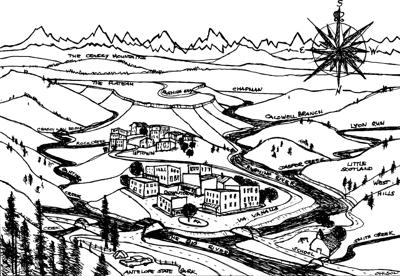
This creative writing is set in the imaginary western town of Warhaven, which lies at the confluence of the Rushing and Big rivers. The town was settled in 1867 by veterans of the Battle of Gettysburg, who sought to leave the carnage and duplicity of the East for a more harmonious society in the West. In Warhaven, city government works efficiently with altruism for the commonweal of the community, which is the work’s overriding theme.



Commented
Sorry, there are no recent results for popular commented articles.