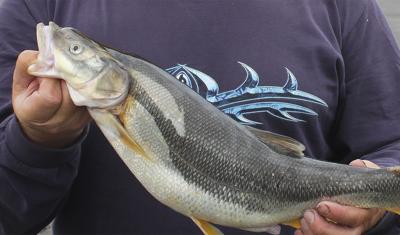
A fisherman shows off a large northern pikeminnow at the registration booth located at The Dalles Marina in 2017. The Dalles typically reports some of the highest numbers for pikeminnow success on the Columbia, especially early in the season, which opened Wednesday.
A fisherman shows off a large northern pikeminnow at the registration booth located at The Dalles Marina in 2017. The Dalles typically reports some of the highest numbers for pikeminnow success on the Columbia, especially early in the season, which opened Wednesday.
Anglers earned nearly $1,162,000 in 2019 through participation in the Northern Pikeminnow Sport Reward Program in 2019. In all, they removed more than 146,000 northern pikeminnow from the Columbia and Snake rivers, which means fewer big fish preying on juvenile endangered salmon.
Each year millions of juvenile salmon and steelhead in the Columbia and Snake rivers make their way downstream toward the Pacific Ocean. These young fish face numerous predators along the way, including the ravenous northern pikeminnow. The native fish is responsible for depleting the numbers of out-migrating juveniles.
For nearly 30 years the Bonneville Power Administration has funded the Northern Pikeminnow Sport Reward Program, paying fishing enthusiasts to remove pikeminnow from the river, reducing predation of juvenile salmon.
Registered anglers who removed pikeminnow more than 9 inches long earned $5 to $8 per fish. Specially tagged northern pikeminnow were each worth $500.
The 2019 northern pikeminnow sport reward season wrapped up Sept. 30, and BPA continues to meet its annual goal to remove 10-20 percent of the predators.
Fishery facts
• Fish removed, 146,225
• Registered anglers, 2,700
• Average angler catch 7.2 fish/day
• Total paid to anglers, $1,161,421
• Total earnings, $53,107
• Fish removed, 6,482
Program goals
The program’s goal is not to eliminate northern pikeminnow, but to reduce the average size and number of larger, predatory fish.
“Large northern pikeminnow are responsible for eating the most salmon and steelhead smolts,” said Eric McOmie, BPA program manager. “Reducing the number of large pikeminnow can help more young salmon make their way to the ocean, which means more of them will return as adults.”
The program’s effectiveness may even go beyond saving juvenile salmon and steelhead.
“Lamprey are often found in the diets of the northern pikeminnow,” said Mac Barr, Oregon Department of Fish and Wildlife Predation Studies project leader. “In 2019, we began exploring ways to better estimate how many juvenile lamprey in the Columbia and Snake rivers are eaten by the northern pikeminnow. Understanding the predation rates on lamprey is important because they are a state sensitive species as well as a federal species of concern and are culturally important to many Columbia Basin tribes.”
The Sport Reward Program has removed more than 5 million northern pikeminnow from the Columbia and Snake rivers since 1990, reducing predation on young salmon and steelhead by up to 40 percent. BPA funds the Northern Pikeminnow Sport Reward Program as part of its mitigation for the construction and operation of the dams on the Columbia and Snake rivers. The program operates each year from May 1 to Sept. 30 and is managed by the Pacific States Marine Fisheries Commission.
The PSMFC works with the Oregon and Washington fish and wildlife departments to offer information and seminars at events throughout the year.



Commented
Sorry, there are no recent results for popular commented articles.