
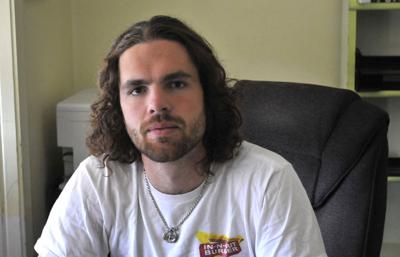
Adam Jenkins, newly graduated from seminary and serving for a year as minister at First United Methodist Church, studies an unusual aspect of life: the junction of religion and economics.
“When the Dalai Lama makes a statement, it changes markets all around the world,” said Jenkins. “Same with the pope.”
In school, he studied “not just how religious belief affects markets, but politics, culture, demographics, technology.” In other words, he was curious how religion “affects pretty much every aspect of life.”
Jenkins started out with an eye to politics. “I wanted to be president one day, and then I wanted to be an ambassador.”
When he nearly failed his first political science class, an economics professor told him: “don’t worry about that political science stuff; you can learn that from the newspapers.”
So he became an econ major, and when he went to England to study international marketing, he visited the spot where “John Wesley had his heart warmed and started the whole Methodist movement.
Jenkins actually based his education on Wesley’s teachings. “Economics is the study of human behavior and human behavior is motivated by religious beliefs.”
Now, he’s taking a break from studies and seeing where the theology he’s learned has taken him and how he can apply it.
He’s seeking ordination as a deacon, which is the point at which “church meets society.” It can be active roles like becoming a youth minister or leading a food bank.
“I would say where rubber meets pavement and it takes off and becomes a transforming agent in the world. Deacons do a lot of behind the scenes work,” he said.
After getting his bachelor’s degree in economics and business with a minor in religious studies and ethics from Randolph Macon College in Virginia, Jenkins graduated from Claremont School of Theology in California with a master’s degree.
He hasn’t ruled out further education, but will be spending a year as the pastor at First United Methodist, which has agreed to be a training location for new ministers.
Jenkins is an assigned laity pastor for the congregation.
Jenkins loves the outdoors and is a semi-pro snowboarder.
With his long hair, which he usually has contained in a bun, he figures he was seen as some “hippie from LA” when he arrived.
He hasn’t come in making changes, but will let the church drive any changes it wants to see, he said.
“I’m still getting the feel of the church and what their needs are,” he said.
He said, “This church, I’m actually very happy with. From everything I’ve studied it’s what the United Methodist Church wants their church to look like.”
It’s a congregation-led church, he said. “This church could pretty much function without its pastor, which is great.”
One goal of the church is to see more engagement by younger members of the community. He and Tyler Beane, pastor at Zion Lutheran and also a former pastor at First United Methodist, are looking to partner on ways to increase youth activities.
Jenkins just finished a mission to Cambodia, his second trip there, where the group he helped lead did worship, community service focused on climate change, and lead a vacation bible school.
His first trip to Cambodia in 2010 on an economics internship was “profoundly life changing. After the trip I knew I was going to seminary.”
“Before, I thought mission was a one-way; you raise a group of people up. I realized it goes both ways.”
John Wesley, the founder of the Methodist Church, said he saw God in the face of the poor. “I felt very much that calling. It happened to me.”
He found Cambodia was a county of extreme contrasts: people driving their Mercedes Benzes past children fighting over bread. Some religious buildings had floors literally made of silver, and diamond-studded gold statues of Buddha.
“I know I had to take what I experienced there and convey it back here,” he said.


Commented